Key takeaways
- studio acoustic treatment fixes room problems before they become bad mix decisions.
- Monitor placement should happen before buying panels or plugins.
- Broadband panels at first reflection points usually beat random foam placement.
- Bass traps matter for DJs and producers working on kick-heavy music.
- Foam is useful for flutter echo, but weak for serious low-end control.
- Reference tracks and simple listening tests can expose room problems fast.
If studio acoustic treatment is wrong, your kick lies to you, your vocal sits in the wrong place, and the same track that felt huge at midnight falls apart in the car the next morning. Bad rooms make producers over-EQ, over-compress, and chase fixes that were never mix problems. studio acoustic treatment does not need to mean turning your bedroom into a mastering suite or spending three grand before you write another tune.
The job is simpler: stop the room from bullying your decisions. A DJ editing sets on a Pioneer DDJ-FLX10, a producer finishing tech house in Ableton Live, and an artist checking custom stems all need the same thing, a listening position that tells fewer lies. Treat the worst reflections first, control the corners, set your monitors properly, and your plugins start making sense again.
What does studio acoustic treatment actually fix?
Studio acoustic treatment fixes the room, not the song. That sounds obvious until you watch someone put FabFilter Pro-Q 4 on every channel because the room has a 140 Hz lump the size of a parked van.
The main problems are early reflections, bass buildup, flutter echo, and uneven decay. Early reflections smear the stereo image. Bass buildup makes one note boom and the next one vanish. Flutter echo gives claps and vocals that cheap bathroom ring. None of that gets solved by another limiter.
What studio acoustic treatment is not
It is not soundproofing. Soundproofing stops noise getting in or out, usually with mass, isolation, sealed doors, and serious building work. Treatment changes how sound behaves inside the room.
It is also not decoration. Those thin foam tiles behind a laptop look like a studio on Instagram, but they mostly shave off top end. The kick and bass still bounce around below 200 Hz, which is where dance records either translate or embarrass you.
- Early reflections blur panning and stereo width.
- Standing waves cause bass notes to jump or disappear.
- Flutter echo makes vocals, claps, and snares sound cheap.
- Uneven decay makes reverb decisions unreliable.
- Good treatment makes small EQ moves easier to trust.
Why do my studio monitors sound fine until I play the track elsewhere?
Your monitors are probably not the main villain. The room is. A pair of Yamaha HS8s, KRK Rokit 7 G4s, or Adam Audio T7Vs can all sound useful when the setup is sane. Push them against a wall, sit in the center of a square bedroom, leave bare plaster on both sides, and they will feed you nonsense.
studio acoustic treatment gives your speakers a fair chance. Without it, you mix the room curve instead of the record. You cut 80 Hz because the desk area is booming, then the club PA feels thin. You add 3 dB at 10 kHz because the curtains and foam killed the top, then the hi-hats slice ears on earbuds.
Translation is the real test
A good room is not one that sounds flattering. It is one that lets your track survive other systems. Check the same bounce on AirPods, a phone speaker, a car stereo, and a half-decent PA if you can. If the low end changes wildly every time, your room is steering your decisions.
For dance music, I care most about the kick and bass relationship from about 45 Hz to 160 Hz. If that area is lying, sidechain ducking, saturation, and bus compression become guesswork.
- If every mix is too bright elsewhere, your room is probably dull.
- If every mix is bass-light elsewhere, your room is probably boomy.
- If vocals keep landing too dry, your room may be too reflective.
- If panning feels random outside the studio, check side-wall reflections.
Where should I put acoustic panels first?
Start with the first reflection points. Not the ceiling cloud first, not random checkerboard foam, not a giant panel behind the camera. The first reflection points are where sound from each speaker bounces off the side walls and reaches your ears a split second after the direct sound.
studio acoustic treatment works best when placement is boring and accurate. Sit in your mix position. Have a friend slide a mirror along the left wall. Wherever you can see the left or right speaker in the mirror, mark that spot. Do the same on the right wall. Put broadband panels there.
Use real broadband panels
A useful panel is usually 100 mm thick, or 4 inches, filled with mineral wool or fiberglass and covered with breathable fabric. Leave a small air gap behind it if you can. That gap helps the panel work lower than it would flat on the wall.
After the side walls, treat the ceiling above the listening position if the room allows it. A cloud above the desk can clean up comb filtering and make vocal placement less slippery. Then think about the wall behind the monitors and the rear wall behind your chair.
- First reflection panels on left and right walls.
- Ceiling cloud above the listening position.
- Thick absorption behind the monitors if the wall is close.
- Rear wall treatment behind your chair.
- Corners for low-frequency control.

Do bass traps matter in a bedroom studio?
Yes. If you make club music, bass traps are not optional fluff. Bedroom-sized rooms are brutal below 200 Hz because the wavelengths are long and the room dimensions are short. That is why one bass note shakes the desk while another drops out.
studio acoustic treatment without bass control is like mixing a kick drum with the sub muted half the time. You can still work, but you will print bad decisions. Thick corner trapping gives the low end somewhere to go instead of bouncing around until your ears give up.
Corners are pressure zones
Low frequencies build up in corners, especially wall-to-wall and wall-to-ceiling corners. Triangular superchunks are great if you have space. Straddled 100 mm or 150 mm panels across corners also help. Thin foam corner wedges look tidy, but they do not do enough where kick drums live.
If your desk sits near the front wall, trap the front vertical corners first. Then look at rear corners. In a tiny rental room, two serious traps in the front corners beat twelve thin foam squares scattered like confetti.
- Use thicker material for bass than for side reflections.
- Treat front corners before chasing small cosmetic fixes.
- Air gaps make panels more effective at lower frequencies.
- Do not expect thin foam to fix sub problems.
- Check kick and bass notes after each treatment change.
Can foam panels fix a bad room?
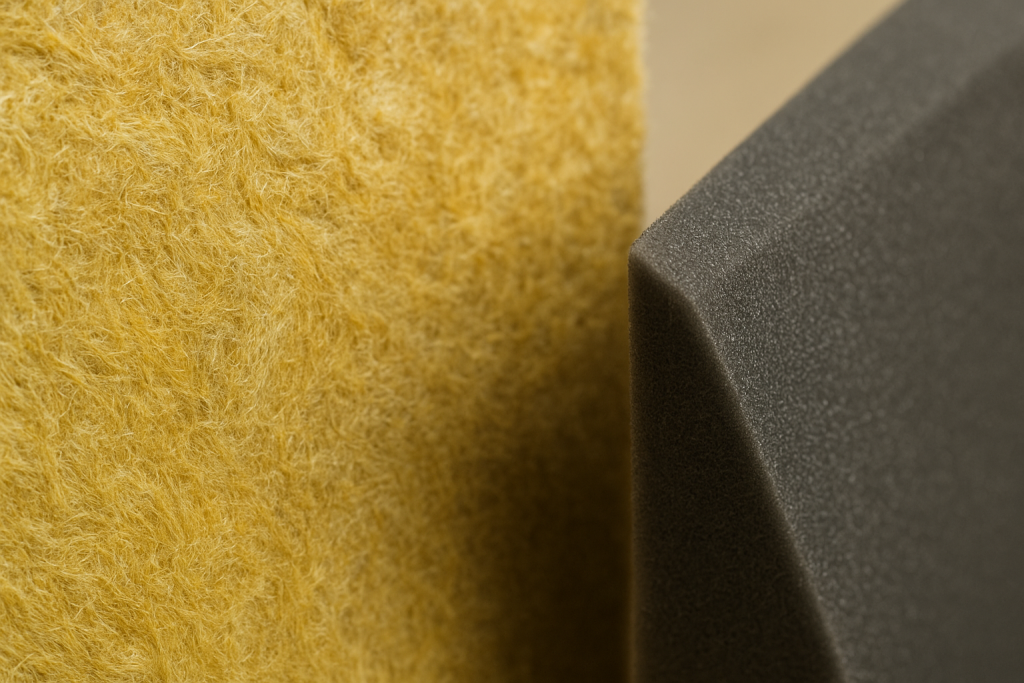
Foam can help with flutter echo and bright reflections. That is the nice version. The blunt version: foam cannot fix a bad room for music production if the low mids and bass are out of control.
studio acoustic treatment should be matched to the problem. If hand claps ring between two bare walls, foam may reduce that zing. If your 909 kick blooms at 90 Hz and disappears at 110 Hz, foam is the wrong tool. You need mass, thickness, and better placement.
When foam is still useful
Use foam for small reflection issues, vocal booth taming, or stopping a nasty slapback near a recording corner. I would not build a whole mix room around it. The classic mistake is covering every visible wall with 25 mm foam and ending up with a dead top end over a messy low end.
That room feels controlled for about ten minutes. Then you notice every mix is dull, boxy, and weirdly heavy around 220 Hz. Cut there if the track needs it, sure. Do not cut it because your room made you paranoid.
- Foam is best for high-frequency flutter.
- Mineral wool panels handle a wider frequency range.
- Bass traps need depth and density.
- Overusing foam can make a room dull but still boomy.
- Treat the problem frequency range, not the wall space.
How do I set up monitors and a DJ desk before buying panels?
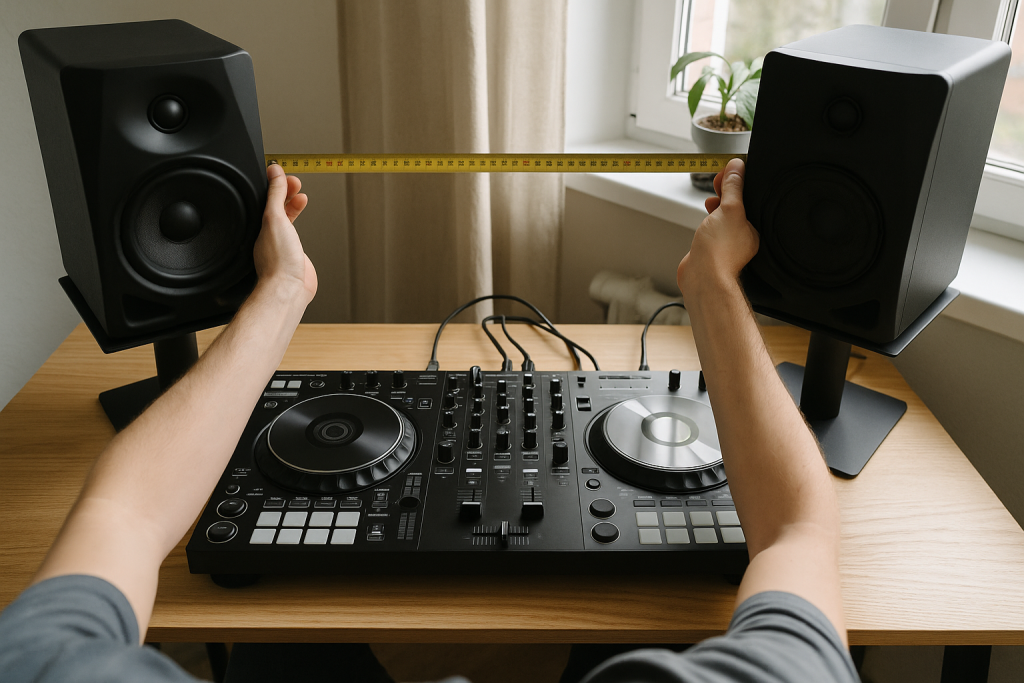
Fix placement first. It costs nothing and can change more than a cheap treatment bundle. Put your monitors on stands or solid isolation pads, not directly on a rattly IKEA desk beside a coffee mug and a hard drive.
For most bedroom studios, the speakers and your head should form an equilateral triangle. If the monitors are 120 cm apart, your head should be roughly 120 cm from each speaker. Tweeters at ear height. Speakers aimed at your head, not your shoulders. Simple. Painfully effective.
Do not sit in the exact middle
Avoid sitting halfway between the front and back wall. That position often lands you in a bass null, which makes you boost low end that is already fine. Try sitting around 38 percent of the room length from the front wall as a starting point, then adjust by ear.
Keep both side walls as symmetrical as possible. A bookshelf on one side and a bare window on the other will pull the image sideways. studio acoustic treatment cannot fully rescue a layout that is lopsided from the start.
- Make the monitor triangle equal before judging tone.
- Set tweeters at ear height.
- Keep left and right walls as symmetrical as possible.
- Move the desk away from the exact room center.
- Decouple monitors from hollow furniture.
How can I check my room without expensive measurement gear?
You can learn a lot before buying a measurement mic. Clap once in the room and listen. A clean, short decay is fine. A metallic ping or zipper-like flutter between walls tells you where treatment should go.
studio acoustic treatment also reveals itself through reference tracks. Pick three records you know cold. Not random playlist filler. Use tracks that translate everywhere: one clean commercial vocal record, one kick-heavy club tune, and one sparse track with obvious stereo placement.
Use simple tests before software
Play a sine sweep quietly from 40 Hz to 200 Hz. You will hear some notes jump out and others vanish. That is the room. You do not need to be a physicist to spot a 70 Hz boom that rattles the wardrobe.
If you want measurements, a miniDSP UMIK-1 and Room EQ Wizard are a solid route. Still, do not stare at graphs until you forget to listen. Measurements show you where to look. Your ears still decide whether the room helps you work.
- Clap near bare walls to find flutter echo.
- Use reference tracks at the same volume every time.
- Run a low sine sweep to find bass peaks and nulls.
- Check mono to expose reflection and phase weirdness.
- Keep notes after each room change.

What should I fix if I use ghost production or custom tracks?
If you are buying custom music production, editing ghost-produced stems, or checking a finished demo before release, your room still matters. You are making approval decisions. Those decisions can cost money if the room lies.
studio acoustic treatment helps you judge whether the supplied mix is actually bright, whether the kick is really too loud, and whether the vocal needs a revision or just sounds buried in your untreated bedroom. I have seen artists ask for three low-end revisions when the real issue was their desk sitting in a bass null.
Judge stems on a stable system
When you receive stems, do not immediately start pushing faders because the room feels strange. Play the full mix first. Then check stems in groups: drums, bass, music, vocals, effects. Keep the master at about -6 dB headroom if you are doing edits before mastering.
If a custom track sounds good on headphones but wrong on monitors, do not assume the producer missed something. Compare against references and move around the room. If the bass changes every half meter, your room is the suspect.
- Approve mixes from the listening position, not while pacing around.
- Check supplied stems against the full reference mix.
- Leave headroom if you make arrangement or vocal edits.
- Use headphones as a second opinion, not the only opinion.
- Ask for revisions only after checking translation.
| Fix | Best For | Weak Spot | Use First? |
|---|---|---|---|
| Monitor placement | Stereo image, bass balance, translation | Cannot absorb reflections by itself | Yes |
| 100 mm broadband panels | First reflections, low mids, cleaner imaging | Need space and correct placement | Yes |
| Bass traps | Kick, sub, bass note consistency | Bulky in small rooms | Yes for club music |
| Thin foam | Flutter echo and bright slapback | Weak below the upper mids | Only for specific problems |
| Room correction software | Final response smoothing | Does not fix decay or nulls | After physical fixes |
Further reading
- Sound On Sound acoustics — Sound On Sound is a long-running professional audio publication with detailed, practical studio acoustics coverage.
- Genelec monitor placement — Genelec is a respected studio monitor manufacturer with authoritative guidance on speaker positioning and listening setups.
Frequently asked questions
What is studio acoustic treatment for a bedroom producer?
studio acoustic treatment means controlling reflections, bass buildup, flutter echo, and decay inside your room so your speakers tell fewer lies. For a bedroom producer, that usually starts with monitor placement, broadband panels at first reflection points, and bass traps in corners.
Do I need acoustic treatment if I only DJ at home?
If you record mixes, prepare sets, edit mashups, or judge transitions at home, treatment helps. You do not need a full studio build, but controlling reflections and bass makes cue points, EQ moves, and track energy easier to judge before playing on a bigger system.
Are bass traps more important than wall panels?
For dance music, bass traps are usually just as important as side-wall panels. Panels clean up imaging and reflections, while bass traps help the kick and bass stay consistent. If your budget is tight, buy fewer thick panels instead of covering the room with thin foam.
Can room correction software replace acoustic panels?
No. Software can smooth the frequency response at your listening position, but it cannot remove flutter echo, shorten messy decay, or fix a deep bass null. Use physical treatment first, then consider correction software as a final tuning step.
How much acoustic treatment does a small studio need?
Start with two side-wall broadband panels, a ceiling cloud if possible, and two front-corner bass traps. That is enough to hear a real improvement in many rooms. Add rear-wall treatment and more corner trapping after checking references and low-frequency behavior.
Should I treat the wall behind my speakers or behind my chair?
Both can matter, but the priority depends on the room. If speakers are close to the front wall, absorption behind them can help. If your rear wall is close to your head, treat that wall too because strong rear reflections can smear timing and stereo depth.
Conclusion
studio acoustic treatment is not glamorous, but it is one of the fastest ways to stop fighting your own setup. Start with the free moves: speaker triangle, ear-height tweeters, symmetrical side walls, and a listening position that is not dead center. Then add broadband panels at first reflection points and real bass trapping where the room piles up low end.
Do not chase perfection before making music. Chase fewer lies. If your kick decisions translate, your vocal balance holds up, and references make sense at a steady level, the room is already doing its job. Try the mirror test, move your monitors 10 cm at a time, and bounce your next mix before and after the changes.
Studio acoustic treatment — Quick Recap
The fastest way to lock in studio acoustic treatment is to internalise the workflow above and repeat it on every project. Start small: pick one technique from this studio acoustic treatment guide, apply it to your next session, and audit the result against a reference track.
- studio acoustic treatment fixes room problems before they become bad mix decisions.
- Monitor placement should happen before buying panels or plugins.
- Broadband panels at first reflection points usually beat random foam placement.
- Bass traps matter for DJs and producers working on kick-heavy music.
Treat studio acoustic treatment as a habit, not a one-off — the producers who consistently nail studio acoustic treatment are the ones who run the same checks on every track. That’s the difference between a clean, club-ready master and a track that sounds great at home but falls apart on a real system.
In a real studio session, studio acoustic treatment comes down to the order in which you make decisions: reference first, gain stage second, then the creative work. Producers who treat studio acoustic treatment as a checklist instead of a vibe end up shipping more tracks.
Most producers and DJs undervalue studio acoustic treatment because the wins are invisible until the track plays back on a real system. Bake studio acoustic treatment into your template and the next ten projects benefit automatically.
When you struggle with studio acoustic treatment, the fix is rarely a new plugin. Loop a problem section, A/B against a reference, and isolate which element is breaking your studio acoustic treatment.
Treat studio acoustic treatment as a craft, not a chore. The producers releasing on the biggest labels lock studio acoustic treatment in early so they can spend their energy on melody and arrangement instead of fighting the mix.
Document your studio acoustic treatment process — even a short note in the project file. Future-you will rebuild the same studio acoustic treatment win in half the time.
My Career makes videos from your own track and posts them for you, pitches your release to 34,000+ labels, playlists, radio stations, YouTube channels and blogs, puts it in every store and briefs you every morning. Free plan, no card, two minutes to set up.