Key takeaways
- Width is contrast, not a permanent setting on every channel.
- The safest stereo width techniques protect kick, sub, vocal, and clap first.
- Haas widening works on ear candy, but it can hollow out important parts.
- Mid/side EQ often translates better than broad stereo imaging.
- Mono checks still matter for clubs, phones, and streaming playback.
- DJ-style reference checks expose weak width faster than solo listening.
Stereo width techniques get oversold as the shortcut to a bigger record, and that belief wrecks more club mixes than it saves. Most stereo width techniques sound impressive for 20 seconds on headphones, then collapse when the kick, bass, vocal, and lead all fight for the same side energy.
The myth is simple: wider equals more professional. The measurement says otherwise. If your correlation meter lives below 0, your side channel is not adding size, it is borrowing energy from mono playback. A CDJ-3000 into a club mixer will not forgive that. A phone speaker will not either.
The better move is boring but reliable: choose where width belongs, measure it, then automate it with intent. These are the seven tools I trust when a track has to survive headphones, Rekordbox prep, club PAs, and streaming compression.
Belief: More Stereo Width Techniques Always Make a Mix Bigger
The first bad assumption is that stereo width techniques should be spread across the whole session. That is how you get a huge intro, a soft drop, and a low end that disappears when summed to mono.
Width is not size. Width is contrast. A narrow kick and bass make a wide synth feel bigger because the listener has a center reference. The working alternative is to protect the middle first, then widen only the parts that can afford phase risk.
Stereo Width Techniques Start With a Mono Anchor
Keep the kick, sub, main bass fundamental, and lead vocal or hook mostly centered. In dance music, I usually mono everything below 120 Hz, sometimes 150 Hz if the bass patch has chorus or unison spread baked in.
Ableton Utility can do this fast: put it on the bass group, enable Bass Mono, set the frequency around 120 Hz, then check the drop in mono. If the groove loses 2 dB or more when you hit mono, the width is stealing from the record.
The Tools I Use First
Ableton Utility, Voxengo SPAN, and iZotope Insight 2 are not glamorous, but they tell the truth. SPAN shows low-end build-up around 80 to 220 Hz. Insight shows correlation. Utility lets you kill fake width before you start polishing a problem.
- Kick: mono, no stereo enhancer.
- Sub: mono below 120 Hz.
- Clap and hats: width allowed above 400 Hz.
- Risers and FX: wide, but automated down before the drop hit.
- Treat width as arrangement contrast, not a default mix setting.
- Mono the sub range before adding any stereo imager.
- Check the drop in mono at the same loudness, not louder.
- Use meters before you trust headphones.
- Leave the hook or main groove with a strong center image.

Belief: The Haas Effect Is a Safe Shortcut
The Haas trick sounds clever: delay one side by 10 to 30 ms and the sound appears wider. The problem is that this is one of the most abused stereo width techniques because it creates comb filtering when collapsed to mono.
At 10 ms, the first cancellation sits around 50 Hz and repeats upward. At 20 ms, it starts around 25 Hz and keeps notching the spectrum. You may not hear the math as math, but you hear it as a vocal that gets hollow or a synth stab that loses bite.
Use MicroPitch Instead of Blind Delay
Soundtoys MicroShift and Eventide MicroPitch are safer than a raw sample delay because they mix small pitch offsets with timing differences. That still creates phase movement, but it is less static and usually less brutal in mono.
My usual starting point on a dry vocal chop is 8 to 12 percent mix, not 40. On a synth stab, I may push 18 percent, then automate it down when the kick returns. Wide moments beat wide everything.
Where Haas Still Works
Use it on sounds that are not carrying the song: short ear candy, noise sweeps, reverse cymbals, or a one-bar fill before a drop. Do not use it on the main bass, the only vocal hook, or the snare body.
If you insist on a simple delay, keep the delayed side under 15 ms and high-pass the widened return at 300 Hz. Then hit mono. If the part becomes smaller, not just narrower, remove it.
- Haas widening is phase manipulation, not free stereo.
- Keep the wet amount low on important musical parts.
- High-pass widened returns to protect the low mids.
- Automate the effect around arrangement changes.
- Reject any setting that changes tone badly in mono.

Belief: Stereo Imagers Fix a Flat Master
This belief is backwards. If a master needs heavy stereo width techniques to feel alive, the mix probably has poor contrast, weak arrangement layers, or a lead sound taking up too much midrange.
iZotope Ozone Imager 2 is useful, but it should not be asked to rescue a flat production. A mastering imager is best for half a dB of polish on the right band, not rebuilding the stereo field after the session is printed.
Use Ozone Imager Like a Surgeon
On a full mix, split the bands. Keep 20 to 120 Hz mono. Leave 120 to 400 Hz mostly alone unless the mix is painfully narrow. Try widening 2 kHz to 10 kHz by 5 to 12 percent, then compare at matched gain.
Do not judge louder as wider. Ozone can make the sides feel louder, which tricks you into accepting a weaker center. Match output level, then check the vocal, clap, and bass relationship.
FabFilter Pro-Q 4 Beats Wide-Button Mixing
FabFilter Pro-Q 4 in mid/side mode is usually cleaner than a broad imager. If the sides are cloudy, cut 220 Hz on the side channel by 1.5 to 3 dB with a medium Q. If the mix needs air, add a gentle side shelf around 8 kHz.
This is one of the stereo width techniques that actually translates because it changes tonal balance in the side channel without smearing timing. You are not inventing width. You are cleaning the width already there.
- Never widen the full frequency range on a master by default.
- Use multiband imaging only where the mix can handle it.
- Mid/side EQ is often cleaner than artificial widening.
- Match loudness before judging any stereo processor.
- If the mix feels flat, fix the arrangement before the master.

Belief: Mono Compatibility Is Old Advice for Old Systems
Mono checking sounds dusty until you play a track on a real system. Many club subs run effectively mono, festival low end is tightly controlled, and plenty of Bluetooth speakers sum low frequencies in ways you do not control.
The working alternative is not mixing in mono all day. It is a 20-second checkpoint after every major width decision. If the record survives that, you can get aggressive again.
Correlation Is Not Optional
A correlation meter reading near +1 means the left and right channels are very similar. Around 0 means they are wide or decorrelated. Below 0 means mono playback may cancel parts of the sound.
I do not panic if a riser dips below 0 for one beat. I do care if the chorus pad, vocal doubler, or lead synth sits there for eight bars. That is not width. That is a translation problem waiting to happen.
A 60-Second Mono Test
Use this test before sending a demo, premaster, or custom production reference:
- Switch the whole mix to mono with Ableton Utility or Logic Gain.
- Listen to the drop at low volume.
- Check if kick, bass, vocal, and clap still lead the groove.
- Flip back to stereo without changing volume.
- If the stereo version only wins because it is brighter, fix the mix.
- Mono checking is still relevant for clubs, phones, and small speakers.
- Short negative correlation is fine for FX, not core hooks.
- Low-volume mono exposes weak centers fast.
- A wide mix should become narrower in mono, not broken.
- Use mono checks as checkpoints, not as a creative prison.
Belief: Pads and Reverbs Should Always Be Wide
Wide pads are addictive. They also hide lazy voicing, muddy low mids, and reverb tails that blur the groove. Of all stereo width techniques, this is the one that most often makes a track feel expensive in solo and smaller in context.
The better alternative is selective width. Make one support layer wide, keep another narrow, and carve the side channel so the center groove stays readable.
Soothe2 Can Clean the Sides Without Killing the Pad
oeksound Soothe2 is strong on harsh side buildup. Put it in mid/side mode, process only the side channel, and target 2.5 to 6 kHz if the pad or reverb is fighting the vocal edge.
Go light. Depth around 1 to 3 is enough. Heavy settings can make the sides pump in a strange way, especially when the vocal hits. If Soothe2 is working hard, the arrangement is probably too crowded.
Reverb Width Needs Pre-Delay and Filters
A huge reverb with no pre-delay can push the lead backward. Start with 20 to 40 ms pre-delay on vocal or synth reverb so the dry sound stays forward. High-pass the reverb at 250 Hz and low-pass it around 10 kHz if the top gets fizzy.
For club tracks, I often keep the main reverb return narrower than the delay return. Delays can create rhythmic width. Reverbs can create fog.
- Do not widen every pad layer.
- Filter reverb returns before widening them.
- Use pre-delay to keep the lead sound forward.
- Control harsh side energy with dynamic processing.
- Let delays carry width when the groove needs clarity.

Belief: Headphones Tell the Truth About Width
Headphones exaggerate separation because the left ear gets the left channel and the right ear gets the right channel with almost no acoustic crossfeed. That makes stereo width techniques feel cleaner than they are.
The working alternative is a three-playback check: headphones, nearfields, and a DJ-style playback chain. If a track is meant for DJs, test it like a DJ will handle it.
Check Width on DJ Gear, Not Just Studio Monitors
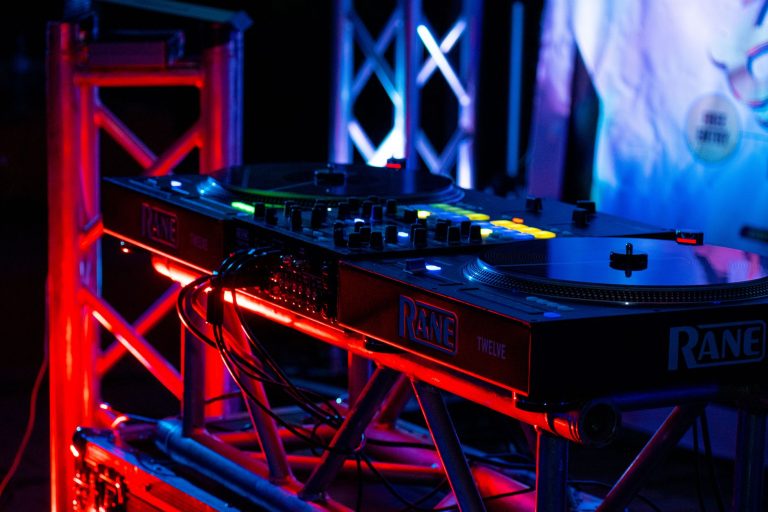
Export a premaster with -6 dB headroom, load it into Rekordbox, and play it through a CDJ-3000 or a controller such as the Pioneer DDJ-FLX10 if that is what you have. Cue it against a released reference at matched loudness.
Listen through the transition. If your wide intro vanishes under the reference track, the sides are decorative, not useful. If your drop feels smaller after the blend, your center image is not strong enough.
Ableton Push 3 Workflow for Fast Checks
With Ableton Push 3, map Utility Width, mono, and reference-track mute to macros. I like a 4-bar loop over the drop, then I switch between 100 percent width, mono, and the reference without touching the mouse.
This turns stereo width techniques into decisions instead of guesses. The gear does not make the mix better by itself, but fast switching stops you from falling in love with a bad setting.
- Headphones flatter hard-panned and phasey sounds.
- Nearfields reveal center strength better than headphones.
- DJ playback exposes weak intros and thin drops.
- Reference against released tracks at matched loudness.
- Map width checks to hardware so you actually use them.
| Tool | Best Use | Risk |
|---|---|---|
| Ableton Utility | Mono bass, width trim, fast A/B checks | Easy to over-narrow a mix if used blindly |
| FabFilter Pro-Q 4 | Mid/side EQ cuts and side air shelves | Can make sides brittle with too much top boost |
| iZotope Ozone Imager 2 | Small multiband mastering width moves | Weakens the center if pushed too far |
| Soundtoys MicroShift | Vocal chops, synth doubles, ear candy | Mono tone can change if wet mix is high |
| Eventide MicroPitch | Classic pitch-based stereo spread | Can blur lead focus on dense drops |
| oeksound Soothe2 | Dynamic cleanup of harsh side energy | Heavy settings can make sides breathe oddly |
| Voxengo SPAN or iZotope Insight 2 | Spectrum and correlation checking | Meters help, but they do not replace listening |
Further reading
- Ableton audio effects — Ableton's official manual documents Utility, audio effects behavior, and practical routing inside Live.
- Sound On Sound stereo — Sound On Sound is a long-running engineering publication with detailed stereo mixing and depth coverage.
Frequently asked questions
What are the safest stereo width techniques for beginners?
Start with mono bass, mid/side EQ, filtered reverb returns, and low wet amounts on chorus or MicroShift-style effects. Avoid widening the whole master first. If the kick, bass, vocal, and clap still work in mono, your wide layers are probably supporting the record instead of weakening it.
Should bass always be mono in electronic music?
The sub should be mono almost all the time. That usually means everything below 100 to 150 Hz. You can keep upper bass harmonics stereo if they survive mono and do not pull the groove sideways, but the fundamental should stay centered for club translation.
Is the Haas effect bad for mixing?
It is not bad, but it is risky. A short delay between left and right creates width through timing differences, which can cause comb filtering in mono. Use it on secondary parts, keep the wet level low, and check the sound in mono before committing.
Can I use a stereo imager on the master bus?
Yes, but use it lightly and by frequency band. Keep the low end mono, make tiny moves above the low mids, and compare at matched loudness. If the master imager is doing heavy lifting, return to the mix and fix the stereo balance there.
Why does my mix sound wide on headphones but weak on speakers?
Headphones isolate left and right channels, so phasey width can feel impressive. Speakers blend in the room, and mono playback exposes cancellation. Check your mix on nearfields, in mono, and through a DJ-style playback chain before trusting the headphone version.
How wide should vocals be in a dance track?
Keep the main vocal or hook centered, then widen doubles, delays, or reverb around it. A centered lead gives the crowd something stable to follow. The width should frame the vocal, not replace its position in the middle of the mix.
Conclusion
The best stereo width techniques are usually the least dramatic ones: mono the low end, clean the side channel, widen support layers, and test the result before you print. The myth says a wider mix is automatically better. Real playback says a centered, punchy mix with selected wide moments hits harder.
Use the tools here in a simple order: Utility first, meters second, mid/side EQ third, then MicroShift, Ozone Imager, Soothe2, or reverb width only where the arrangement asks for it. Try this in your next session: take one busy drop, mute every widening plugin, rebuild the stereo field one part at a time, and stop when the groove gets bigger instead of just wider.
Stereo width techniques — Quick Recap
The fastest way to lock in stereo width techniques is to internalise the workflow above and repeat it on every project. Start small: pick one technique from this stereo width techniques guide, apply it to your next session, and audit the result against a reference track.
- Width is contrast, not a permanent setting on every channel.
- The safest stereo width techniques protect kick, sub, vocal, and clap first.
- Haas widening works on ear candy, but it can hollow out important parts.
- Mid/side EQ often translates better than broad stereo imaging.
Treat stereo width techniques as a habit, not a one-off — the producers who consistently nail stereo width techniques are the ones who run the same checks on every track. That’s the difference between a clean, club-ready master and a track that sounds great at home but falls apart on a real system.
In a real studio session, stereo width techniques comes down to the order in which you make decisions: reference first, gain stage second, then the creative work. Producers who treat stereo width techniques as a checklist instead of a vibe end up shipping more tracks.
Most producers and DJs undervalue stereo width techniques because the wins are invisible until the track plays back on a real system. Bake stereo width techniques into your template and the next ten projects benefit automatically.
When you struggle with stereo width techniques, the fix is rarely a new plugin. Loop a problem section, A/B against a reference, and isolate which element is breaking your stereo width techniques.
Treat stereo width techniques as a craft, not a chore. The producers releasing on the biggest labels lock stereo width techniques in early so they can spend their energy on melody and arrangement instead of fighting the mix.
Document your stereo width techniques process — even a short note in the project file. Future-you will rebuild the same stereo width techniques win in half the time.
My Career makes videos from your own track and posts them for you, pitches your release to 34,000+ labels, playlists, radio stations, YouTube channels and blogs, puts it in every store and briefs you every morning. Free plan, no card, two minutes to set up.