Key takeaways
- Finished records sound intentional before they sound loud.
- Low-end translation starts with phase, mono control, and clean arrangement choices.
- Drum punch comes from transient control, parallel compression, and headroom.
- Vocals and leads sit better after automation and tone matching, not extra reverb.
- DJ-ready tracks need clean phrasing, usable intros, and exports that work on decks.
- Outside production help makes sense when you know the bottleneck clearly.
Professional sounding tracks fall apart fast when the kick masks the bass, the vocal feels pasted on, and the master gets louder but somehow smaller. Professional sounding tracks are not magic exports from a famous studio. They come from boring decisions made in the right order: gain staging before compression, arrangement before saturation, references before guessing.
If you are an aspiring DJ, bedroom producer, or artist thinking about ghost production or custom music production, the goal is the same. You need a record that survives headphones, car speakers, Rekordbox prep, and a club PA without apologising for itself. Give yourself 45 focused minutes. You will not rewrite the song. You will tighten the parts that make listeners believe the track is finished.
What makes professional sounding tracks feel finished?
Finished records sound intentional. That is the real difference. A clean amateur mix can still feel unfinished if the hook is too quiet, the drums have no front edge, or the stereo width changes every eight bars for no reason.
Professional sounding tracks usually share three traits: stable balance, controlled movement, and no ugly surprises. The listener does not think about the mix. The DJ does not reach for the trim knob. The vocal, lead, kick, and bass all know their jobs.
The professional sounding tracks test
Load a reference into your DAW, not because you want to copy it, but because your ears lie after 40 minutes. In Ableton Live, put the reference on its own audio track, route it directly to the master, and level-match it by ear. Do not compare your -8 LUFS demo to a quieter reference. That tells you nothing.
Try this simple pass:
- Turn your track down until the master peaks around -6 dB.
- Mute every reverb send for 20 seconds, then bring back only what you miss.
- Check whether the hook is obvious at low volume.
- Play the drop after 30 seconds of silence and trust your first reaction.
If the drop feels smaller than the build, fix arrangement and low-end balance before reaching for a limiter.
- The kick and bass do not fight for the same space.
- The main hook is readable on phone speakers.
- The loudest section still has punch, not just density.
- Effects support transitions instead of covering weak writing.
- The mix sounds close to a reference at matched loudness.

Why does my low-end disappear on club PAs?
Club low-end punishes guesswork. A bass that sounds huge on small monitors can vanish on a real system because the sub, kick, and low mids are all arguing. Professional sounding tracks rarely have more low-end elements. They have fewer, placed better.
Start by deciding who owns the sub. In tech house, I usually give the kick the punch around 55 to 75 Hz and let the bass speak either below it or above it, not both all the time. In melodic house, the bass may carry the sub while the kick gets a shorter, tighter low thump.
Clean the sub before you compress it
Put FabFilter Pro-Q 4 or Ableton EQ Eight on the bass. High-pass anything that is not the kick or bass. Pads often need a cut at 120 Hz. Vocals may need a high-pass between 80 and 140 Hz. Percussion loops can lose everything below 180 Hz without losing their vibe.
Then check phase. Flip polarity on the bass, nudge it a few milliseconds, or use a sample delay plugin. If the low-end suddenly returns, the problem was not your limiter. It was timing.
For sidechain ducking, do not crush the bass just because everyone does it. Start with 2 to 4 dB of gain reduction, fast attack, release timed to the groove. On a four-on-the-floor record at 124 BPM, a release around 120 to 180 ms often feels tighter than a dramatic pump.
- Mono the sub below 100 Hz.
- Cut rumble below 25 to 30 Hz unless it is musical.
- Do not stack two long sub tails under the same kick.
- Use a spectrum analyser, then confirm with your ears.
- Check the low-end at quiet volume before mastering.
How do I get drums to hit without clipping?
Drums hit when the transient is clear and the body is controlled. Clipping the drum bus can sound exciting for six seconds, then tiring for the rest of the track. Professional sounding tracks keep drum energy consistent without turning every channel into a red warning light.
Build from the kick outward. Soloing the snare for ten minutes is a trap. The kick, clap, hat groove, and bass relationship tells you whether the record moves.
Use parallel compression, not panic limiting
Create a drum parallel bus. Send kick, clap, tops, and percussion to it. Use an 1176-style compressor or Ableton Glue Compressor with heavy gain reduction, maybe 8 to 12 dB, then blend it quietly under the dry drums. You want density, not a smashed loop.
For transient control, a clipper before the drum bus compressor can shave peaks cleanly. StandardCLIP, KClip, or Ableton Saturator in soft clip mode can work. Push until the snare starts to flatten, then back off 1 dB.
Leave headroom. If your drum bus peaks at -3 dB before the bass and music arrive, you have already spent the whole budget. Pull the drum bus down and keep the punch.
- Tune the kick to suit the bass, not the other way around.
- Shorten kick tails if the groove feels lazy.
- Layer claps only if each layer has a different job.
- High-pass hat loops around 250 to 500 Hz when needed.
- Clip peaks before limiting the full master.
Why do my vocals or leads sound pasted on?
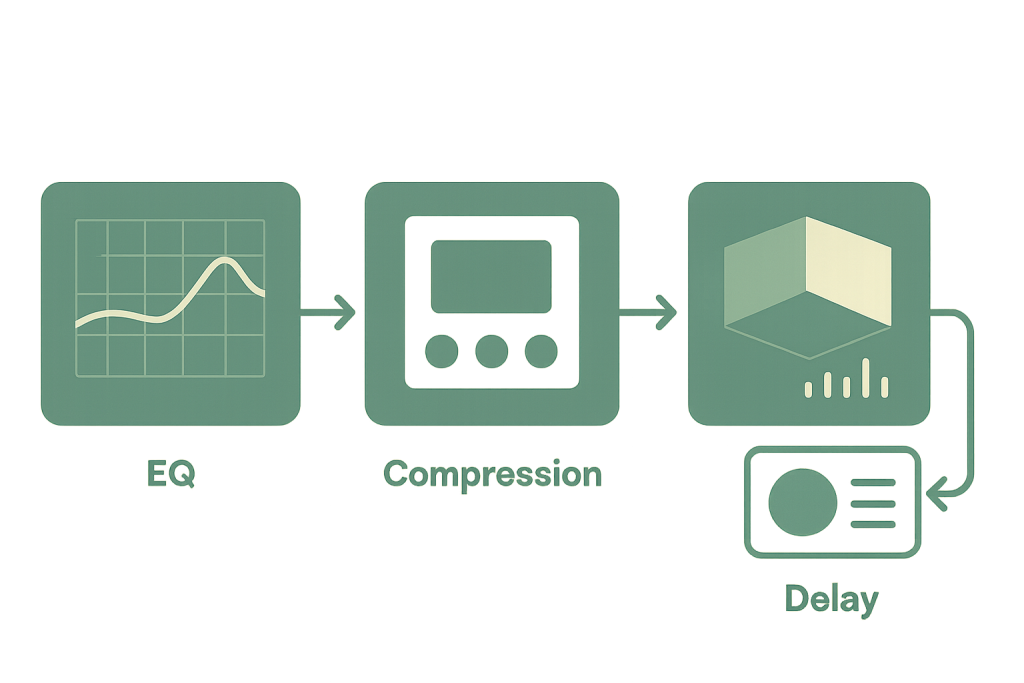
A vocal sounds pasted on when it has a different space, tone, or timing than the track underneath it. Same for a lead synth. Professional sounding tracks make the feature element feel like it grew out of the record.
Do not start with reverb. Start with volume automation. A vocal that is 1.5 dB too loud in the verse and 1 dB too quiet in the hook will never sit, even through a fancy chain.
Match tone before adding space
Use subtractive EQ first. If the vocal is boxy, cut around 220 to 400 Hz with a medium Q. If it stabs your ear, sweep 2.5 to 5 kHz carefully. For harsh modern vocals, Soothe2 can catch resonances, but I would rather use 2 dB less than 2 dB too much. Over-smoothing kills emotion.
For leads, carve a pocket around the vocal or main hook. Mid/side EQ helps here. If a pad is wide and beautiful but blocking the vocal sides, cut 2 to 3 dB around 1.5 to 3 kHz on the side channel.
Use short ambience before long reverb. A 0.6 second room or slap delay can glue a vocal to the groove. Long halls are for moments, not every line.
- Automate vocal volume before compression.
- De-ess before bright saturation.
- Use tempo delays on throws, not every phrase.
- Filter reverb returns below 200 Hz and above 8 kHz.
- Check the lead against the kick and clap, not in solo.
How loud should my track be before mastering?
Your premaster should feel balanced, not loud. If you send a distorted two-track to mastering or a custom music production engineer, there is no secret knob that brings back clean transients. Professional sounding tracks usually reach the loudness stage with space still available.
A safe premaster peaks around -6 dB, with no limiter on the master unless it is part of the sound and you also export a clean version. Integrated LUFS can sit anywhere from -18 to -10 at this point. The number matters less than the absence of ugly clipping.
Stop mastering into a broken mix
If your master chain needs 6 dB of EQ to fix the low mids, go back to the channels. A mastering EQ move of 0.5 to 1.5 dB can polish a strong mix. Big surgery on the master usually means the arrangement or balance is wrong.
A practical rough master chain might be Pro-Q 4, gentle bus compression, tape or saturation, then FabFilter Pro-L 2. Keep the limiter working 1 to 3 dB on the loudest section. If it needs 7 dB to compete, the mix is probably too peaky or too crowded.
For club music, loudness without punch is a bad trade. I would rather play a slightly quieter record on a CDJ-3000 that kicks hard than a flat sausage that looks impressive in a waveform preview.
- Export at 24-bit WAV or AIFF.
- Leave true peaks below 0 dB before final limiting.
- Remove master limiters before sending stems unless requested.
- Print a rough master for reference.
- Name files clearly with BPM and key.

What should I fix first if the whole mix sounds muddy?
Mud is usually arrangement plus low mids, not one evil frequency. Too many parts are playing sustained notes in the same octave. Professional sounding tracks leave holes. Bedroom demos often fill every gap because silence feels unsafe.
Mute before EQ. If removing a pad makes the groove clearer, that pad was not supporting the track. It was rent-free clutter.
Use arrangement mutes as EQ
Work in 4-bar phrases. Mute one musical layer at a time during the verse, pre-drop, and drop. Ask one question: does the section lose emotion or gain clarity? If it gains clarity, delete, automate, or thin the sound.
Common mud zones are 180 to 350 Hz for vocals, 200 to 500 Hz for synth stacks, and 120 to 250 Hz for percussion loops recorded with room tone. Cut with purpose. A 2 dB cut on three busy channels can beat one brutal 8 dB master cut.
Use sidechain beyond kick and bass. A pad can duck 1 dB when the vocal enters. A bass mid layer can duck when the kick hits while the sub stays stable. Small moves add up.
- Mute one layer per 4-bar phrase and listen to the groove.
- Cut low mids on competing sounds, not on everything.
- Shorten release times on pads and reverbs.
- Use mono checks to find masked hooks.
- Keep the main idea louder than the decoration.
How do I know if my track will work for DJs?
A DJ-friendly record is not just a loud master. It has readable phrasing, clean intros and outros, and transitions that make sense on decks. Professional sounding tracks give the DJ confidence before the first drop lands.
Open your track in Rekordbox, Serato, or Traktor. If the grid is messy, the intro is confusing, or the first 32 bars hide the groove, fix the arrangement. DJs make fast decisions.
Think like a CDJ, not just a DAW
Most club records still respect 8, 16, and 32-bar logic. You can break rules, but random 6-bar builds and surprise half-bars make mixing harder unless the payoff is massive. Keep intros functional. A tight kick, hat, percussion idea, or filtered motif gives the next DJ something to blend.
Test the file on gear if you can. A Pioneer DDJ-FLX10, XDJ-RX3, or CDJ-3000 will tell you whether the low-end jumps out, whether the waveform looks over-limited, and whether the cue points make sense.
If you are preparing music for a DJ set, export a clean version, an extended mix, and sometimes an instrumental. Do not make the only version a two-minute streaming edit with no mix-in.
- Use 16 or 32-bar intros for club versions.
- Keep the first kick clean enough to grid accurately.
- Avoid full-spectrum impacts on every transition.
- Leave an outro that can be mixed, not just faded.
- Check the master in Rekordbox before delivery.

When should I use ghost production or custom music production?
Use outside production help when the song idea is strong but the finish keeps missing. That is not failure. DJs hire mix engineers, artists hire writers, and labels send records through several sets of ears. Professional sounding tracks often come from collaboration, not lonely hero work.
The key is knowing what you need. Ghost production, custom music production, mixing, and mastering are different jobs. Asking for the wrong one wastes time and money.
Pick the service by the actual bottleneck
If you have only a voice memo and a reference playlist, you need custom music production. If you need a finished track in a specific lane, ghost production may fit. If the arrangement is strong but the sonics are weak, mixing is the move. If the mix is already balanced and translation is the issue, mastering is enough.
Be direct with references. Send two tracks for groove, one for low-end, one for vocal tone, and one for arrangement. Say what you do not want too. A clear brief beats a huge folder of random inspiration.
Also be honest about your goal. A DJ tool for your sets needs different choices than a vocal single for Spotify pitching. The same producer can do both, but the brief changes the finish.
- Choose ghost production when you need a finished record built to a lane.
- Choose custom production when the concept, vocal, or artist identity matters most.
- Choose mixing when the song works but the balance does not.
- Choose mastering when the mix already translates well.
- Send references with specific notes, not just links.
| Problem | Best First Move | Tool Example | Why It Works |
|---|---|---|---|
| Kick and bass feel weak | Phase check and sidechain ducking | Ableton Utility, Pro-Q 4 | Restores low-end space before compression |
| Drums lack impact | Parallel compression and light clipping | Glue Compressor, KClip | Adds density while keeping dry transients |
| Vocal feels detached | Volume automation and short ambience | Clip gain, Valhalla Room | Makes the vocal sit before big effects |
| Mix sounds muddy | Mute layers and cut low mids | Pro-Q 4, EQ Eight | Removes overlap instead of boosting clarity |
| Master gets loud but flat | Reduce limiter work | Pro-L 2, Ozone Maximizer | Keeps punch and avoids crushed peaks |
Further reading
- Ableton Live manual — Ableton's official manual is a primary source for routing, warping, gain staging and stock device behavior.
- Sound On Sound mixing — Sound On Sound is a long-running engineering publication with detailed, editor-reviewed mixing technique articles.
Frequently asked questions
How do I make professional sounding tracks at home?
Start with gain staging, references, and low-end control. Keep the master peaking around -6 dB while mixing, compare against level-matched releases, and fix kick-bass masking before mastering. A treated room helps, but good decisions on headphones plus car and speaker checks can still get you close.
What plugins make tracks sound professional?
No plugin fixes a weak balance, but a practical set includes FabFilter Pro-Q 4 for EQ, Pro-C 2 or Ableton Glue Compressor for dynamics, Soothe2 for harsh resonances, Valhalla Room for space, and Pro-L 2 for limiting. Use fewer tools with clearer intent.
Why does my mix sound good in headphones but bad in the car?
Headphones often exaggerate width and hide room-related low-end problems. Cars expose muddy low mids, harsh vocals, and weak sub balance quickly. Check mono, reduce unnecessary stereo bass, and compare your track to a reference at the same volume before changing the master chain.
Should I mix into a limiter?
You can use a limiter for vibe checks, but do not depend on it. Keep a clean premaster without limiting. If the limiter is doing more than 3 dB of gain reduction most of the time, fix drum peaks, bass balance, or arrangement density first.
How much headroom should I leave for mastering?
Leave around -6 dB peak headroom and avoid clipping individual buses. The exact number is less critical than a clean, undistorted export. Send a 24-bit WAV or AIFF, plus a rough mastered version if that shows the loudness and tone you like.
Is ghost production worth it for new DJs?
It can be worth it if you need release-ready music for sets, branding, or label pitching and you know the sound you want. The best results come from clear references, honest feedback, and a brief that explains the role of the track, not just the genre.
Conclusion
Professional sounding tracks come from a repeatable order of decisions: balance first, low-end second, space third, loudness last. Do not start the session by throwing a limiter on the master and hoping the record becomes serious. Check the kick and bass relationship, automate the main element, mute clutter, and compare against a reference at matched loudness.
The 45-minute promise is realistic because you are not trying to reinvent the song. You are removing the obvious reasons it feels unfinished. Open your next session, set a timer, and run the checks in this order before you export another version.
Professional sounding tracks — Quick Recap
The fastest way to lock in professional sounding tracks is to internalise the workflow above and repeat it on every project. Start small: pick one technique from this professional sounding tracks guide, apply it to your next session, and audit the result against a reference track.
- Finished records sound intentional before they sound loud.
- Low-end translation starts with phase, mono control, and clean arrangement choices.
- Drum punch comes from transient control, parallel compression, and headroom.
- Vocals and leads sit better after automation and tone matching, not extra reverb.
Treat professional sounding tracks as a habit, not a one-off — the producers who consistently nail professional sounding tracks are the ones who run the same checks on every track. That’s the difference between a clean, club-ready master and a track that sounds great at home but falls apart on a real system.
In a real studio session, professional sounding tracks comes down to the order in which you make decisions: reference first, gain stage second, then the creative work. Producers who treat professional sounding tracks as a checklist instead of a vibe end up shipping more tracks.
Most producers and DJs undervalue professional sounding tracks because the wins are invisible until the track plays back on a real system. Bake professional sounding tracks into your template and the next ten projects benefit automatically.
When you struggle with professional sounding tracks, the fix is rarely a new plugin. Loop a problem section, A/B against a reference, and isolate which element is breaking your professional sounding tracks.
Treat professional sounding tracks as a craft, not a chore. The producers releasing on the biggest labels lock professional sounding tracks in early so they can spend their energy on melody and arrangement instead of fighting the mix.
Document your professional sounding tracks process — even a short note in the project file. Future-you will rebuild the same professional sounding tracks win in half the time.
If professional sounding tracks sounds great in headphones but bad in the car, you have a translation problem, not a creative one. The professional sounding tracks tweaks above are designed to survive every system.
Schedule a recurring professional sounding tracks pass on every project: same checklist, same reference tracks. Repeating professional sounding tracks drills is what separates a consistent producer from a lucky one.
Ultimately, professional sounding tracks is a craft you compound. Every project you finish raises the floor of your next attempt at professional sounding tracks, which is why shipping consistently matters more than chasing perfection.
My Career makes videos from your own track and posts them for you, pitches your release to 34,000+ labels, playlists, radio stations, YouTube channels and blogs, puts it in every store and briefs you every morning. Free plan, no card, two minutes to set up.