 By Emma Carter · July 28, 2026
The biggest Australian dance record of the year has AI credits on Spotify — and top-tier editorial placement on Apple Music, where nothing tells you a machine sang it.
Josh Fawaz AI cover of Madonna’s “Like a Prayer” spent four weeks at No. 1 on Australia’s national radio airplay chart, hit the ARIA Top 5, and has racked up more than 38 million Spotify streams. Then, after an ABC investigation, something quietly changed on its Spotify page: the credits were updated to acknowledge generative AI vocals and AI drums.
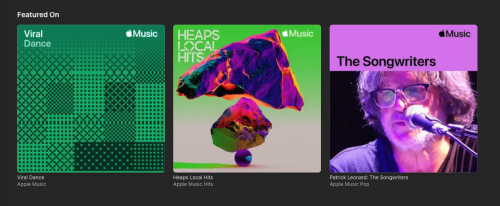
On Apple Music? Nothing changed at all. At the time of writing, the track sits on Apple’s own editorial playlists — Viral Dance and Heaps Local Hits — with no AI label anywhere on the page. Apple launched Transparency Tags in March 2026 for exactly this situation. The tag isn’t there.
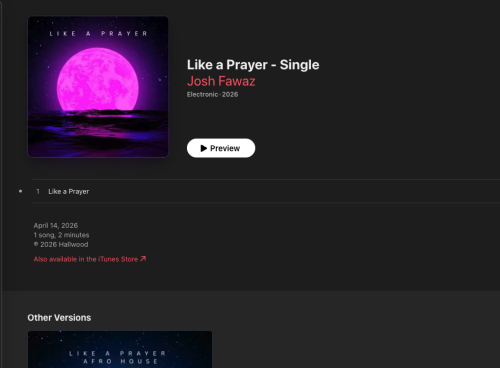
The timeline: from “just be better” to Josh Fawaz AI credits
This didn’t start with the credits change. It started with producers hearing something off.
- May: Australian producer Mitch Thomas (who performs as Needs No Sleep) began publicly questioning how the track was made, pointing to audio artifacts and frequency cutoffs typical of generative platforms. He offered to publicly apologise if proven wrong. He hasn’t had to.
- June: Fawaz responded to critics on Instagram: “Stop having a little sook buddy, just be better,” adding “I use AI as a tool, it’s not that deep.”
- July: Following the ABC’s investigation, the track’s Spotify credits were updated to credit generative AI for both vocals and drums.
- The “clapback”: Fawaz then posted a behind-the-scenes video — captioned “Behind the scenes on some vocals to my songs” — showing himself singing a deliberately rough take into a microphone, then feeding it into Suno, the generative AI platform. Out came a polished, R&B-styled vocal with different phrasing and an American accent. Rolling Stone’s verdict: the video “spectacularly proves his critics’ point.”
What’s actually confirmed — and what isn’t
To be precise, because precision is what this debate is missing: nobody has published proof that the entire record was machine-generated. What is on the record:
- The official Spotify credits now list generative AI vocals and AI drums — added only after journalists came asking.
- Fawaz himself has said, repeatedly, that he uses AI “as a tool.”
- His own workflow video shows a Suno pipeline transforming his rough vocal into the finished performance style.
- RMIT senior research fellow Sam Whiting, who reviewed the track, put the stakes plainly: “This is a very… impressive vocal performance if it was delivered by a human but if it’s not, that brings in really worrying questions around what we value any more in terms of human expression.”
That’s not a witch hunt. That’s the artist’s own credits, his own words, and his own video.
The Apple Music problem
Here’s where it stops being about one DJ.
Spotify has been moving — imperfectly, but moving. Its global head of artists policy, Sam Duboff, announced a disclosure feature urging artists to declare AI use, and the platform says it removed 75 million “spammy” tracks in a year. Whatever you think of Spotify, the “Like a Prayer” credits page now tells you the truth.
Apple Music’s Transparency Tags — covering AI use in audio, composition, artwork and video — are declaration-based. Apple defers to labels and distributors to apply them, and there’s no public enforcement. So a track that Spotify’s own credits describe as featuring generative AI vocals can sit on Apple’s editorial playlists — playlists curated by Apple’s own team, carrying Apple’s own brand — completely unlabeled. Not because Apple decided it isn’t AI. Because nobody was required to say so.
Editorial placement is not a neutral algorithm. It’s an endorsement. When Apple’s curators put a track on Viral Dance, they’re spending Apple Music’s credibility on it — and right now they’re spending it on a record whose AI credits exist one app over.
Why the dance community is furious
Radio airplay charts and editorial playlists are zero-sum. Every week this record spent at No. 1 on the airplay chart was a week a human-performed record didn’t. That’s the heart of the backlash from Australian DJs and producers — a wider reckoning over creators accused of using AI to divert streams, slots and radio quota support from artists who sing their own hooks and pay session vocalists.
And the standard being asked for is genuinely modest: nobody is demanding AI music be banned. They’re demanding it be labeled. Listeners can decide for themselves — once they’re told.
The uncomfortable question for streaming
If a machine-assisted vocal can top an airplay chart for a month, gather 38 million streams and land Apple editorial support before anyone is told how it was made, then disclosure isn’t a nice-to-have — it’s the whole ballgame. The tools aren’t going away. Suno isn’t going away. The only variable still up for grabs is honesty at the point of listening.
There’s an irony here that our corner of the industry knows well. Ghost production — a producer making a track that an artist releases — has existed for decades, and at its best it’s built on the thing this story lacks: a clear, contractual, disclosed transfer of human work. Every track on our marketplace is made by a verified human producer, passes AI-detection checks before listing, and is sold with a signed rights agreement. The buyer knows exactly what they’re getting and where it came from. That’s the bar. It isn’t high. Streaming’s biggest platforms are still tripping over it.
FAQ
Is Josh Fawaz AI “Like a Prayer” AI-generated?
Its official Spotify credits were updated in July 2026 — after an ABC investigation — to acknowledge generative AI vocals and AI drums. Fawaz says he uses AI “as a tool” and has shown a workflow feeding his rough vocals into Suno. No one has published proof the entire track was machine-generated.
Did Josh Fawaz AI admit to using AI?
Yes. He has said “I use AI as a tool, it’s not that deep,” and posted a behind-the-scenes video showing a Suno-based vocal workflow.
Does Apple Music label AI music?
Apple launched Transparency Tags in March 2026, but the system is declaration-based — labels and distributors decide whether to apply a tag, and there is no public enforcement. “Like a Prayer” currently carries no AI tag on Apple Music while appearing on Apple editorial playlists.
Does Spotify disclose AI music?
Spotify has updated this track’s credits to list generative AI vocals and AI drums, and has announced a disclosure feature urging artists to declare AI use. Disclosure remains inconsistent across the platform.
How can I tell if a track is AI-generated?
Listen for unnaturally smooth vocal phrasing, odd consonant artifacts, and abrupt high-frequency cutoffs — the tells producers flagged here months before the credits changed. Producer-grade ears help, but platform-level disclosure is the only real answer.
Sources: Rolling Stone AU, Rolling Stone AU (clapback), EDM.com, The Music Network, Tone Deaf, RUSSH. All quotes attributed to their original reporting. This article covers a matter of public interest; claims are reported as documented by the cited outlets.
My Career makes videos from your own track and posts them for you, pitches your release to 34,000+ labels, playlists, radio stations, YouTube channels and blogs, puts it in every store and briefs you every morning. Free plan, no card, two minutes to set up.