Key takeaways
- Kick and bass timing matters more than copying a perfect EQ curve.
- Good gain staging protects transient feel, not just digital headroom.
- Mono sub below 100 to 120 Hz is still the safest club decision.
- Reverb and delay returns need rhythm, filtering and automation.
- Stereo width should support the arrangement, not replace a strong centre.
- A rough master should test pressure, not hide mix problems.
Proper house music mixing starts where most screenshots stop: how the groove survives a club limiter, a mono sub stack, and a DJ mixer running hotter than it should.
Good house music mixing is not a pile of EQ moves copied from a YouTube thumbnail. It is a chain of decisions. Kick length affects bass rhythm. Bass phase changes perceived loudness. A beautiful reverb can turn useless once the room adds another two seconds of decay. A wide synth may feel huge on Adam A7Xs and vanish on a Pioneer DJM-900NXS2 summed into a tired booth monitor.
The target here is simple: get a mix that still feels like yours when it leaves the bedroom. We are talking CDJ-3000 playback, DDJ-FLX10 practice sessions, Ableton Live 12 bounces, FabFilter Pro-Q 4 decisions, Soothe2 restraint, and loudness that does not punish the groove.
House Music Mixing Starts With Kick-Bass Geometry
The kick and bass relationship is not a frequency chart problem first. It is a time-domain problem. Most house music mixing advice says to carve the bass around the kick fundamental and call it done. That works until the bass note starts early, the kick tail is 180 ms too long, and the compressor recovers in the wrong part of the groove.
Draw it. Zoom in. If the kick transient, sub bloom and bass attack all land inside the same 40 ms window, EQ becomes damage control.
House music mixing lives in the first 120 ms
On a four-on-the-floor record, the first 120 ms after every kick tells you nearly everything. If the kick fundamental sits around 50 Hz and the bass note also blooms there, choose a hierarchy. I usually let the kick own the first hit and let the bass speak after the transient.
Use sidechain ducking as timing, not punishment. In Ableton Compressor, start with 2 to 4 ms attack, 80 to 140 ms release, and 2 to 5 dB of gain reduction. If you need 10 dB, the arrangement is probably lying to you.
Stop EQing before you check polarity
Flip polarity on the bass channel before reaching for Pro-Q 4. Then nudge the bass region by 5 to 20 samples and listen in mono. Yes, samples, not milliseconds. A tiny move can turn a weak 55 Hz pocket into a confident one.
All-pass filters are useful here, but they are not magic. Sound Radix Pi, Little Labs IBP, and the phase rotation inside some channel strips can help when the bass sample has a phase curve that fights the kick. Print the result once it works. Endless phase options make people timid.
Tune length before tuning pitch
A kick tuned to the key can still wreck house music mixing if the tail is too long. For a 124 BPM groove, a 180 to 220 ms kick often sits better than a 350 ms subby monster. Shorter can feel louder because it leaves space for the bass note.
Try trimming the kick tail, then adding a controlled low shelf around 60 Hz if needed. That beats boosting a long tail and wondering why the master limiter coughs.
- Check kick and bass in mono before widening anything.
- Leave at least -6 dB peak headroom before any mix bus limiter.
- Use sidechain release as a groove control, not a loudness trick.
- Trim kick tails before cutting bass fundamentals.
- Test bass phase after every sample swap.
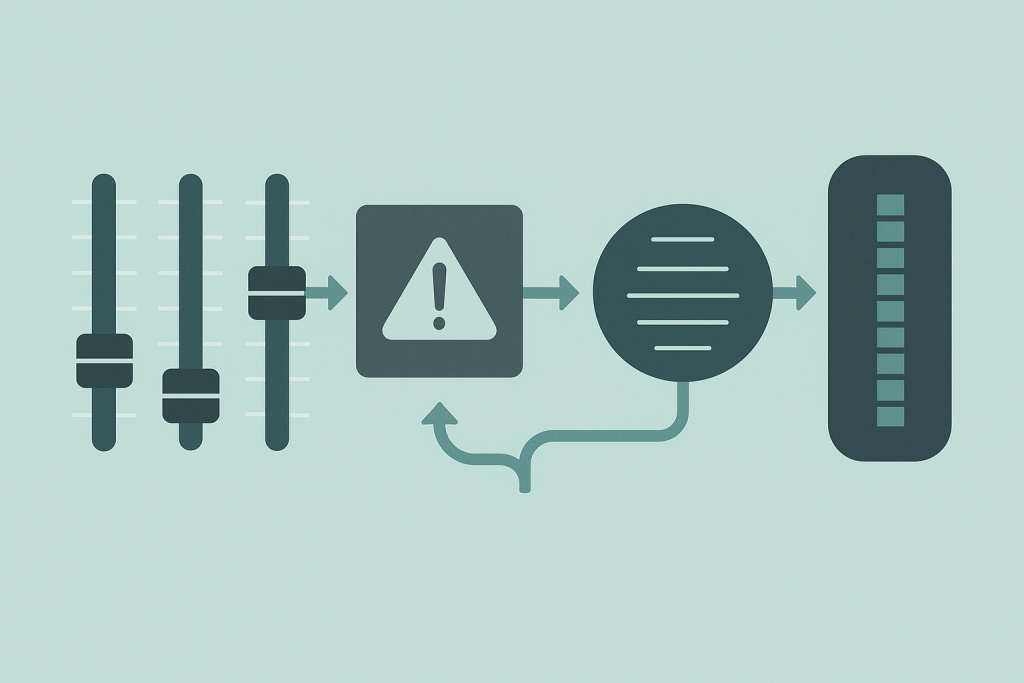
Gain Staging Is About Groove, Not Just Headroom
Headroom is the boring version of the topic. The useful version is transient budget. In house music mixing, every clipped drum bus, hot synth group and parallel chain changes where the groove feels like it leans forward.
I like a premaster peaking around -6 dBFS, but the number is not sacred. What matters is whether the kick transient remains readable before mastering. If the mix bus already looks like a sausage at -6 dBFS, the number is theatre.
Clip drums before compressing them, but mean it
Soft clipping on individual drums can beat bus compression when the problem is stray peaks. StandardCLIP, KClip 3, Ableton Saturator in Soft Clip mode, or a clean clipper inside Ozone can shave 1 to 3 dB from a clap or rim without dragging the whole groove down.
Do not clip everything by habit. A 909 open hat with a ragged transient may love it. A shaker loop may turn into sandpaper. House music mixing benefits from selective aggression.
Parallel compression should return energy, not fog
On a drum parallel, high-pass before compression around 120 to 180 Hz unless the kick needs extra body. Then use an 1176-style compressor, all buttons if it suits the record, and blend until the room tone wakes up. Pull it back 2 dB from where it first sounds exciting.
The common mistake is leaving full low end in the parallel path. That stacks sustain under the kick and makes the main low end feel slower, even if the meters look fine.
Calibrate monitoring before blaming the mix
Pick a working SPL and keep it boring. Around 78 to 82 dB SPL C-weighted is enough in a small room if treatment is decent. If you only mix loud, your kick decisions will be too soft. If you only mix quiet, hats and rides will creep up.
Use LUFS-S for momentary section checks, but do not mix to it like a scoreboard. LUFS-I matters later. Groove still wins.
- Clip single drum channels before crushing the drum bus.
- Keep parallel low end filtered unless you want extra kick sustain.
- A/B level matched, not louder against quieter.
- Watch crest factor on the drum bus, not only peak level.

Low-End Translation: Phase Beats Pretty Spectrum Curves
A spectrum analyser is useful, but it can make bad house music mixing look tidy. A smooth curve from 30 to 120 Hz tells you nothing about whether the bass disappears when summed, whether a room mode is flattering one note, or whether the kick fundamental is late against the transient.
Reference records help, but only if you level match and filter your ego out of the process.
Use references for ratios, not imitation
Load a reference from Defected, Toolroom, Anjunadeep, or another label close to the target. Turn it down until the loudness matches your mix, then compare kick-to-bass ratio, vocal position and hat brightness. Do not copy the tonal curve. Different arrangements earn different curves.
A FabFilter Pro-Q 4 spectrum overlay is fine for checking broad balance. If your bassline is one octave higher than the reference, forcing the same 50 Hz energy is a bad move.
Mono sub is still the safer call
Below 100 to 120 Hz, mono usually wins. There are exceptions, but most club systems reward a stable centre. In house music mixing, wide sub effects can feel clever in headphones and useless on a real floor.
Use Utility in Ableton, bx_control V2, or Pro-Q 4 mid/side mode to keep the side channel clean under 120 Hz. If the record needs width, build it above the bass: percussion delays, chorus on pads, stereo room returns, not stereo sub wobble.
Soothe2 is not a substitute for choosing notes
Resonance suppression can tidy a bass bus, but it will not fix a bassline that fights the chord progression. Soothe2 around 80 to 250 Hz can catch ugly note jumps if you keep depth conservative. Push it too hard and the bass loses intention.
For house music mixing, I prefer manual automation on one or two notes over broadband dynamic smoothing. If one F is 4 dB louder because your room loves it, automate the clip gain and move on.
- Check mono below 120 Hz on every mix pass.
- Compare references after loudness matching, never raw.
- Automate bad bass notes before inserting another dynamic EQ.
- Treat analyser curves as evidence, not verdicts.
- Avoid stereo enhancers on true sub information.

Depth Works When Reverbs Stay Rhythmically Accountable
House records do not need dry mixes. They need depth that keeps time. Bad house music mixing often has reverb that sounds expensive during a solo check and sloppy once the kick, bass and vocal hook return.
Reverb is arrangement. Treat it like a part, not dust sprayed over channels.
Short rooms beat giant tails for drums
For claps, snares and percussion, a short room or ambience patch between 0.3 and 0.8 seconds usually carries better than a huge hall. Valhalla Room, FabFilter Pro-R 2, or Ableton Hybrid Reverb can all do it. Roll off the return below 250 Hz and above 8 to 10 kHz unless the top needs sparkle.
Schroeder-style algorithmic reverbs give motion and density. Convolution reverbs give believable spaces, but they can feel static on repetitive drums. I use algorithmic rooms more often for club percussion.
Pre-delay is a groove parameter
Pre-delay around 15 to 35 ms can keep a vocal chop or stab present without drying it out. Sync it to feel, not a grid. At 124 BPM, 1/64 note is roughly 30 ms. That is often enough to separate attack from wash.
Duck the reverb return from the dry signal with Pro-C 2 or Trackspacer if the hook needs front placement. Two or three dB of ducking can clean more than a harsh high-mid cut.
Delay returns should pass the DJ test
A dotted eighth delay may sound lush in the studio and clutter a DJ transition. Filter it. Automate it. Kill it before the drop if it steps on the next downbeat.
House music mixing is partly about leaving enough negative space for another record to enter. That matters if the track is meant for DJs, not only streaming playlists.
- High-pass reverb returns before the low end gets cloudy.
- Treat pre-delay as timing, not decoration.
- Duck long returns from vocals and lead stabs.
- Automate delay throws so transitions stay clean.

Width Needs Mid/Side Discipline, Not Random Stereo Toys
Width is where competent producers overcook things. The mix feels small, so they add chorus, Haas delay, MicroShift, stereo spread, and a mid/side EQ boost. Then the hook folds badly in mono and the hats smear across the room.
Strong house music mixing puts width in the right layers and keeps the centre boring in the best way.
House music mixing needs a centre lane
Kick, sub, main vocal, and the main rhythmic hook need a reliable centre lane. That does not mean mono everything. It means the record still makes sense when a club processor, phone speaker, or broadcast chain narrows it.
Check correlation, but trust the mono button more. A correlation meter can look acceptable while the emotional part of a synth vanishes. If the hook dies in mono, rebuild the patch with a stronger mid component instead of trying to rescue it with EQ.
Widen above the job frequency
Every sound has a job frequency. A piano stab might need 250 to 800 Hz for identity and 3 to 6 kHz for bite. Widening the full signal can pull the identity away from the centre. Use mid/side EQ instead: keep low mids steadier, open sides above 2 kHz if the arrangement allows it.
FabFilter Pro-Q 4, iZotope Ozone Imager, Ableton Roar, and Soundtoys MicroShift all work if you decide what should stay central first.
Haas delay is a special effect, not a mix strategy
Delaying one side by 8 to 20 ms can make a sound jump wide, but it also creates comb filtering when summed. Use it on ear candy, not the main musical message. If a pluck riff carries the drop, chorus or dual-voice detune is usually safer.
For house music mixing, I would rather have a slightly narrower hook that punches on a club rig than a huge one that disappears during the best eight bars.
- Keep kick, sub and lead message stable in the centre.
- Use mid/side EQ before reaching for global wideners.
- Check mono after every stereo effect, not only at the end.
- Reserve Haas tricks for ear candy and transitions.
- Build width with arrangement layers, not only plugins.

Loudness Decisions Before Mastering: LUFS, Clipping and Risk
Loudness does not begin at the mastering limiter. House music mixing sets the risk level long before the premaster leaves the session. If the kick is too long, the bass is phase-soft, and the drum bus is already flat, no lookahead limiter will give you a clean club master.
Do not chase -8 LUFS-I inside the mix. Chase a premaster that can survive being pushed there.
Separate LUFS-I from LUFS-S
LUFS-I tells you the integrated loudness across the track. LUFS-S shows short-term density across smaller windows. For a club house track, the drop might sit much hotter than the breakdown. That is normal.
Use Youlean Loudness Meter, Insight 2, or Logic Loudness Meter to understand sections, not to flatten them. If every section has the same short-term loudness, the arrangement probably lost its lift.
Clipper into limiter beats limiter alone
A clean clipper before a lookahead limiter often keeps drums firmer than asking the limiter to do all the work. Try 1 to 2 dB clipping into FabFilter Pro-L 2, DMG Limitless, or Ozone Maximizer IRC IV. Listen to the kick click and low-mid punch, not only the loudness number.
House music mixing should leave mastering choices open. If your rough master needs 6 dB of limiter gain reduction to feel finished, go back to the mix bus and remove the bottleneck.
Print three premaster versions
Print a clean premaster, a clipped premaster, and a loud reference bounce. Name them clearly. The clean version gives mastering room. The clipped version shows intent. The loud bounce tells you whether the groove survives pressure.
This is also useful when working with a ghost producer or custom production team. A loud rough says more than a paragraph of adjectives.
- Leave mix bus limiting off until the rough master check.
- Use clipping for peak control before heavy lookahead limiting.
- Judge loudness by groove damage, not only LUFS-I.
- Print clean, clipped and loud reference versions.
- If the limiter changes the groove, the mix is not ready.
| Move | Use It When | Watch For | Good Tools |
|---|---|---|---|
| Sidechain ducking | Kick and bass overlap in the first 120 ms | Over-ducked bass that loses note length | Ableton Compressor, Pro-C 2, Trackspacer |
| Soft clipping | Drum peaks steal limiter headroom | Brittle hats and flattened clap transients | StandardCLIP, KClip 3, Ableton Saturator |
| Mid/side EQ | Width needs control by frequency | Thin centre image or phasey sides | FabFilter Pro-Q 4, bx_control V2 |
| Dynamic resonance control | One bass note or vocal band jumps out | Over-smoothed tone with no attitude | Soothe2, Pro-Q 4 dynamic bands |
| Lookahead limiting | Checking master pressure before delivery | Limiter pumping that changes groove | Pro-L 2, DMG Limitless, Ozone Maximizer |
Further reading
- Ableton audio effects — Ableton's official manual documents Compressor, Saturator, Hybrid Reverb and other tools referenced in the workflow.
- Sound On Sound phase — Sound On Sound is a long-running technical publication with reliable explanations of phase, polarity and recording principles.
Frequently asked questions
What is the best way to start house music mixing?
Start with kick, bass and drum bus balance in mono. Set rough headroom around -6 dBFS, check polarity between kick and bass, then shape sidechain release until the groove breathes. Leave wideners, reverbs and master loudness until the low-end timing feels reliable.
How loud should a house mix be before mastering?
A clean premaster can peak around -6 dBFS, but peak level alone does not matter much. Avoid heavy mix bus limiting and keep the groove intact. Print a separate loud reference if needed, but send the mastering engineer a version with transients and low-end movement still alive.
Should house music bass be mono?
Most true sub content below 100 to 120 Hz should be mono for club reliability. You can create width higher up with percussion, synth harmonics, delays and reverb returns. Wide sub may impress on headphones, but it often weakens translation on club systems.
Why does my house mix sound muddy in clubs?
Mud usually comes from low-mid sustain, long kick tails, unfiltered reverb returns, or bass notes that excite the room unevenly. Check 150 to 350 Hz on bass, keys and drum parallels. Then shorten tails and automate problem notes before making broad EQ cuts.
Is sidechain compression always needed in house?
No, but some form of kick-bass timing control usually is. That might be sidechain compression, volume shaping, MIDI-triggered ducking, sample editing or arrangement changes. The point is not the pumping effect. The point is giving the kick transient and bass note their own space.
How do I know if my mix will work on CDJs?
Export a 24-bit WAV and a 320 kbps MP3, then test through Rekordbox, a controller like the DDJ-FLX10, or CDJ-style playback if available. Listen for weak intros, overlong reverb tails, harsh hats and low end that falls apart when the booth monitor is mono or narrow.
Conclusion
House music mixing gets easier when you stop treating the mix as a polish stage and start treating it as groove engineering. The kick tail, bass phase, drum clipping, reverb timing, stereo centre and limiter reaction are connected. Change one and the others answer back.
The practical test is blunt: can the record survive mono, level-matched references, a loud rough master, and a DJ transition without losing its point? If yes, you are close. If no, do not add another shiny plugin. Go back to the section that collapses first and fix the cause.
Try this in your next session: print a clean premaster, a clipped premaster and a loud reference, then compare them against one club record you actually respect.
House music mixing — Quick Recap
The fastest way to lock in house music mixing is to internalise the workflow above and repeat it on every project. Start small: pick one technique from this house music mixing guide, apply it to your next session, and audit the result against a reference track.
- Kick and bass timing matters more than copying a perfect EQ curve.
- Good gain staging protects transient feel, not just digital headroom.
- Mono sub below 100 to 120 Hz is still the safest club decision.
- Reverb and delay returns need rhythm, filtering and automation.
Treat house music mixing as a habit, not a one-off — the producers who consistently nail house music mixing are the ones who run the same checks on every track. That’s the difference between a clean, club-ready master and a track that sounds great at home but falls apart on a real system.
In a real studio session, house music mixing comes down to the order in which you make decisions: reference first, gain stage second, then the creative work. Producers who treat house music mixing as a checklist instead of a vibe end up shipping more tracks.
Most producers and DJs undervalue house music mixing because the wins are invisible until the track plays back on a real system. Bake house music mixing into your template and the next ten projects benefit automatically.
When you struggle with house music mixing, the fix is rarely a new plugin. Loop a problem section, A/B against a reference, and isolate which element is breaking your house music mixing.
Treat house music mixing as a craft, not a chore. The producers releasing on the biggest labels lock house music mixing in early so they can spend their energy on melody and arrangement instead of fighting the mix.
Document your house music mixing process — even a short note in the project file. Future-you will rebuild the same house music mixing win in half the time.
My Career makes videos from your own track and posts them for you, pitches your release to 34,000+ labels, playlists, radio stations, YouTube channels and blogs, puts it in every store and briefs you every morning. Free plan, no card, two minutes to set up.