Key takeaways
- Ableton Live is stronger for finishing and revising club-focused arrangements.
- FL Studio shines when MIDI basslines and percussion details need fast editing.
- Groove depends on microtiming, phase, and envelope control more than sample quantity.
- A tech house mix should work before limiting, with clean mono low end and useful headroom.
- Reference tracks should be timestamped and functional, especially for ghost production briefs.
Tech house production is less about finding a magic bass preset and more about making tiny timing, phase, and arrangement decisions that survive a CDJ-3000 at 2 a.m.
Most tech house production tutorials get the headline moves right, short vocal hook, rolling bass, dry drums, but miss the decisions that separate a workable loop from a record a DJ can trust. Ableton Live and FL Studio can both finish the job. I still think Ableton wins when the session needs fast arrangement judgment, clean resampling, and disciplined automation. FL Studio is faster for pattern sketching and drum variation, but that speed can trap you in a perfect eight-bar loop. If you are producing your own tracks, briefing a ghost producer, or ordering custom music, this is the stuff worth checking before anyone talks about loudness.
Where tech house production Actually Splits Ableton and FL Studio
The Ableton vs FL Studio argument gets boring when it becomes a fan poll. For tech house production, the real split is workflow pressure. Ableton pushes you toward performance, resampling, and arrangement decisions earlier. FL Studio rewards pattern detail and fast MIDI mutation, which can be brilliant until the Playlist turns into a museum of unused ideas.
My bias is clear: if the target is a club record with a playable intro, controlled break, and DJ-friendly outro, Ableton Live 12 makes fewer excuses. Session View into Arrangement View still feels like a proper sketch-to-record bridge.
Why tech house production Exposes DAW Habits
Tech house has nowhere to hide. A melodic house record can carry a weak groove with chords and pads. A big-room track can lean on impact design. In tech house production, a bad closed hat at 1/32 early becomes the whole personality of the track, and not in a good way.
Ableton’s Groove Pool, audio warping, and resampling flow let you audition feel against the full loop without bouncing mental tabs. FL Studio’s Piano Roll is still excellent for note-level bass edits, but the Pattern system tempts producers to keep adding instead of committing.
The DAW Decision I Would Make for Paid Work
For custom music production, I would rather inherit an Ableton session with frozen tracks, named groups, and return effects than a scattered FL project full of half-muted patterns. That matters when revisions arrive. A client asking for a darker second drop should not mean hunting through 38 pattern clips called Pattern 12.
- Ableton wins for arrangement speed, audio editing, resampling, and revision handling.
- FL Studio wins for MIDI experimentation, drum rolls, and fast pattern variation.
- Neither saves a weak groove, bad kick choice, or lazy vocal edit.
- Use Ableton when arrangement discipline matters more than sketch speed.
- Use FL Studio when the bassline and percussion need heavy MIDI detail.
- Keep the session printable, labeled, and easy to revise.
- Judge the DAW by club translation, not forum loyalty.

Drum Groove Is Timing, Not Sample Shopping
Bad tech house drums usually come from over-curated samples and under-edited timing. Producers will audition 200 kicks, then leave every shaker nailed to the grid. That is backwards. In tech house production, the drum rack should feel like one machine leaning forward, not five sample packs stapled together.
Microtiming Beats Another Kick Folder
Start with one kick that works at club volume, then build around its envelope. A 909-style kick with a tight 45 to 60 ms punch and short decay often leaves more room than a huge subby sample. Put the clap slightly late, maybe 8 to 14 ms, and push a short hat ahead by 4 to 8 ms if the groove feels sleepy.
In Ableton, apply Groove Pool swing lightly, 52 to 56 percent is enough. In FL Studio, use per-note shift in the Piano Roll instead of global swing when the percussion layers need different pocket positions.
Layer Less, Tune More
Most tech house production drum stacks get too wide and too polite. Tune the kick fundamental to sit cleanly with the bass, but do not force everything into song key like a superstition. If the kick’s best weight lands around 49 Hz and the bass is working around 98 Hz, let that relationship breathe.
- High-pass busy percussion around 180 to 300 Hz, depending on the sample.
- Cut boxy clap layers around 500 to 800 Hz with FabFilter Pro-Q 4.
- Use parallel compression on a drum bus, not a smashed master bus.
- Keep one dry transient layer untouched for club definition.
- Move claps and hats by milliseconds, not beats.
- Check groove with the bass muted and unmuted.
- Avoid stacking three kicks unless each layer has a clear job.
- Print percussion loops if audio editing makes the pocket easier.

Bassline Design: Phase Beats Loudness
The fastest way to ruin tech house production is to chase bass loudness before checking phase. A rolling bassline that looks massive on a spectrum analyzer can vanish on a mono club rig if the sub layer, kick tail, and sidechain timing fight each other.
Use a simple rule: the kick owns the first hit, the bass owns the conversation after it. If they both talk at once, neither sounds expensive.
Sidechain Ducking Needs Release Timing, Not Just Depth
A compressor sidechain at 4 to 6 dB gain reduction can work, but the release decides the groove. Too fast and the bass chatters. Too slow and the line loses momentum. I often start around 80 to 140 ms release for 124 to 128 BPM tech house, then adjust by ear against the kick decay.
Volume-shaper tools like Cableguys ShaperBox or Xfer LFO Tool give cleaner curves than a compressor when the kick pattern is simple. Use a lookahead limiter only after the mix is behaving, not as a groove repair tool.
Sub, Mid Bass, and All-Pass Trouble
Split bass layers only when the part demands it. A clean sine or triangle sub under a midrange FM layer from Serum 2, Operator, or Phase Plant can work, but all-pass filters inside synth effects may rotate phase in ways that weaken the low end. Bypass chorus, unison, and stereo widening below 120 Hz. No mercy.
For tech house production, I prefer mono sub, narrow low mids, and controlled aggression from 700 Hz to 2 kHz. That range tells laptop speakers the bassline exists while the club rig handles the body.
- Check kick and bass in mono before touching the limiter.
- Keep stereo widening above the bass fundamental.
- Use oscilloscope checks for phase, but trust the groove first.
- Automate bass filter movement only when it serves the arrangement.
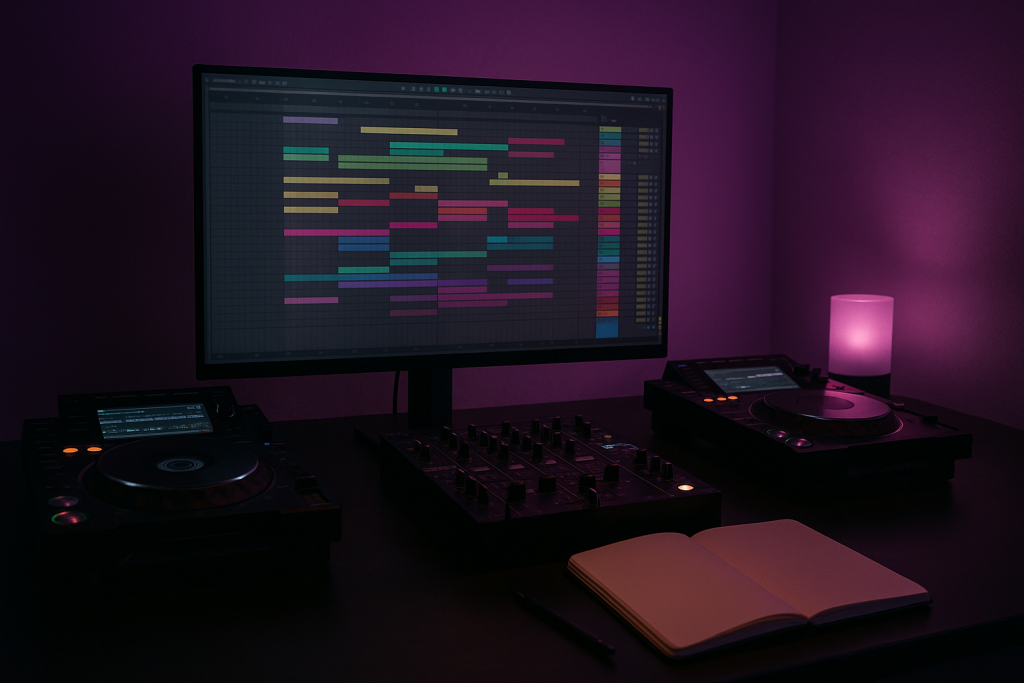
Arrangement Pressure: Four-Bar Loops Need Consequences
A strong four-bar loop is only a starting point. Tech house production fails when nothing meaningful changes after bar 17. The track does not need EDM theatrics, but it needs pressure, release, and small bits of information arriving at the right time.
Write for DJs Without Making a DJ Tool
Give the intro 16 or 32 bars of clean mixing space, but do not make it dead. A filtered percussion answer, a muted vocal consonant, or a one-shot bass pickup can tell the DJ where the record is heading. On CDJ-3000 waveforms, obvious phrase movement matters.
Every 8 bars should answer one question: what changed, and why should the floor care? If the answer is another crash cymbal, rewrite the section.
Vocal Hooks Need Editing, Not Worship
One good vocal phrase can carry tech house production, but only if you treat it like rhythm. Chop breaths. Move consonants. Gate tails. A phrase that feels natural solo may drag against swung drums, so edit against the groove, not against the waveform grid.
Use short slap delay, 70 to 120 ms, with low feedback. For reverb, I usually prefer a tight algorithmic room or Schroeder-style patch over convolution on main hooks. Convolution can sound too realistic and too slow for dry club records.
- Mark 4-bar and 8-bar phrase points before adding fills.
- Use silence as an arrangement move, not only risers.
- Keep the first drop leaner than the second if the hook can grow.
- Test the intro and outro in Rekordbox or on actual players.

Mix Translation: Stop Mastering Around a Bad Groove
Mastering cannot rescue weak tech house production. If the kick and bass feel late, if the hats smear, or if the vocal sits like a sticker, a limiter will only make the problem louder. Build a mix that already works at -6 dB headroom, then make it competitive.
LUFS-I vs LUFS-S in Club Context
Do not obsess over one loudness number. LUFS-I tells you the integrated average across the track. LUFS-S shows short-term energy, which often matters more when judging drops and breakdown returns. A tech house master around -8 to -7 LUFS-I can be fine if the transient shape is clean. Pushing to -5.5 LUFS-I with flattened drums usually sounds smaller.
Use a true peak ceiling around -1 dBTP for streaming safety, but check a club-focused reference too. The floor reacts to punch and groove before it reacts to a loudness meter.
Mid/Side EQ and Dynamic Control
Mid/side EQ is useful when you are strict. Keep sub information centered. Pull low-mid clutter from the sides around 180 to 350 Hz if wide percussion muddies the bass. FabFilter Pro-Q 4 makes this painless, but the decision still has to be musical.
Soothe2 can tame harsh hats around 6 to 10 kHz, yet it can also sand the attitude off the groove. Use small depth. If the record starts sounding expensive but boring, back off the smart processors and rebalance the samples.
- Mix into headroom before chasing loudness.
- Watch LUFS-S during drops, not just LUFS-I at export.
- Keep sub energy mono and side lows controlled.
- Use lookahead limiting late, after the groove already hits.

References, Briefs, and Ghost Production Quality Control
If you are briefing a producer or judging a finished record, references should be functional, not decorative. Tech house production references need to describe groove density, vocal attitude, low-end shape, and arrangement behavior. Saying you want something that sounds like a label playlist is too vague to be useful.
What a Serious Reference Pack Includes
Send three tracks, not twenty. One for drums, one for bass pressure, one for vocal or arrangement taste. Add timestamps. If the bass at 1:03 is the reason you like the track, say that. If the break feels too long for your sets, say that too.
For tech house production, I also want a DJ context: warm-up, peak-time, afterhours, or streaming-first. Those are different records. A peak-time track can tolerate sharper hats and faster payoffs. An afterhours track needs more hypnotic movement and less obvious stunt writing.
Stems Reveal the Real Standard
Ask for organized stems: kick, bass, drums, percussion, vocal, music, FX, and returns if needed. If the stereo premaster sounds good but the stems fall apart, the mix was probably glued together with master bus pressure. That is fragile.
Good tech house production should survive stem playback. The kick and bass alone should still feel like a record. Drums without bass should still swing. Vocals without effects should still have timing. That is the practical quality check.
- Use timestamped references instead of mood words.
- Define the DJ moment the track is built for.
- Request clean stems and a premaster with headroom.
- Check whether the groove survives without master bus glue.
| Decision Area | Ableton Live | FL Studio | My Take |
|---|---|---|---|
| Loop to arrangement | Session View to Arrangement View makes commitment fast and visible. | Playlist can become crowded when patterns multiply. | Ableton wins for finishing records. |
| Drum programming | Groove Pool and audio warping are strong for feel. | Piano Roll and per-note edits are excellent for percussion detail. | FL Studio wins for surgical MIDI edits. |
| Bass resampling | Fast freezing, flattening, and audio chopping. | Works well, but takes more routing discipline. | Ableton is cleaner for sound-design commitment. |
| Revision handling | Groups, returns, and frozen tracks stay easy to audit. | Pattern naming and routing must be managed carefully. | Ableton is safer for client work. |
| Club testing | Arrangement exports and stems are quick to prep. | Stem export is solid if the mixer is organized. | Either works if the producer is disciplined. |
Further reading
- Ableton Live — Official source for Ableton Live features, workflow, instruments, and production tools referenced in the article.
- CDJ-3000 player — Official product information for a club-standard media player used to discuss DJ playback and arrangement translation.
Frequently asked questions
What is the best DAW for tech house production?
Ableton Live is my pick for tech house production because arrangement, resampling, warping, and revision handling are faster under pressure. FL Studio is excellent for MIDI basslines and drum detail, but it requires stricter organization to avoid loop clutter and messy delivery.
How loud should a tech house master be?
Many club-ready tech house masters sit around -8 to -7 LUFS-I, but the number is not the whole story. Check LUFS-S during the drop, true peak level, transient punch, and low-end movement. A quieter master with better kick shape often works harder on a real system.
Why does my tech house bass disappear in mono?
The usual causes are phase rotation, stereo widening below 120 Hz, clashing kick tails, or layered synths with different start phases. Collapse the low end to mono, bypass chorus and unison on sub layers, then adjust sidechain release until the bass returns cleanly after the kick.
How many bars should a tech house intro have?
Sixteen or thirty-two bars usually works, depending on energy and label style. Give DJs enough clean percussion to mix, but include small identity cues early. A dead intro may be technically mixable, but it will not help the record stand out in a set.
Should I use loops in tech house tracks?
Yes, but edit them hard. Move hits, remove fills, tune percussion, and match the groove to your kick and bass. A loop dropped in raw usually advertises the sample pack. A chopped loop can add human movement without stealing the record’s identity.
What should I send when ordering custom tech house music?
Send three timestamped references, your preferred key or vocal direction if you have one, target energy level, and any DJ context. Ask for a premaster, master, and organized stems. The clearer the brief, the less time gets wasted on cosmetic revisions.
Conclusion
tech house production rewards restraint, but not laziness. The record still needs a point of view: a bassline that locks with the kick, drums that lean in the right direction, a vocal edit with rhythm, and an arrangement that gives DJs useful phrase movement. Ableton vs FL Studio is not a moral argument. Ableton is the better finishing room for most club-ready work. FL Studio is a fast sketchpad with serious MIDI power if you keep it organized.
Try this in your next session: mute everything except kick, bass, clap, and one hat for 16 bars. If that loop does not move, fix timing and phase before adding another sound.
Tech house production — Quick Recap
The fastest way to lock in tech house production is to internalise the workflow above and repeat it on every project. Start small: pick one technique from this tech house production guide, apply it to your next session, and audit the result against a reference track.
- Ableton Live is stronger for finishing and revising club-focused arrangements.
- FL Studio shines when MIDI basslines and percussion details need fast editing.
- Groove depends on microtiming, phase, and envelope control more than sample quantity.
- A tech house mix should work before limiting, with clean mono low end and useful headroom.
Treat tech house production as a habit, not a one-off — the producers who consistently nail tech house production are the ones who run the same checks on every track. That’s the difference between a clean, club-ready master and a track that sounds great at home but falls apart on a real system.
In a real studio session, tech house production comes down to the order in which you make decisions: reference first, gain stage second, then the creative work. Producers who treat tech house production as a checklist instead of a vibe end up shipping more tracks.
Most producers and DJs undervalue tech house production because the wins are invisible until the track plays back on a real system. Bake tech house production into your template and the next ten projects benefit automatically.
When you struggle with tech house production, the fix is rarely a new plugin. Loop a problem section, A/B against a reference, and isolate which element is breaking your tech house production.
My Career makes videos from your own track and posts them for you, pitches your release to 34,000+ labels, playlists, radio stations, YouTube channels and blogs, puts it in every store and briefs you every morning. Free plan, no card, two minutes to set up.