Key takeaways
- Start with the strongest musical moment, not branding or slow setup.
- Cut short-form edits on 4-bar or 8-bar phrases so the groove feels natural.
- Use captions as listening cues, not decoration.
- Batch performance, DAW and before-and-after clips from one session.
- Measure saves, shares, DMs and profile taps before celebrating views.
Music promotion reels fail when they look busy but do not make the track feel useful, exciting or memorable in the first two seconds. Good music promotion reels are not random studio selfies with a kick drum underneath. They are small proof clips: here is the hook, here is the room reaction, here is the before-and-after, here is why this record belongs in a DJ set.
If you are an aspiring DJ, bedroom producer or artist using ghost production or custom music production, your short-form content has one job. Make someone stop, understand the sound and take the next action. That action might be saving the reel, sending it to a vocalist, asking for the ID or checking the full track. Keep it that practical. Fancy edits can wait.
Stop Treating music promotion reels Like Tiny Music Videos
A reel is a hook test, not a three-act video treatment.
The common mistake is filming a polished 30-second montage with no clear reason to keep watching. A good music video can build slowly. music promotion reels cannot. If your first frame is a logo animation, a laptop lid or a moody walk to the studio chair, you already lost half the room.
Music promotion reels Hook Check
Use the strongest musical moment first. For dance music, that is often the first drop, the bass switch, the vocal chop or the bar where the percussion opens up. If the track only makes sense after 16 bars, cut a better reel version.
I would rather post a rough phone clip of a CDJ-3000 playing the drop to a moving floor than a glossy render that hides the record. Proof beats polish.
- Start with the hook, not the intro.
- Show the track doing something useful.
- Keep brand marks out of the first frame.
- Cut anything that needs explanation.
Lead With the Drop, Not the Logo
Your logo does not earn attention before the audio does.
Many artists put a cover mockup, nameplate or animated visualiser first because it feels official. That is backwards. music promotion reels need the part of the record that a DJ would rewind, not the bit that proves you own Canva.
Put the Record First
Open on the drop impact, a vocal line, a synth stab or a physical reaction. A Pioneer DDJ-FLX10 performance clip, a Rekordbox waveform hitting the chorus, or a phone recording from the booth gives the viewer context immediately.
Use your artwork later in the reel, around second five or six. By then, the listener has already decided whether the sound is worth saving.
- Frame one: sound or reaction.
- Frame two: movement or context.
- Frame three: track name if needed.
- Logo last, if at all.
Make the First Two Seconds Brutally Clear
If the viewer cannot name what is happening by second two, the edit is soft.
The first two seconds of music promotion reels should answer one question: why should I care? You can do that with text on screen, but the audio and picture still need to carry the clip without a lecture.
Write One Useful On-Screen Line
Do not write, “New track out soon.” That says nothing. Write, “I made a tech house drop around one dirty FM bass,” or “Testing this afro house vocal on a small club system.” Specific beats vague every time.
For custom music production, show the brief clearly: “Client wanted Keinemusik-style tension, but with a darker bassline.” That line gives the viewer a reason to listen closely.
- Name the genre fast.
- Name the main sound.
- Name the situation.
- Avoid mystery captions.
Cut Reels on 4-Bar Phrases
Bad timing makes strong tracks feel amateur.
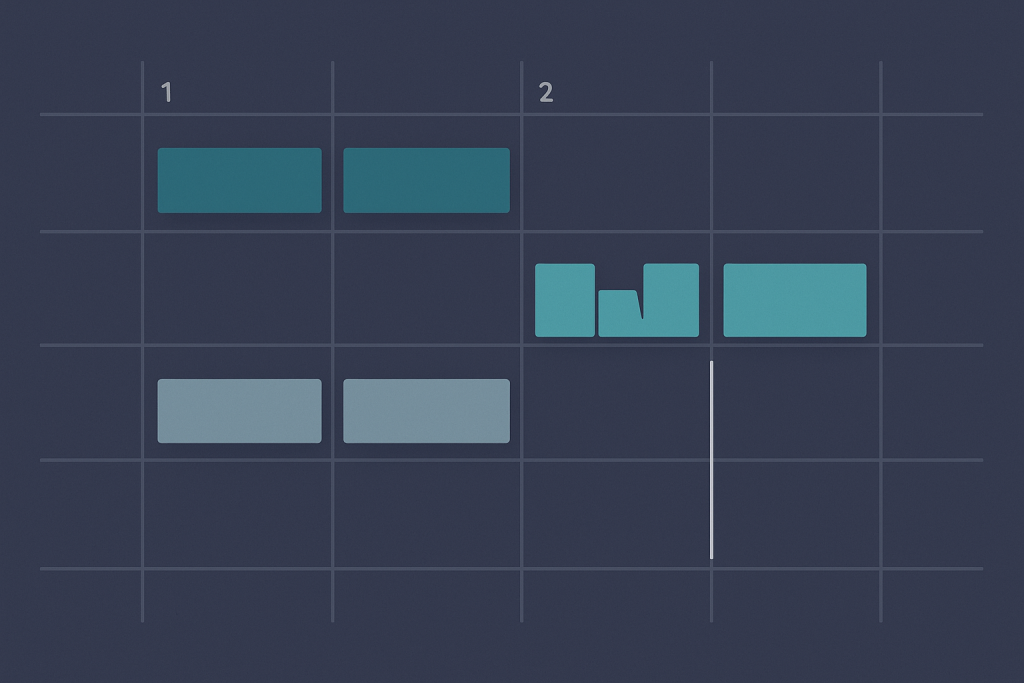
Dance music is phrase-based. If you cut music promotion reels across random beats, the groove feels clipped even when the mix is clean. Use 4-bar or 8-bar chunks unless the jump cut is meant to create a shock.
Edit Like a DJ Would Mix
Drop the audio into Ableton Live, Logic Pro or Premiere, set the tempo, then make cuts on bar lines. If the track is 126 BPM, a 4-bar phrase is just under eight seconds. That gives you enough time for a hook, a change and a clean exit.
Do small audio work too. Pull the reel master down to leave about -1 dB true peak, use light limiting, and check it on phone speakers. If the bass vanishes, add harmonics around 150 to 250 Hz rather than just turning up the sub.
- Cut on bar 1 where possible.
- Use 4-bar chunks for tight clips.
- Use 8-bar chunks for tension clips.
- Check the edit on a phone.
Show Proof, Not Poses
People trust evidence faster than aesthetic shots.
A studio pose says you own speakers. A useful clip shows the track working. The best music promotion reels for DJs and producers often look simple: a deck, a crowd from behind, a DAW screen with no readable private info, or hands muting stems on Ableton Push 3.
Use Real Context
Proof can be a room reaction, a DJ transition, a before-and-after mix fix, or a bassline being rebuilt from a dry MIDI part. If you sell your identity as a producer, process clips matter. If you sell your identity as a performer, crowd and booth clips matter more.
Do not fake the big-room moment. A clean rehearsal clip on monitors can beat a staged crowd shot if the sound and idea are clear.
- Film hands, decks and meters.
- Capture crowd silhouettes from behind.
- Show the track inside a mix.
- Use before-and-after audio when possible.

Use Captions Like Arrangement Markers
Captions should guide the ear, not decorate the frame.
Weak captions describe the obvious. Strong captions tell the listener what to notice. That matters because many people see music promotion reels before they hear them properly, or they hear them through cheap phone speakers on a train.
Point at the Moment
Write captions like arrangement notes: “Bass opens here,” “Vocal chop answers the lead,” “Sidechain ducking is doing the bounce,” or “Kick loses 220 Hz to clear the low-mid.” These lines make a technical clip easier to follow without turning it into a classroom.
Keep captions short. Seven words is usually enough. If the sentence needs a comma, it is probably too long for a fast reel.
- Use captions as listening cues.
- Keep each line under seven words.
- Avoid generic hype language.
- Place text away from app buttons.

Batch Three Formats From One Session
Posting more gets easier when one session creates multiple angles.
Do not film from scratch every day. That burns people out. One track session can create three or four music promotion reels if you plan the shots before opening the camera.
Build a Repeatable Clip Pack
Film one performance angle, one DAW angle and one explanation angle. For example, record hands launching stems on Ableton Push 3, then capture the Pro-Q 4 curve where you cut 220 Hz from the bass bus, then film a 10-second clip explaining why the kick needed more space.
This gives you different posts without pretending you made ten different pieces of content. Same track. Different proof.
- One performance reel.
- One production-detail reel.
- One before-and-after reel.
- One crowd or DJ-test reel.
Match Reel Audio to the Track You Actually Sell
Do not promote a version that listeners cannot find or license.
This mistake hits producers using edits, remixes, ghost-produced demos or custom production references. If music promotion reels use a different master, different vocal take or fake extended intro, the listener arrives confused when they hear the real track.
Keep the Promo Version Honest
Make a dedicated reel edit from the real master. If the public version is 2:48, do not advertise a fake 6-minute club tool unless that extended mix exists. If the best moment depends on an uncleared vocal, do not build the whole campaign around it.
For DJs, include the transition point. Show the track coming out of a known groove, then let the new record land. That tells selectors where it fits.
- Use the real master.
- Avoid uncleared vocal hooks.
- Show the DJ-friendly entry point.
- Keep reel edits consistent with release versions.

Track Saves, Shares and DMs, Not Vanity Numbers
Views are useful only when they lead to intent.
A reel with 40,000 passive views can be less valuable than a reel with 800 views, 60 saves and five real DMs from DJs. music promotion reels should be judged by listener behaviour, not just reach.
Measure the Right Signals
Track saves, shares, profile taps, link clicks and serious comments. A comment like “ID?” matters more than ten fire emojis. If custom music production is part of your business, DMs asking about stems, exclusivity or reference tracks are strong signals.
Keep a simple weekly note. Reel topic, hook line, length, save rate, share rate, DMs. After ten posts, patterns appear. Double down on the clips that create action.
- Save rate shows future interest.
- Shares show social proof.
- DMs show buying or booking intent.
- Profile taps show curiosity.
| Format | Best Use | Typical Length | What to Measure |
|---|---|---|---|
| Drop-first clip | Testing the strongest hook or bass switch | 7-12 seconds | Replays and saves |
| Before-and-after mix clip | Showing production skill or custom work | 10-18 seconds | Shares and comments |
| DJ transition test | Proving the track fits a set | 12-25 seconds | DMs from DJs |
| DAW breakdown | Explaining a sound design choice | 15-30 seconds | Watch time and follows |
Further reading
- Instagram Reels help — Official Instagram support documentation for Reels features and platform behaviour.
- Ableton Live — Official Ableton product resource for DAW-based editing, arranging and audio workflow.
Frequently asked questions
How often should I post music promotion reels?
Post three to five times per week if you can keep the clips specific. Daily posting with weak ideas usually trains people to ignore you. Batch from one session, rotate drop clips, DJ tests and production breakdowns, then judge the save and DM rate after two weeks.
What length works best for Reels promoting music?
For hook testing, 7 to 12 seconds is usually enough. For a DJ transition or before-and-after production clip, 15 to 25 seconds can work. If the reel needs 45 seconds to make sense, the idea is probably too slow for short-form promotion.
Should DJs use original audio or trending sounds?
Use your own audio when the goal is track discovery, licensing, bookings or fan growth around your sound. Trending sounds can help personality content, but they do not prove your record works. If you want people asking for the ID, the reel needs your track front and centre.
Do I need professional video gear for music Reels?
No. A recent phone, stable framing and clean audio beat an expensive camera with a messy idea. Use a small tripod, wipe the lens, avoid backlit faces and record the track directly where possible. Good framing around decks, hands or the DAW is enough.
What should producers show if they do not play live yet?
Show the record being built. Film automation moves, stem mutes, drum layering, bass sound design, vocal processing or a before-and-after master check. A producer without gigs can still prove taste, workflow and sound quality through tight studio clips.
Can Reels help sell custom music production services?
Yes, if the clips show clear problems being solved. Post examples like a weak drop becoming club-ready, a reference brief turning into a finished idea, or a vocal sitting better after EQ and compression. Avoid vague studio lifestyle posts if the aim is serious enquiries.
Conclusion
music promotion reels work when they make the track obvious fast. Lead with the hook. Cut on phrases. Show proof. Keep captions useful. Match the reel audio to the version people can actually hear, license or request.
The real fix is not posting harder. It is editing with intent. Build a simple batch from your next session: one drop-first clip, one production-detail clip and one DJ-test clip. Post them across a week, track saves and DMs, then keep the format that creates real listener action.
Music promotion reels — Quick Recap
The fastest way to lock in music promotion reels is to internalise the workflow above and repeat it on every project. Start small: pick one technique from this music promotion reels guide, apply it to your next session, and audit the result against a reference track.
- Start with the strongest musical moment, not branding or slow setup.
- Cut short-form edits on 4-bar or 8-bar phrases so the groove feels natural.
- Use captions as listening cues, not decoration.
- Batch performance, DAW and before-and-after clips from one session.
Treat music promotion reels as a habit, not a one-off — the producers who consistently nail music promotion reels are the ones who run the same checks on every track. That’s the difference between a clean, club-ready master and a track that sounds great at home but falls apart on a real system.
In a real studio session, music promotion reels comes down to the order in which you make decisions: reference first, gain stage second, then the creative work. Producers who treat music promotion reels as a checklist instead of a vibe end up shipping more tracks.
Most producers and DJs undervalue music promotion reels because the wins are invisible until the track plays back on a real system. Bake music promotion reels into your template and the next ten projects benefit automatically.
When you struggle with music promotion reels, the fix is rarely a new plugin. Loop a problem section, A/B against a reference, and isolate which element is breaking your music promotion reels.
My Career makes videos from your own track and posts them for you, pitches your release to 34,000+ labels, playlists, radio stations, YouTube channels and blogs, puts it in every store and briefs you every morning. Free plan, no card, two minutes to set up.