Key takeaways
- Start with 100 real listeners, not vague hopes for more streams.
- One clear listener sentence makes every campaign decision easier.
- Turn one strong drop into several useful clips instead of posting the same asset repeatedly.
- Small, targeted DJ promo sends beat huge blind email blasts.
- Paid ads work best after an organic clip has already shown traction.
- Ghost-produced or custom tracks still need an honest artist-led story.
Music marketing starts before you post the cover art, not after the track is already gasping for attention on day three. Pull up your latest finished record. We are going to build a campaign around that one track, the same way we would build a mix session: clean inputs, clear routing, no random moves.
Do not start with “I need more plays.” Start with 100 real listeners. Real means a DJ who might test it, a fan who saves it, a curator who knows your lane, or an artist manager who can hear where you fit. Treat music marketing like arrangement work. Four-bar phrases. Clear hooks. No wasted space. If the track is ghost-produced, custom-made, or fully self-produced, the job is the same: make people understand it fast, then give them a reason to care.
Build your music marketing map before you post
Open a blank note. Not Canva. Not Instagram. A note. A good music marketing map starts with one sentence: who this track is for, where they already listen, and what they should do next.
Your music marketing falls apart when every platform gets the same lazy caption. A melodic house DJ on SoundCloud needs different context than a short-form video viewer who hears three seconds while waiting for coffee. Same track. Different entrance.
Write the music marketing sentence
Use this format: “This track is for [listener], who already likes [reference], and should [action].” Keep it ugly at first. Example: “This track is for late-night tech house DJs who play Cloonee and Chris Lake, and should download the promo for weekend sets.”
That sentence tells you the clip, the email, the artwork, the BPM tag, and the first three people to send it to. music marketing is not shouting louder. It is removing confusion.
Pick one primary lane
Do not call the same record “Afro house, melodic techno, deep house, tech house, and club ready.” Pick the strongest lane. If your kick sits at 124 BPM, the bass is dry and percussive, and the vocal chop repeats every 4 bars, call it tech house. Own it.
References help, but do not clone the reference language. “For fans of John Summit and Mau P” is useful internally. Publicly, say what the record feels like in one clean line.
- Target one listener group before choosing platforms.
- Name two reference artists, then write your own angle.
- Choose one main action: save, download, reply, pre-save, or DM.
- Cut any genre label that makes the track harder to understand.
Package the track so people get it in ten seconds
music marketing gets easier when the package does half the explaining. That means title, cover, first clip, short description, and promo version all point in the same direction.
Think like a DJ checking promos before a Friday set. They are not reading your life story. They want BPM, energy, clean intro, strong drop, and a reason this record belongs in the crate.
Make a 15-second proof clip
Drag the track into Ableton Live, Logic Pro, or FL Studio. Find the strongest 15 seconds. Usually that is the first drop after the vocal hook, not the breakdown. Put a locator there. Export vertical video with the exact section, no soft intro.
If the drop needs 32 bars of setup to make sense, the drop is probably not the clip. Use the hook. If you have to explain it, it is not the hook.
Check the cover at phone size
Zoom your artwork down to thumbnail size. If the artist name turns into soup, simplify it. The cover should read from two meters away on a cracked phone screen. Harsh test. Useful test.
Keep one strong visual cue: a color, a symbol, a face crop if that fits your artist brand, or a clean abstract shape. Do not stack five ideas because the track “has many emotions.”
- Export a clean WAV, a 320 kbps MP3, and a radio-safe edit if needed.
- Label files with artist, title, BPM, key, and version.
- Prepare a 15-second vertical clip and a 30-second horizontal clip.
- Write a two-line track description with genre, mood, and strongest use case.
Walkthrough: turn one drop into seven posts
Now we build the content pack. This is the part most producers skip, then complain that the algorithm hates them. The algorithm did not hear the full master. People heard one weak clip.
Use one drop. Seven angles. Same record, different proof.
The 30-minute content pass
Step 1: Open your DAW and bounce the strongest 16 bars of the drop. Leave -1 dB true peak on the clip export so social compression does not chew the transient.
Step 2: Make a performance clip. Hands on a Pioneer DDJ-FLX10, Ableton Push 3, Maschine Mikro, or even your laptop keys. No face needed. Let the viewer see the movement.
Step 3: Make a breakdown clip. Mute the kick, bass, vocal, and synth one by one. Bring them back every 2 bars. Producers love this because it shows decisions, not posing.
Cut the seven post versions
Export seven versions from the same 16 bars. Keep names boring: drop-performance, drop-breakdown, bass-solo, vocal-hook, before-after-mix, DJ-test, artwork-loop. Boring file names save you when you are tired.
Post them across two weeks, not all in one panic burst. music marketing rewards repetition with a reason. If every post shows a different part of the record, repetition feels like context, not spam.
- Post 1: the main drop with no intro.
- Post 2: the vocal hook over the instrumental.
- Post 3: bass solo into full drop.
- Post 4: DAW arrangement view with sections muted.
- Post 5: DJ test clip on headphones or controller.
- Post 6: before-and-after mix comparison.
- Post 7: release-day clip with the clearest call to save.
Send better promos to DJs, curators, and labels
A promo is not a mass email with “hope you’re well” and a private link. Good music marketing respects the other person’s time. Send the right version, with the right context, to the right person.
Start small. Ten proper sends beat 200 blind emails. I will take a real reply from a warm-up DJ over fake playlist placement every time.
Build the tight promo pack
Your promo pack should include a private streaming link, a download link, BPM, key, clean and extended versions, artwork, and two sentences about where the track fits. That is enough.
Use Dropbox, Google Drive, DISCO, or Proton Drive. Test the link in an incognito browser. If the DJ needs permission to open it, you already lost the play.
Write the short email
Subject line: “124 BPM tech house promo for late sets.” Body: three lines. Who you are, why you sent it, what the track does. No autobiography. No begging.
Example: “Hey Maya, I caught your recent basement set and heard the darker percussion lane. Sending a 124 BPM tech house record with a 32-bar intro and dry vocal hook. Private link below if it fits your weekend folder.”
- Mention one real reason you chose that person.
- Put BPM and genre in the first two lines.
- Use a private stream before the download link.
- Follow up once after five to seven days.
- Stop sending if they do not engage after two attempts.

Use paid ads without burning the track budget
Paid ads can help music marketing, but boosting a random post is usually a donation to the platform. Spend like a producer setting gain staging. Small moves. Watch the meters.
Start with $5 to $10 per day for seven days. Send traffic to one action: Spotify save, YouTube view, email signup, or download gate. One campaign, one job.
Do not sell the whole song cold
Cold listeners do not owe you three minutes. Use the hook clip first. Test three creatives: drop clip, studio breakdown, and DJ reaction style clip. Kill the weakest one after 48 hours.
Check cost per landing page view, not just likes. Likes are soft. Saves, follows, email signups, and repeat viewers matter more. music marketing needs evidence, not applause.
Retarget the people who stayed
If you use Meta Ads Manager, create a warm audience from people who watched 50 percent or more of the clip. Then retarget them with the release-day save link or full video.
Do not start with 12 countries. Pick two or three markets where your genre actually moves. For tech house, that might be UK, Netherlands, and Germany. For Latin tech, test Mexico, Spain, and Colombia.
- Budget test: $35 to $70 for the first week.
- Creative test: three clips, same hook, different angle.
- Audience test: one broad genre audience and one reference-artist audience.
- Success marker: saves, follows, replies, downloads, or email captures.

Read the numbers that point to real fans
Do not stare at total streams like it is a VU meter. Total plays tell you volume. They do not tell you whether the campaign worked.
Open Spotify for Artists, YouTube Studio, SoundCloud stats, Chartmetric, or your distributor dashboard. We are looking for behavior.
Measure saves before streams
A save rate around 6 to 10 percent is usually healthier than a pile of passive streams from a weak playlist. If 1,000 listeners produce 12 saves, something is off. Wrong audience, wrong track position, or wrong promise.
Check source of streams. Algorithmic plays, profile visits, and listener playlists are stronger signals than random third-party playlists with no follow-through.
Tag your links
Use Feature.fm, Linkfire, ToneDen, or simple UTM links if you run your own site. Label traffic by platform and campaign: instagram_dropclip, dj_email_round1, youtube_short_hook.
Good tags turn music marketing from vibes into decisions. If TikTok gives views but no saves, and email gives fewer clicks but more replies, you know where to work next week.
- Save rate: did listeners want the track later?
- Follower conversion: did the artist brand stick?
- Playlist adds: are real people collecting it?
- Profile visits: did curiosity move beyond the clip?
- Replies and DMs: did anyone care enough to talk?
Market ghost-produced and custom tracks correctly
If your record came from a ghost producer or custom music production session, the campaign still needs your fingerprints. The audience does not care who sidechained the bass. They care whether the artist identity feels believable.
That is where music marketing gets sensitive. You need to own the story without inventing fake studio mythology.
Connect the track to your artist identity
If The Ghost Production or another producer helped build the track, focus your public angle on curation, taste, performance, and direction. Say less about “I spent 80 hours mixing this snare” if you did not. Say more about why this sound fits your sets, your vocals, your visual identity, or your release series.
Be precise. “A peak-time Afro house tool for my sunset club sets” is stronger than “new banger out now.” That line gives DJs a job for the track.
Check rights and metadata before release
Confirm ownership, distribution rights, publishing splits, vocal sample clearance, and whether you can pitch the track to labels. Do this before upload day. Boring? Yes. Necessary? Also yes.
Custom music production can give you a sharper starting point, but music marketing still decides whether the record reaches the right ears. A finished master is not a campaign.
- Keep the public story honest and artist-led.
- Make sure your artist name, ISRC, and credits are correct.
- Ask for stems or clean edits if your DJ promo needs them.
- Build content around performance, direction, and taste.
Run a 30-day release schedule you can repeat
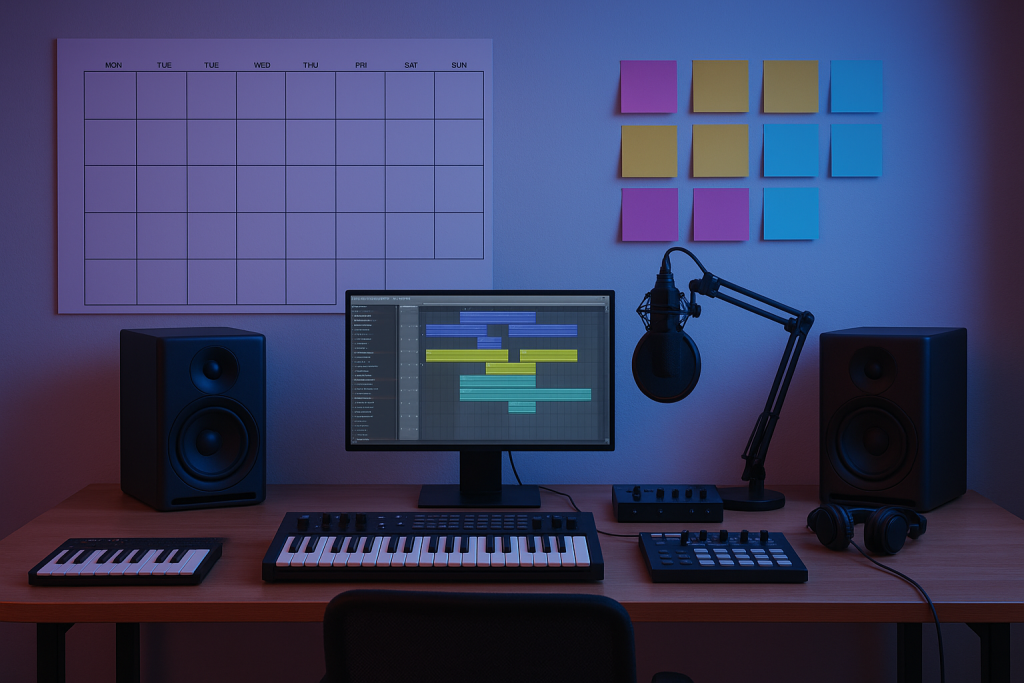
Here is the working calendar. Use it once, then tighten it. music marketing improves when you repeat a system instead of rebuilding from panic every release.
Print this if you have to. Put it next to your MIDI keyboard. A release without a calendar becomes “I posted twice and nothing happened.”
Days 1 to 14: prepare and warm the room
Day 1: write the one-sentence map. Day 2: export clips. Day 3: finish artwork. Day 4: upload to your distributor. Day 5: pitch through Spotify for Artists if timing allows. Day 6 to 10: send DJ promos. Day 11 to 14: post hook clips and collect early replies.
Do not announce the release every day. Show the track from different angles. Studio clip. DJ test. Bass solo. Cover reveal. Short story behind the sound.
Days 15 to 30: release, retarget, and learn
Release day: post the clearest clip first. Ask for one action. “Save this for your weekend playlist” beats “link in bio” because it tells people what to do.
After release, send the full link to anyone who replied before. Retarget warm viewers if you run ads. On day 30, write the report: best clip, best platform, best audience, biggest waste. That report is your next music marketing lesson.
- Week 1: message, assets, distributor upload.
- Week 2: promo sends and teaser clips.
- Week 3: release week and warm-audience push.
- Week 4: follow-ups, stats review, and next-track notes.
| Channel | Best Use | Watch This Metric | My Take |
|---|---|---|---|
| DJ promo email | Getting club feedback and possible set support | Replies, downloads, set videos | Highest value if the list is small and targeted |
| Instagram Reels | Testing hooks and visual angles fast | Saves, shares, profile visits | Good for proof, weak for full-song listening |
| YouTube Shorts | Showing production process and repeatable clips | Retention, subscribers, comments | Better than most producers think, if the first second hits |
| Spotify pitch | Reaching editorial and algorithmic surfaces | Saves, source of streams, playlist adds | Worth doing, but never your only plan |
| Paid social ads | Scaling the best organic clip | Landing page views, saves, follows | Do not spend until one clip has already shown life |
Further reading
- Spotify pitching advice — Official Spotify for Artists guidance on playlist submission and release pitching.
- Meta Ads Manager help — Official Meta Business documentation for setting up and measuring paid social campaigns.
Frequently asked questions
What is the best music marketing strategy for a new producer?
Pick one finished track, define one listener group, and build a 30-day release plan around that record. Use short hook clips, targeted DJ or curator outreach, Spotify for Artists pitching, and simple tracking links. Do not chase every platform at once. Win one lane first.
How do I promote my first track with no followers?
Start with people, not platforms. Send the track to 20 relevant DJs, producers, small curators, and friends who actually like the genre. Post three different hook clips and watch which one gets saves or replies. Use that strongest angle for your next round.
Should I pay for playlist promotion?
Be careful. Most playlist packages sell inflated streams with weak saves and no real fan movement. If a service guarantees numbers, walk away. Spend that money on better artwork, a targeted ad test, or a clean content shoot. Real listeners leave signals beyond play count.
How often should I post before a release?
Post three to five useful pieces before release day. Show the hook, the drop, a breakdown, a DJ test, or the story behind the sound. Daily posting only works if each post has a different angle. Repeating the same cover graphic gets old fast.
Can I market a ghost-produced track as my own release?
Yes, if your rights agreement allows it and the metadata is correct. Build the campaign around your artist identity, taste, performances, and direction. Do not fake technical studio stories. The clean move is to own the release angle and make the track fit your brand.
How much should I spend on ads for a single release?
Start with $35 to $70 over one week. Test three short clips and kill the weakest creative after 48 hours. Spend more only if the campaign produces saves, follows, email signups, or useful retargeting data. Likes alone are not enough.
Conclusion
music marketing is not a magic layer you slap on after mastering. It is a release workflow. Define the listener. Package the track so it makes sense in ten seconds. Cut the strongest drop into useful clips. Send promos like a human. Spend small, measure hard, then write down what happened.
If you only do one thing from this workshop, do the 30-day schedule with your next finished record. Open the calendar. Pick the release date. Build seven clips from one drop. Send ten proper promos. After 30 days, read the numbers and adjust the next campaign. That is how you stop guessing and start building listeners one release at a time.
Music marketing — Quick Recap
The fastest way to lock in music marketing is to internalise the workflow above and repeat it on every project. Start small: pick one technique from this music marketing guide, apply it to your next session, and audit the result against a reference track.
- Start with 100 real listeners, not vague hopes for more streams.
- One clear listener sentence makes every campaign decision easier.
- Turn one strong drop into several useful clips instead of posting the same asset repeatedly.
- Small, targeted DJ promo sends beat huge blind email blasts.
Treat music marketing as a habit, not a one-off — the producers who consistently nail music marketing are the ones who run the same checks on every track. That’s the difference between a clean, club-ready master and a track that sounds great at home but falls apart on a real system.
In a real studio session, music marketing comes down to the order in which you make decisions: reference first, gain stage second, then the creative work. Producers who treat music marketing as a checklist instead of a vibe end up shipping more tracks.
Most producers and DJs undervalue music marketing because the wins are invisible until the track plays back on a real system. Bake music marketing into your template and the next ten projects benefit automatically.
When you struggle with music marketing, the fix is rarely a new plugin. Loop a problem section, A/B against a reference, and isolate which element is breaking your music marketing.
Treat music marketing as a craft, not a chore. The producers releasing on the biggest labels lock music marketing in early so they can spend their energy on melody and arrangement instead of fighting the mix.
Document your music marketing process — even a short note in the project file. Future-you will rebuild the same music marketing win in half the time.
My Career makes videos from your own track and posts them for you, pitches your release to 34,000+ labels, playlists, radio stations, YouTube channels and blogs, puts it in every store and briefs you every morning. Free plan, no card, two minutes to set up.