Key takeaways
- Strong arrangements start with markers and contrast, not more plugins.
- A DJ-friendly intro usually needs 16 to 32 clean bars.
- Drops hit harder when the build leaves space before impact.
- Vocals work better when phrases answer the groove instead of covering it.
- Reference tracks are best used as timing rulers, not creative crutches.
- A focused 30-minute pass can turn a loop into a usable track structure.
Music arrangement tips only matter when your eight-bar loop is starting to feel like a prison sentence. The best music arrangement tips are not abstract theory, they are decisions you can make in half an hour: where the drums enter, where the bass shuts up, where the vocal earns space, and where the DJ can actually mix the record.
If your track sounds strong for 20 seconds but collapses across three minutes, the problem probably is not your kick sample. It is structure. A club record needs signposts. A streaming track still needs motion. A custom production brief needs a clear arc before anyone starts polishing the mix with FabFilter Pro-Q 4 or Soothe2. Set a timer for 30 minutes. Duplicate your project, mute the fancy automation, and fix the skeleton first.
What music arrangement tips fix a loop that never becomes a track?
The fastest fix is brutal: stop adding sounds and start removing them on purpose. Most stuck loops are already crowded. They need an intro, a first impact, a low-energy section, a second impact, and an exit. That is arrangement, not decoration.
I like to drop locator markers every 8 or 16 bars before touching any plugin. In Ableton Live, make a blank arrangement map first. In FL Studio, use time markers. On Logic, color regions by function. These music arrangement tips work because they force you to see the track like a DJ would.
Music arrangement tips for the first 16 bars
Your first 16 bars should tell the listener what room they are in without giving away the whole record. For house or techno, start with kick, hat, a filtered percussion loop, and maybe one tonal hook. Keep the bassline out until bar 17 unless the genre demands it.
For pop-leaning electronic tracks, the first 10 seconds matter more. Bring in a vocal chop, hook synth, or signature texture early, then strip it back before the first proper section. Contrast beats constant fullness.
Stop treating every section like the drop
A loop becomes a track when sections have different jobs. The intro is for mixing and identity. The build creates pressure. The drop pays it off. The breakdown resets the ear. If every section has full drums, bass, pads, FX, and vocals, nothing feels big.
Try this: duplicate your main loop across four minutes, then mute 40 percent of the parts in every section except the main drop. It feels wrong for five minutes. Then the track starts breathing.
- Place markers before adding new sounds.
- Use 8-bar and 16-bar blocks for dance music clarity.
- Mute parts first, automate later.
- Keep one signature sound active in low-energy sections.
- Make the second drop different, not just louder.

How long should my intro be for DJs on CDJ-3000s?
For most club tracks, give DJs at least 16 clean bars, and 32 bars is safer if the groove is busy. A Pioneer CDJ-3000 can make beatmatching easy, but DJs still need time to blend, EQ, and decide whether your record is usable in a set.
One of the most useful music arrangement tips for aspiring producers is this: your intro is not wasted space. It is the handshake between your track and the previous track.
What belongs in a DJ-friendly intro?
Keep the first 16 bars rhythm-first. Kick, closed hat, shaker, clap tease, filtered stab, or a quiet vocal texture can work. Avoid full bass movement too early unless the bass is the hook and the low end is controlled.
A clean intro lets the DJ cut lows on your track and blend mids and highs over the outgoing record. If your full sub hits on bar 1, you are asking for mud on a big PA.
When should the bass enter?
Bar 17 or bar 33 is the safe answer for house, tech house, melodic techno, and many Afro house records. Drum and bass can move quicker, but it still needs a clean runway. If the bass enters at bar 9, make sure the first eight bars are incredibly clear.
On a controller like the Pioneer DDJ-FLX10, test your intro with two tracks loaded. If you cannot mix your own intro over a reference without panic EQ moves, the arrangement is not DJ-ready yet.
- Use 16 bars minimum for club intros.
- Keep sub bass out of the first blend section.
- Bring one hook element early, but not the whole drop.
- Test the intro against a released reference track.
- Leave room for EQ mixing, not just beatmatching.

Why does my drop feel smaller than the build?
Because the build probably has too much. This is the classic bedroom producer trap. The riser stacks, snare rolls, white noise, pitch automation, extra claps, vocal fills, and toms all hit before the drop, then the drop arrives with fewer new events than the build promised.
Good music arrangement tips usually sound boring until you try them: pull energy out before the drop, then return it with one clear new element.
Use silence before impact
A quarter-bar gap can hit harder than another riser. Mute the kick for the final two beats before the drop. Cut the reverb tail with automation. Stop the bass for one beat. These moves reset the ear so the downbeat feels heavier.
Do not fill every gap with noise. Space is not empty. It is tension.
Make the drop earn one new sound
The first drop should introduce one thing the listener was waiting for: full bass, main lead, complete drum groove, or vocal answer. Not six things. Six new things can blur into one expensive mess.
Try sidechain ducking the bass 2 to 4 dB from the kick, then automate the lead up 1.5 dB only on the first drop phrase. These music arrangement tips are small, but they change the perceived impact without wrecking headroom.
- Mute the kick for the last two beats before the drop.
- Remove low end during the final build phrase.
- Introduce one major new element on the downbeat.
- Keep risers quieter than the drop, not equal.
- Check the drop at low monitor volume.
How do I arrange vocals without burying the groove?
Vocals can make a track feel finished, but they can also flatten the groove if they never leave. If the vocal runs across every transition, every fill, and every drop, the drums lose their authority.
The better move is call and response. Let the vocal ask. Let the synth, bass, or drum fill answer. That is one of the music arrangement tips I use constantly on custom music production briefs, especially when the artist sends a strong topline but the track needs club weight.
Give the vocal lanes
Think of the vocal as traffic. The lead vocal gets the center lane. Ad-libs get side lanes. Chops can sit wider with a short slap delay. If everything is centered and constant, the vocal blocks the snare, bass, and hook.
Use automation before compression. Pull the vocal down 1 dB in dense drop sections and push it up 1 dB in breakdowns. That is cleaner than smashing it with another compressor.
Cut words before you cut frequencies
If a phrase fights the groove, remove a word. Producers reach for EQ too quickly. A vocal phrase that lands over the snare can feel late, crowded, or cheesy even after perfect EQ.
When EQ is needed, try a narrow cut around 250 Hz if the vocal feels boxy, then a dynamic dip around 2.5 to 4 kHz on synths using Pro-Q 4 when the vocal plays. Arrangement first, mixing second.
- Mute vocals during key drum fills.
- Use short vocal answers instead of constant phrases.
- Automate volume before adding more compression.
- Keep lead vocals centered and doubles controlled.
- Let the breakdown carry more lyric detail than the drop.
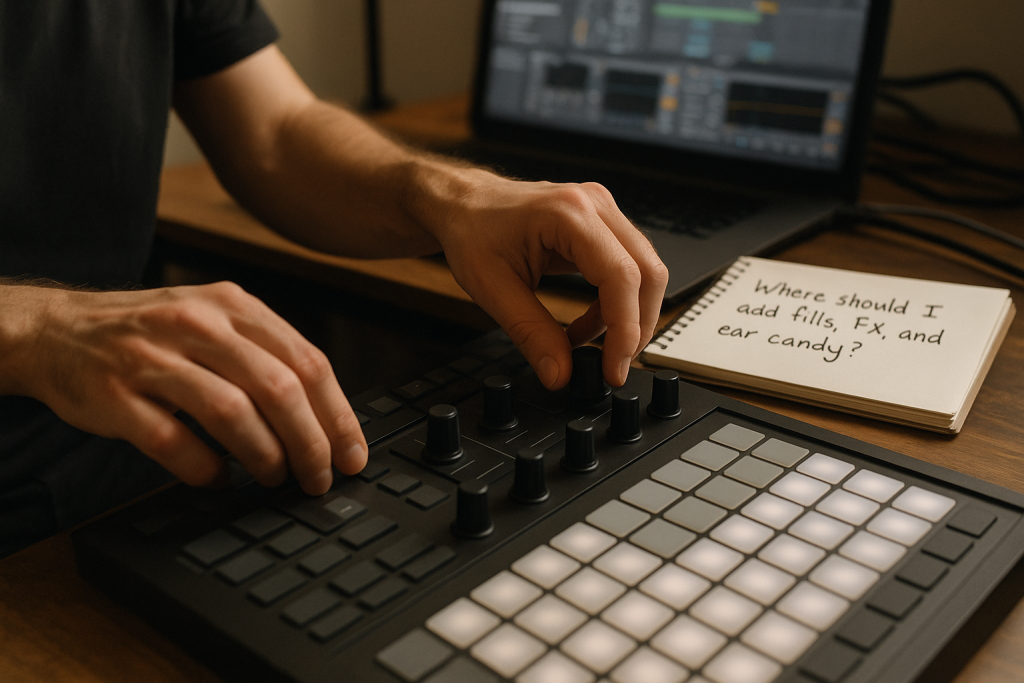
Where should I add fills, FX, and ear candy?
Fills are punctuation. If every two bars has a reverse crash, impact, laser, sweep, snare drag, and vocal chop, the track starts sounding nervous. Strong arrangement uses fewer signs, placed better.
One of the least glamorous music arrangement tips is to mark phrase endings first. Most dance records speak in 4-bar, 8-bar, and 16-bar phrases. Put your ear candy at the end of those phrases, not randomly where the screen looks empty.
Use a fill hierarchy
Not every transition deserves the same size fill. A 4-bar shift might need only an open hat. An 8-bar shift can take a drum fill. A 16-bar section change can use a bigger FX move, vocal throw, or reversed cymbal.
Keep your biggest impact for the moment before the main drop or the second drop. If the intro has your largest crash, you spent the budget too early.
Print FX and edit them like audio
Print reverb throws, delay tails, and risers to audio. Then cut the tails cleanly. Fade the front edge. Reverse small slices. You will make better decisions when the FX are visible and editable, not hidden inside five plugins.
In Ableton, resample to a new audio track. On FL Studio, consolidate the playlist section. This keeps arrangement choices fast and stops the session from turning into plugin archaeology.
- Small fills for 4-bar moves.
- Medium fills for 8-bar moves.
- Big FX only for major section changes.
- Print reverb throws to audio.
- Cut FX tails before the drop if impact feels soft.
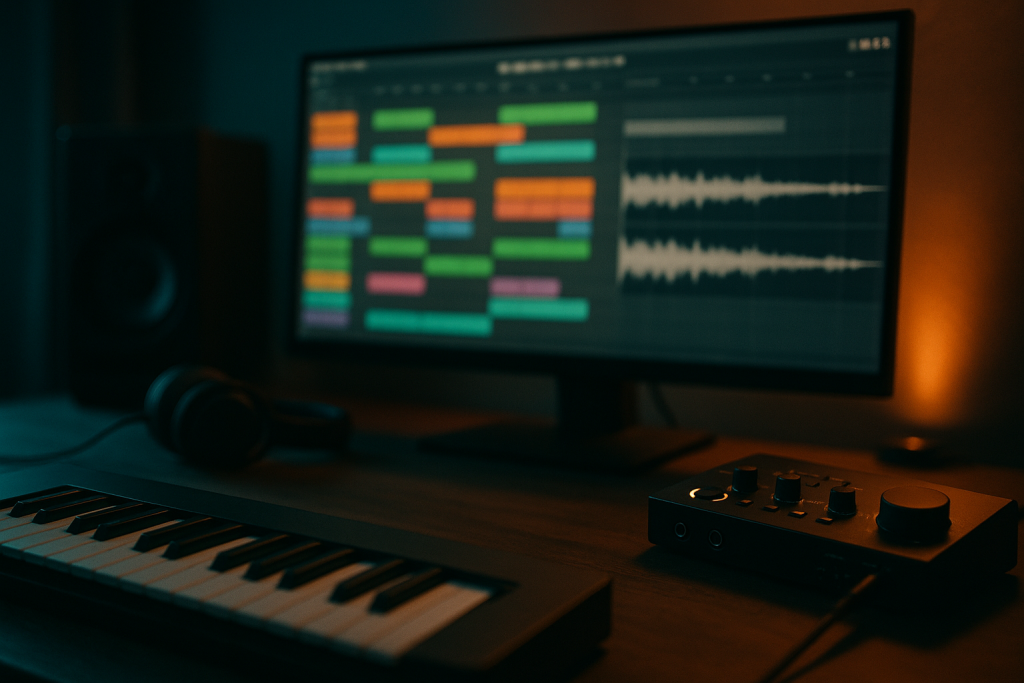
How can reference tracks help my arrangement without copying?
Use references for timing, not identity. Stealing a melody is lazy. Studying where a released track removes the kick, drops the bass, or changes the drum pattern is professional homework.
These music arrangement tips are especially useful if you are preparing a track for ghost production review or pitching a custom instrumental. A vague brief like “make it more clubby” becomes clear when you can say, “the second drop needs a new bass variation at bar 97.”
Build a marker map from one reference
Drag a reference into your DAW and place markers: intro, groove, break, build, drop, breakdown, second drop, outro. Do not match the exact sounds. Match the sense of movement.
If the reference changes every 16 bars and your track sits still for 48 bars, you found the problem. No plugin fixes boredom that long.
Compare energy, not loudness
Turn the reference down until it feels as loud as your rough mix. Then compare arrangement energy. Does your breakdown arrive too early? Does your second drop repeat the first? Does your outro give DJs enough room?
Use a spectrum analyzer if needed, but trust the timeline first. Arrangement problems usually show up visually before they show up on a meter.
- Map section lengths from one reference track.
- Ignore sound design while studying structure.
- Level-match the reference before judging energy.
- Check whether your second drop adds a new idea.
- Use references as rulers, not templates.

What is the fastest 30-minute arrangement pass?
This is the pass I use when a track has a strong loop but no finished shape. It is not pretty. It works. Save a new version, set a timer, and make arrangement decisions before you touch sound design.
If you only use one set of music arrangement tips from this page, use this pass. It turns vague panic into a sequence of visible edits.
Minutes 0 to 10: build the skeleton
Lay out a rough structure with markers. For a club track, try 32-bar intro, 32-bar groove, 16-bar break, 16-bar build, 32-bar drop, 16-bar breakdown, 32-bar second drop, 16 or 32-bar outro. Shorten later if needed.
Duplicate your best loop across the whole structure. Then mute parts to create contrast. Do not add new plugins in this phase.
Minutes 10 to 20: create contrast
Remove bass from breakdowns. Remove kick before drops. Thin the drums in the intro. Add one new drum layer or synth variation to the second drop. If the second drop is identical, the track feels unfinished even when the mix is clean.
Check headroom while arranging. Keep the rough mix peaking around -6 dB so later processing has space. Arrangement and gain staging are not separate jobs.
Minutes 20 to 30: fix transitions
Add fills only at phrase endings. Print one reverb throw. Add one reverse cymbal. Create one short silence before the main drop. Then listen from start to finish without stopping.
Write down the first three moments that feel boring. Fix only those. This keeps the session moving instead of turning into a six-hour hi-hat audition.
- 0-10 minutes: markers and rough structure.
- 10-20 minutes: mutes, contrast, second-drop variation.
- 20-30 minutes: transitions, fills, full playback.
- No new synth patches during the pass.
- Fix the three dullest moments first.
| Problem | Best Fix | Tool or Method | Time Needed |
|---|---|---|---|
| Loop feels boring after 30 seconds | Mute parts across 8-bar sections | DAW markers and clip mutes | 10 minutes |
| Drop feels smaller than build | Remove kick and bass before impact | Automation plus short silence | 5 minutes |
| Intro is hard to DJ mix | Delay bass entry until bar 17 or 33 | CDJ-3000 or DDJ-FLX10 test mix | 10 minutes |
| Vocal buries the groove | Cut phrases and automate level | Volume automation, Pro-Q 4 if needed | 15 minutes |
| Second drop feels copied | Add one new rhythmic or bass variation | MIDI edit or audio chop | 10 minutes |
Further reading
- Ableton Arrangement View — Ableton's official manual explains Arrangement View workflow directly from the software developer.
- Pioneer DJ CDJ-3000 — Pioneer DJ is the manufacturer of the CDJ-3000, a standard player used in many professional DJ booths.
Frequently asked questions
What are the best music arrangement tips for beginners?
Start with markers, not plugins. Build a simple timeline with intro, groove, break, build, drop, breakdown, second drop, and outro. Then mute parts to create contrast. Beginners usually add too much too early, so the fastest improvement is often removing sounds at the right moments.
How many bars should an EDM intro be?
Most DJ-friendly EDM intros work well at 16 to 32 bars. If the groove is minimal, 16 bars can be enough. If the track has percussion, vocals, or a busy hook, 32 bars gives DJs more time to blend cleanly and manage low-end energy.
Why does my song arrangement feel repetitive?
Your sections probably have the same density. Repetition is not always the issue, static energy is. Remove bass from one section, change the drum pattern in another, add a new element to the second drop, and use short gaps before major transitions.
Should I arrange before mixing?
Yes. Arrange first, then mix seriously. Basic level balancing and rough EQ are fine while writing, but detailed mixing before the structure works can waste hours. A weak arrangement will still feel weak after premium EQ, saturation, and compression.
How do I make a second drop more exciting?
Change one main element. Add a bass variation, switch the drum groove, bring in a new vocal chop, or open the lead melody higher. Avoid changing everything at once. The second drop should feel familiar enough to belong and different enough to justify the wait.
Can reference tracks improve arrangement?
Yes, if you use them for structure rather than copying sound design. Map the reference with markers and study when sections change, when bass disappears, and how the second drop differs. Then apply the same pacing logic to your own track.
Conclusion
Music arrangement tips are only useful if they get you back into the session with a clearer move. Build markers first. Give DJs a clean intro. Make the build smaller than the drop. Let vocals breathe. Save the biggest FX for the moments that deserve them. Most half-finished tracks do not need another synth preset, they need a timeline that creates pressure and release.
Open your latest loop, duplicate the project, and run the 30-minute arrangement pass without stopping to mix. When the structure works from start to finish, then reach for Pro-Q 4, Soothe2, compression, saturation, and the rest of the polish.
Music arrangement tips — Quick Recap
The fastest way to lock in music arrangement tips is to internalise the workflow above and repeat it on every project. Start small: pick one technique from this music arrangement tips guide, apply it to your next session, and audit the result against a reference track.
- Strong arrangements start with markers and contrast, not more plugins.
- A DJ-friendly intro usually needs 16 to 32 clean bars.
- Drops hit harder when the build leaves space before impact.
- Vocals work better when phrases answer the groove instead of covering it.
Treat music arrangement tips as a habit, not a one-off — the producers who consistently nail music arrangement tips are the ones who run the same checks on every track. That’s the difference between a clean, club-ready master and a track that sounds great at home but falls apart on a real system.
In a real studio session, music arrangement tips comes down to the order in which you make decisions: reference first, gain stage second, then the creative work. Producers who treat music arrangement tips as a checklist instead of a vibe end up shipping more tracks.
Most producers and DJs undervalue music arrangement tips because the wins are invisible until the track plays back on a real system. Bake music arrangement tips into your template and the next ten projects benefit automatically.
When you struggle with music arrangement tips, the fix is rarely a new plugin. Loop a problem section, A/B against a reference, and isolate which element is breaking your music arrangement tips.
Treat music arrangement tips as a craft, not a chore. The producers releasing on the biggest labels lock music arrangement tips in early so they can spend their energy on melody and arrangement instead of fighting the mix.
Document your music arrangement tips process — even a short note in the project file. Future-you will rebuild the same music arrangement tips win in half the time.
If music arrangement tips sounds great in headphones but bad in the car, you have a translation problem, not a creative one. The music arrangement tips tweaks above are designed to survive every system.
Schedule a recurring music arrangement tips pass on every project: same checklist, same reference tracks. Repeating music arrangement tips drills is what separates a consistent producer from a lucky one.
My Career makes videos from your own track and posts them for you, pitches your release to 34,000+ labels, playlists, radio stations, YouTube channels and blogs, puts it in every store and briefs you every morning. Free plan, no card, two minutes to set up.