Key takeaways
- Make sounds stand out by giving each important part a clear job before adding more processing.
- Arrangement space often solves masking faster than EQ, saturation, or stereo widening.
- Width works best when the center stays strong and the low end remains focused.
- Reference tracks help when they are level-matched and used for specific mix questions.
- Small automation moves can make a vocal or synth feel more produced than another plugin.
- A DJ-style playback test exposes whether the track works outside the studio chair.
Make sounds stand out became the note I wrote on three different sessions last week, which usually means the problem was not one plugin or one synth patch.
The first track was a tech house demo with a dead top loop. The second was a melodic house idea where the lead felt expensive soloed and boring in the drop. The third was a custom music production brief where the artist wanted the vocal to feel closer without turning it up. Same disease. Different symptoms. I kept writing make sounds stand out in the margin, then crossing out the obvious fixes. More saturation. Wider chorus. Brighter EQ. Most of those made the track louder, not clearer. What actually worked was smaller and more annoying: subtracting layers, moving notes, automating dull moments, and checking the record like a DJ instead of a plugin collector.
1. I Tried to Make Sounds Stand Out With Less
I started one session by muting the layer I liked most. Annoying move, but it worked. The bass was a Serum patch with a tight mid growl, and I had stacked it with a quiet reese because it felt thin on headphones. On the monitors, that second layer sat right over the kick tail and made the groove feel slower.
The faster way to make sounds stand out was not another oscillator. It was one sound with a job.
My make sounds stand out check before bounce
I put the important sound in solo for ten seconds, then brought the beat back at low volume. If the part only impressed me in solo, I treated it as decoration. Decoration is fine, but not if it steals the hook’s oxygen.
On that bass, I cut 220 Hz by about 3 dB with FabFilter Pro-Q 4, shortened the amp release by 18 ms, and removed the reese entirely. The groove came forward because the low-mid stopped smearing. That is the boring truth behind plenty of records that make sounds stand out: fewer moving parts, sharper roles.
The layer had to earn rent
I kept three questions on a sticky note beside Ableton Push 3: does this layer add rhythm, tone, or emotion? If it only adds size, I muted it first. Size lies. Arrangement tells the truth.
For artists sending references to a ghost producer, this is useful language. Say which element should carry the identity. Is it the pluck, the vocal chop, the bass tone, or the drum swing? A producer can build around that. A vague request for a bigger sound usually creates clutter.
- Mute the prettiest layer first.
- Keep one bass sound below 120 Hz.
- Check the hook at low monitor volume.
- Make sounds stand out by removing masked doubles.
- Bounce a version with 20 percent fewer parts.

2. The Hook Needed Its Own Pocket
The vocal chop in the second session had the right mood, but it kept disappearing when the open hat and piano arrived. I nearly reached for Soothe2. Then I remembered the chop was playing in the same octave as the piano stab, on the same offbeat, with the same reverb length. No plugin fixes bad traffic.
To make sounds stand out, I had to create a pocket before I polished the sound.
Frequency space came after note space
I moved the piano inversion up one note, shortened its decay, and pushed the chop 12 ms later. That tiny delay made the groove feel human instead of late. After that, a simple high-pass at 150 Hz and a narrow dip around 2.7 kHz on the piano opened the vocal chop without boosting it.
This is where bedroom producers waste days. They EQ first because EQ feels productive. I did too. But if two parts say the same thing at the same time, the mix turns into a committee. The part with the clearest rhythm usually wins.
Sidechain was not only for the kick
I used Trackspacer lightly from the vocal chop into the piano bus, around 18 percent amount. Not enough to hear pumping. Just enough that the piano bowed when the chop spoke. Sidechain ducking is ugly when it becomes the feature by accident, but small dynamic moves make sounds stand out without turning the whole mix into a volume race.
- Move one competing part by an octave.
- Shorten reverb before cutting EQ.
- Try 10 to 20 ms timing offsets.
- Duck the supporting bus, not the lead.
- Leave the hook at the same fader level while fixing space.
3. I Stopped Treating Width Like Size
I played an early bounce on a Pioneer DDJ-FLX10 at a friend’s room before dinner. Wide pad, wide clap, wide vocal throw, wide everything. It felt impressive for eight bars, then the center vanished. The kick and bass had no frame around them.
That was the night I wrote: width is seasoning. It is not dinner. If I want to make sounds stand out, the center has to feel intentional.
Mono told me who was pretending
I collapsed the mix to mono inside Utility in Live 12. The lead lost half its attitude because the chorus plugin was doing the heavy lifting. I swapped the wide chorus for a mono saturation chain, Decapitator into Pro-Q 4, then sent a small amount to a stereo microshift return.
The lead got less wide and more present. Good trade. I have not tested the same chain on Logic 11 yet, but in Live 12 the mono check exposed the fake excitement quickly.
Mid/side EQ gave the edges a border
On the pad bus, I cut the side signal below 180 Hz and dipped 400 Hz on the mid channel. That left the body out of the way and kept the shimmer on the edges. Mid/side EQ can get nerdy fast, but the rule I trust is simple: lows in the middle, identity wherever it reads best.
That move helped make sounds stand out because the lead no longer fought a foggy stereo bed.
- Check the hook in mono.
- Keep sub and kick centered.
- Cut side information below 150 to 200 Hz.
- Use stereo returns instead of widening every insert.
- Make one element wide, then let others stay narrow.
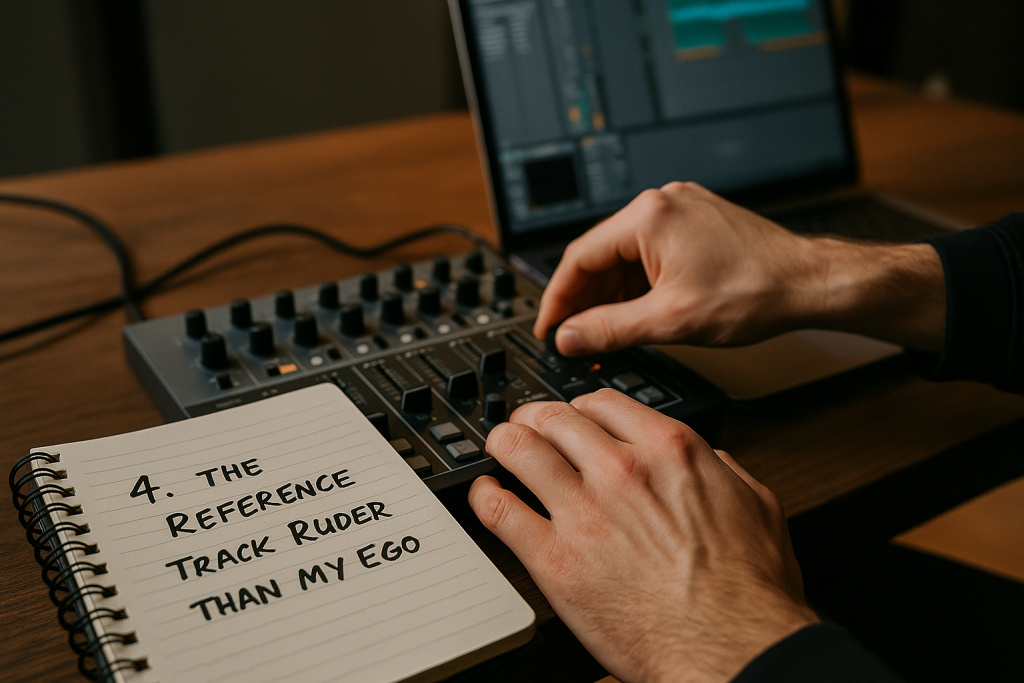
4. The Reference Track Was Ruder Than My Ego
I kept a folder of reference tracks beside the session: one Chris Lake record for drum weight, one Anyma-style melodic track for reverb depth, and one older Dennis Ferrer record for vocal placement. The references were not there to copy. They were there to tell me when I was lying.
Every time I thought I had solved how to make sounds stand out, the reference made one flaw obvious in five seconds.
I matched loudness before judging tone
I used Youlean Loudness Meter and pulled the reference down until it sat near my working mix, not mastered loudness. Comparing a -7 LUFS master against a -14 LUFS session is self-sabotage. The louder file wins, and you start adding top end for no reason.
Once the level was fair, the issue was clear. My clap had too much 700 Hz box and not enough transient. I used SPL Transient Designer, added a little attack, then cut 680 Hz by 2 dB. Small move. Big read.
The spectrum was a clue, not a judge
I opened SPAN and watched the chorus. The reference had a cleaner dip around 250 Hz during the drop. Mine had a shelf of junk from bass layers, toms, and a room reverb I had forgotten about. I killed the room return. The drop breathed.
A spectrum analyzer will not write a hook for you, but it will show where your confidence is hiding mud. If make sounds stand out is the brief, the analyzer is a witness, not the producer.
- Level-match every reference.
- Use one reference for drums, one for space.
- Do not chase a mastered top end too early.
- If make sounds stand out feels impossible, check 200 to 500 Hz.
- Delete forgotten returns before adding new processing.
5. Tiny Automation Beat Another Plugin
The third session had a vocal that felt flat even though the chain looked expensive: Pro-Q 4, 1176-style compression, Soothe2, Pro-DS, a plate, a slap delay. I almost added Fresh Air. Instead, I turned off the screen for a minute and listened to the phrase endings.
The vocal did not need shine. It needed movement. That is often the cheaper way to make sounds stand out.
Volume rides did the emotional work
I rode the vocal up 0.8 dB on the last word of each 4-bar phrase and tucked the breath before the hook by 1.5 dB. Then I automated the plate send only on two words. Suddenly the vocal felt produced, not processed.
For custom music production, this is the difference clients hear even if they cannot name it. A static vocal sounds like a demo. A ridden vocal sounds like someone cared. Automation helps make sounds stand out because it follows the lyric instead of flattening it.
Filter moves made repeats feel written
On a repeated synth stab, I automated a low-pass from 9 kHz down to 5.5 kHz over four bars, then snapped it open before the drop. No riser needed. The ear follows change, even tiny change.
I also automated reverb pre-delay from 18 ms in the verse to 34 ms in the pre-drop. The sound stayed the same, but the room moved back. That gave the drop more front-to-back contrast without adding another track.
- Ride phrase endings by less than 1 dB.
- Automate sends before adding new reverbs.
- Move filters over 4-bar phrases.
- Change pre-delay between sections.
- Print automation and listen without looking.
6. The DJ Test Exposed the Lie
I trust the studio until I put the bounce into Rekordbox. Then the track becomes either a record or a project file wearing shoes. On a CDJ-3000, weak arrangement choices show up fast because you stop admiring the sound and start asking whether it mixes.
The DJ test helped make sounds stand out because it forced context. A huge sound that kills the groove before the next record arrives is not huge. It is inconvenient.
Eight bars told me enough
I mixed the bounce out of a released track and listened to the first 32 beats. The kick was fine. The bass was fine. The top loop was too polite, so the incoming record felt like it lost air. I added a closed hat layer with a short decay, high-passed at 600 Hz, and tucked it 9 dB under the main hat.
That quiet layer changed the perceived energy without changing the hook. Sometimes the support sound is the one that lets the signature sound read.
Headroom kept the master honest
I left about -6 dB peak headroom before the limiter and checked the drop through Ozone only after the mix felt right. If I needed 5 dB of limiting to make the hook exciting, the hook was not ready.
On club-leaning tracks, I would rather have a slightly quieter rough mix with clear movement than a crushed bounce that flatters me for one playback. DJs notice translation, not your plugin count. That is how make sounds stand out becomes practical instead of decorative.
- Test the intro against a released track.
- Listen to the first 32 beats only.
- Keep -6 dB peak headroom while arranging.
- Check the bounce on headphones and monitors.
- Make sounds stand out inside a mix, not in solo.
| Problem | Move I Tried | Tool or Setting | Best Use |
|---|---|---|---|
| Hook masked by chords | Dynamic ducking on the support bus | Trackspacer around 18 percent | Vocal chops, plucks, lead phrases |
| Low-mid smear | Subtractive EQ and shorter release | Pro-Q 4 cut near 220 Hz | Bass layers, toms, synth stacks |
| Fake stereo excitement | Mono check, then stereo send | Ableton Utility plus microshift return | Leads that vanish in mono |
| Flat vocal energy | Manual phrase rides | 0.5 to 1 dB automation moves | Custom vocals and toplines |
| Drop feels polite | Quiet transient support layer | Hat high-passed around 600 Hz | DJ-focused house and club tracks |
Further reading
- Ableton Live manual — Ableton's official manual is an authoritative source for Live 12 mixing, routing, automation, and Utility workflows.
- Sound On Sound mixing — Sound On Sound is a long-running professional audio publication with detailed, editor-reviewed mixing technique articles.
Frequently asked questions
How do I make sounds stand out in a busy mix?
Start by muting layers, not adding processing. Give the main sound its own rhythm, octave, and frequency pocket. Then use small EQ cuts, light sidechain ducking, and automation. If the sound only works in solo, it probably needs arrangement space more than another plugin.
What frequency range makes a sound feel muddy?
Mud often builds between 200 and 500 Hz, but do not cut that range blindly. Check which parts are overlapping there: bass tails, piano body, toms, room reverbs, and pads. A 2 or 3 dB cut on the right supporting part usually beats a huge cut on the lead.
Should I use saturation to make a sound cut through?
Yes, if the sound needs harmonics rather than volume. Saturation can help bass, vocals, drums, and synths read on small speakers. Keep it controlled. If the part gets louder but not clearer, level-match the processed signal and decide again with the full mix playing.
Why does my lead sound big alone but small in the drop?
The drop may be masking it rhythmically or spectrally. Check chords, pads, hats, and effects returns that hit at the same moment. Move one part, shorten a decay, or duck the support bus. A lead needs contrast around it, not just width or brightness.
How much headroom should I leave before mastering?
I usually leave around -6 dB peak headroom on the mix bus while producing. The exact number is less important than avoiding a crushed rough mix. If the limiter is doing all the excitement, fix the drums, hook, and automation before chasing master loudness.
Can reference tracks help without making my track sound copied?
Use references for translation, not melody theft. Pick one for drum weight, one for vocal level, and one for space. Level-match them before judging. You are checking balance, energy, and arrangement behavior, not tracing the creative idea.
Conclusion
The pattern across those sessions was simple: the standout sound was rarely the loudest one. It was the one with space around it, motion inside it, and a clear reason to be there. I had better luck cutting 220 Hz, moving a chord inversion, riding one vocal word, or testing eight bars in Rekordbox than stacking more processing.
If you want to make sounds stand out, pick one unfinished track and run the boring checks first. Mute a layer. Collapse to mono. Level-match a reference. Automate one phrase ending. Then bounce it and play it like a DJ would, not like a producer defending yesterday’s decisions.
Make sounds stand out — Quick Recap
The fastest way to lock in make sounds stand out is to internalise the workflow above and repeat it on every project. Start small: pick one technique from this make sounds stand out guide, apply it to your next session, and audit the result against a reference track.
- Make sounds stand out by giving each important part a clear job before adding more processing.
- Arrangement space often solves masking faster than EQ, saturation, or stereo widening.
- Width works best when the center stays strong and the low end remains focused.
- Reference tracks help when they are level-matched and used for specific mix questions.
Treat make sounds stand out as a habit, not a one-off — the producers who consistently nail make sounds stand out are the ones who run the same checks on every track. That’s the difference between a clean, club-ready master and a track that sounds great at home but falls apart on a real system.
In a real studio session, make sounds stand out comes down to the order in which you make decisions: reference first, gain stage second, then the creative work. Producers who treat make sounds stand out as a checklist instead of a vibe end up shipping more tracks.
My Career makes videos from your own track and posts them for you, pitches your release to 34,000+ labels, playlists, radio stations, YouTube channels and blogs, puts it in every store and briefs you every morning. Free plan, no card, two minutes to set up.