 By Alex Mercer · September 25, 2026
A drums pattern usually feels weak because one lane is doing the job of four: pulse, weight, motion and dirt. I wrote that down after three late sessions where the kick sounded fine alone, then collapsed once the bass and vocal chop arrived. The phrase drums pattern is clumsy, sure, but it is what people search when they want a beat that moves.
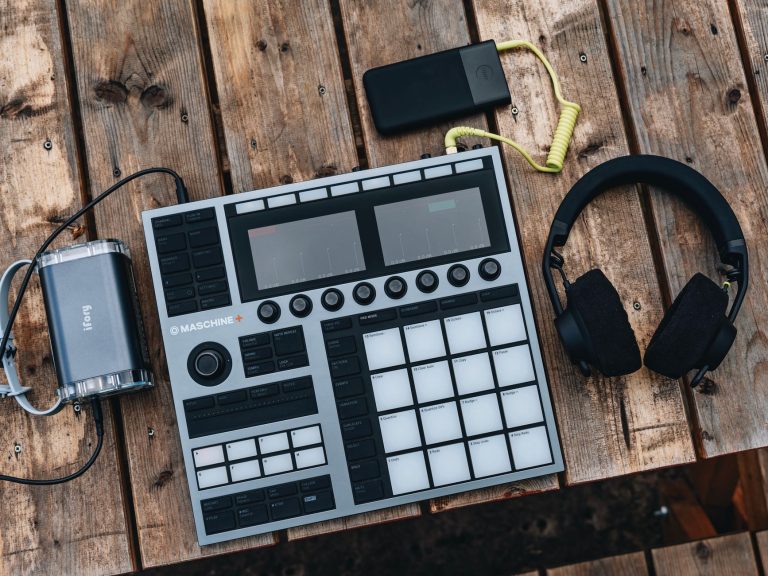
My notebook from those sessions was not full of magic fills. It was boring stuff: kick placement, snare length, 16th-note hats at different velocities, one ghost clap before bar three, and less low-mid trash around 220 Hz. I tested most of this in Ableton Live 12, then copied a few patterns to a Roland TR-8S because hardware exposes lazy programming fast. Pads do not forgive copy-paste.
I stopped writing the drums pattern as one loop
The first fix was mental. I quit treating the beat as a single two-bar object and split it into jobs. The kick carried the floor. The snare or clap marked the room. Hats created speed. Percussion gave me human mess.
When I kept those jobs separate, the loop stopped fighting itself. A house groove at 124 BPM did not need seven clever hits. It needed the kick on 1, 5, 9 and 13, a clap on 5 and 13, an open hat on the offbeats, and one small percussion answer near step 15.
The four-lane sketch that survived every session
I started with a 16-step grid. No swing. No fills. Just a one-bar pattern I could explain while half asleep.
- Kick: steps 1, 5, 9, 13 for house and techno, or 1 and 11 for a broken feel.
- Backbeat: clap or snare on 5 and 13, short decay if the bass is busy.
- Timekeeper: closed hat on 8ths or 16ths, velocity moving between 55 and 92.
- Answer: rim, tom, shaker or clap ghost near step 15, usually 6 to 12 dB quieter.
If that felt boring, good. Boring grids leave room for sound choice, bass movement and arrangement. A busy first bar usually means I am hiding a weak main idea.
Drums pattern for beginners: One bar first, not eight
For beginners, I would rather hear one clean bar than an eight-bar maze. Build a one-bar loop, duplicate it four times, then change only bar four. Remove the first kick of bar four, add a snare drag before the downbeat, or mute the open hat for two beats. That is enough tension for most dance music.
I have seen people hunt for a drums pattern free download when the better move is copying one classic grid by hand. The hand-copying matters. You learn where the silence sits.
- Write the pulse before the decoration.
- Keep the first bar plain enough to loop for a minute.
- Change bar four before adding a new percussion sound.
- Use silence as an arrangement move, not an accident.

The kick lied less after I muted the hats
I had a bad habit of judging kick patterns with the hats running. Hats make almost anything feel energetic for ten seconds. Mute them and the truth shows up. If the kick and clap do not nod without hats, the groove is not ready.
On one 128 BPM tech-house sketch, I kept adding shaker loops. The fix was a single missed kick at step 11 every fourth bar. The room opened. The bass answered. Nothing fancy happened.
Kick placement before kick processing
I tested three kick layouts before touching EQ. Four-on-the-floor worked for the club version. A broken pattern with kicks on 1, 7 and 11 worked for a garage-leaning idea. A trap pattern with kicks on 1, 6, 10 and 14 worked only when the 808 carried the sub and the kick got shorter.
The setting note in my project was blunt: kick tail under 180 ms when the bass plays 16ths. I used Ableton’s Utility to leave about -6 dB peak headroom on the drum bus before the bass joined. That saved me from fake loudness.
A small kick checklist I kept reusing
Before processing, I checked the pattern like this: does the downbeat feel obvious, does bar two answer bar one, does the kick leave space before the snare, and does the bass start after the kick transient rather than exactly on top of it? If two answers were no, I edited MIDI. I did not reach for another sample.
- Mute hats for thirty seconds and judge only kick, clap and bass.
- Shorten the kick before cutting low end if the bass is fast.
- Leave -6 dB peak headroom on the drum bus while writing.
- Move one kick by a 16th before adding another drum lane.

Ghost notes beat extra samples most nights
The best movement I got that week came from quiet hits, not new sounds. A ghost snare 18 dB below the main snare can make a loop lean forward without announcing itself. Same with a low-velocity hat tucked before an open hat.
Real drummers have a name for these tiny notes. Producers often treat them as decoration. I think that is backwards. Ghost notes are the glue between the obvious hits.
Velocity made the machine breathe
On 16th hats, I used a rough velocity row: 82, 48, 64, 55, then repeated with small changes. The downbeat hats stayed stronger. The off-grid ticks stayed lower. On a Roland TR-8S, accent made this obvious because the groove either bounced or barked.
In Live 12, I nudged selected ghost notes late by 5 to 12 ms. More than that started to sound drunk on tight techno. For garage, I could push a few hats 15 ms late and it still felt right.
Where I put the quiet hits
My repeatable spots were simple: one ghost clap just before step 13, a rim at step 16 leading into the next bar, and a quiet closed hat before every open hat. If the loop got nervous, I deleted every second ghost. Restraint won more often than density.
- Main clap at 0 dB reference, ghost clap between -12 and -18 dB.
- Closed hat ghosts 20 to 35 velocity points lower than accents.
- Rims high-passed around 250 Hz so they did not thump.
- Use one ghost note before a main clap, not three.
- Keep ghost snares quieter than you think, usually -12 dB or lower.
- Nudge late by milliseconds, not by whole grid divisions.
- Delete ghost notes when the vocal or lead starts talking.
Swing was a volume decision, not just timing
I used to treat swing like a timing preset. That missed half the sound. A swung note at the same velocity as the straight note can feel clumsy. A slightly late note that is also quieter feels intentional.
For a drums pattern at 122 to 130 BPM, I rarely liked more than 54 to 58 percent swing on 16ths. At 140 BPM and above, I used less. The faster the track, the less the grid tolerates wobble.
The Ableton Groove Pool note
I tried MPC-style 16th swing in Ableton’s Groove Pool at 55 percent, then pulled Random down to zero. Random timing sounded cute solo and messy in the drop. Timing was not the only edit. I dropped the delayed 16ths by 5 to 10 velocity points so the groove tucked behind the kick.
I have not tested the same patch on Logic 11 yet, but the principle should transfer: swing the weaker notes first. Leave the anchors alone unless the whole track wants to lurch.
Swing settings I would actually print
For house, I liked 54 percent swing on closed hats and no swing on the kick. For UK garage, I pushed hats and percussion harder, sometimes 60 percent, while keeping the snare mostly fixed. For techno, I often skipped global swing and manually delayed two hats per bar by 7 ms.
- Swing hats before kicks.
- Lower the velocity of delayed notes.
- Print the groove once it feels right so you stop tweaking.
- Check the pattern against the bass before trusting the solo loop.

The cheat sheet I kept beside the TR-8S
Searches for drum patterns PDF, 101 drum machine patterns PDF and techno drum patterns PDF make sense. A sheet helps when the session is cold. The trap is treating a PDF like taste. Pattern names are starting points, not finished records.
We continuously monitor music industry trends to help producers stay competitive, and one thing keeps showing up across custom production references: familiar drum pattern names still work when the sound design and arrangement feel current. Nobody rejects a four-on-the-floor because it is old. They reject it when it is lazy.
Drum pattern names that still earn their folder space
I kept these in a small drum patterns cheat sheet, not as law, just as session starters. Four-on-the-floor for house and techno. Two-step for garage and future bass. Half-time for dubstep, trap and heavy pop drops. Breakbeat for rave and jungle pressure. Dembow for reggaeton-leaning club ideas. Amen-style edits when I wanted chaos, though I chopped my own breaks when possible.
Why a PDF is useful, then suddenly useless
A drum patterns PDF free download can teach placement, especially if you redraw the pattern into your DAW. It becomes useless when you stop listening. The room does not care that the snare is academically correct. If the vocal phrase lands on beat four, your fill has to move around that phrase.
My rule was one borrowed grid, two personal edits. Change the last kick. Change the hat velocity. Change the clap length. Now it belongs to the track.
- Four-on-the-floor: kick on every quarter note.
- Two-step: broken kicks with backbeat still clear.
- Half-time: snare or clap feeling like beat three.
- Breakbeat: chopped acoustic groove, usually syncopated.
- Dembow: kick and snare conversation with a rolling push.

The mix only worked after the pattern left headroom
A good groove can still fail if every drum is loud, wide and long. I had one loop that slapped on headphones and turned to cardboard on small speakers. The pattern was fine. The gain staging was not.
I pulled the drum bus down, shortened two decays, and filtered percussion that had no business carrying low mids. Suddenly the bass had a lane. The drums felt louder after I made them quieter.
The low-mid cleanup note
On busy loops, I checked 180 to 300 Hz first. Not with a huge smiley EQ move. I used narrow cuts around 220 Hz on boxy claps, sometimes 2 to 4 dB. Toms got high-passed until the weight disappeared, then I backed off slightly. Hats got low-cut anywhere from 300 Hz to 700 Hz depending on the sample.
Sidechain ducking mattered too. I set the drum room or percussion bus to duck 1 to 2 dB from the kick with a fast attack and 80 to 140 ms release. More than that made the groove pump in a cheap way.
Parallel compression without crushing the grid
My parallel drum bus sat 10 to 18 dB under the dry drums. Attack around 20 ms, release around 100 ms, ratio 4:1. I wanted the tails and ghost notes lifted, not the kick flattened. If the main kick lost its front edge, the compressor was too excited.
This is where a stiff drums pattern can trick you. You may think it needs more swing, but it might only need shorter decay, lower ghost notes and a quieter parallel return.
- Cut boxy claps around 220 Hz before boosting air.
- Keep percussion sidechain ducking around 1 to 2 dB.
- Blend parallel compression quietly under the dry bus.
- Shorten drum tails when the bass line gets busier.
| Pattern name | Basic grid | Best tempo range | Use when |
|---|---|---|---|
| Four-on-the-floor | Kick on 1, 5, 9, 13; clap on 5 and 13 | 118-132 BPM | House, techno and club tracks need a stable floor |
| Two-step | Broken kicks, snare or clap still on the backbeat | 128-140 BPM | Garage swing or future bass needs bounce |
| Half-time | Kick early, snare feeling like beat three | 70-90 or 140-180 BPM | Trap, dubstep and heavier drops need space |
| Breakbeat | Syncopated kick and snare with shuffled hats | 125-175 BPM | Rave, jungle or big edits need human pull |
| Dembow | Kick and snare answer each other in a rolling loop | 90-105 BPM | Latin club influence needs forward motion |
Worth a deeper read: Ableton beat lessons.
Questions producers actually ask
What is a drums pattern called?
A drums pattern is usually called a drum beat, groove, rhythm pattern or drum machine pattern. If people are talking about named styles, they may say four-on-the-floor, two-step, half-time, breakbeat, dembow or shuffle. In a DAW session, I usually call it the drum groove.
What is the basic drumming pattern?
The basic pop and dance pattern is kick on beat one and three, snare or clap on beat two and four, with hats playing eighth notes. On a 16-step grid, that means kick on 1 and 9, snare on 5 and 13, hats on every odd step.
What is the most famous drum pattern?
The Amen break is probably the most famous sampled drum pattern, especially in jungle, drum and bass, hip-hop and rave music. For club music, four-on-the-floor is the most recognisable programmed pattern: kick on every quarter note, usually with a clap or snare on beats two and four.
What are some common drum patterns?
Common drum patterns include four-on-the-floor, two-step, half-time, breakbeat, shuffle, dembow and basic backbeat grooves. I keep those names as starting points. The track starts to feel personal when you change velocity, move one kick, shorten the clap or add a quiet ghost note.
Are free drum patterns PDF sheets useful?
Yes, if you redraw the grids and listen instead of dragging them in blindly. A free PDF can teach placement fast, especially for beginners. The danger is copying the page without adapting it to the bass line, vocal rhythm and tempo of your own track.
How do I make a drum pattern less stiff?
Lower some velocities, add one or two ghost notes, and swing only the weaker hats or percussion. Keep the kick and main snare steady first. I would also shorten long drum tails and leave about -6 dB headroom, because mix clutter often feels like bad timing.
What to remember
- Separate pulse, backbeat, timekeeping and decoration before judging the groove.
- Mute hats to test whether the kick, clap and bass can move alone.
- Use ghost notes quietly, usually -12 dB or lower against the main hit.
- Swing works better when delayed notes are also softer.
- Pattern names and PDFs help, but two personal edits make the beat belong to the track.
- Headroom, decay length and low-mid cleanup can fix grooves that feel stiff.
Wrapping up
The drums pattern that survives a real session is rarely the cleverest one. It is the one with a clear pulse, controlled velocity, a few quiet human details and enough space for the bass to speak. I would start with one bar, not eight. Mute the hats, fix the kick and clap, then bring movement back with ghost notes and small velocity shifts. After that, check the mix: 220 Hz buildup, long tails and overcooked parallel compression can make a decent groove feel wooden. Try this in your next session: rebuild one existing beat from scratch using only four lanes, then change bar four by one move. Print that version before you start decorating.
My Career makes videos from your own track and posts them for you, pitches your release to 34,000+ labels, playlists, radio stations, YouTube channels and blogs, puts it in every store and briefs you every morning. Free plan, no card, two minutes to set up.