Key takeaways
- eq mixing techniques work best when used in context, not in solo.
- Low end needs one clear owner, usually kick or bass, not both.
- Most amateur mixes reveal problems between 250 Hz and 2.5 kHz.
- Dynamic EQ is ideal for moving clashes, especially kick and bass masking.
- Mid/side EQ should support a strong centre, not replace one.
- Final EQ decisions should be checked against references and DJ-friendly sections.
Eq mixing techniques saved a 126 BPM tech house record for me at 1:40 a.m. in a windowless writing room above a bar, with a Pioneer DDJ-FLX10 on the desk and FabFilter Pro-Q 4 open on the kick bus. The client had already approved the hook. The drop worked on headphones. Then we ran it through a pair of battered Yamaha HS8s and the bass line folded into the kick like wet cardboard.
I had two hours before delivery. No new sound design. No fancy rebuild. Just EQ, gain, and decisions. I cut the bass at 48 Hz, dipped the kick around 220 Hz, moved the vocal air with a shelf at 11 kHz, and stopped pretending every channel needed surgical work. That night is still how I think about eq mixing techniques in 2026: less decoration, more translation.
Why EQ Mixing Techniques Changed Again in 2026
The last couple of years changed how I treat EQ. Not because ears changed. The playback chain did. Bedroom producers are checking mixes on AirPods, car speakers, phone clips, club rigs, and stems inside DJ software. A mix that only behaves in the studio is not finished.
eq mixing techniques now have to survive more handoffs. A DJ might drag your master into Rekordbox, use track separation, loop the breakdown, and run it through a CDJ-3000 into a limiter-heavy club chain. If the low mids are lazy, everyone hears it.
The old solo-button habit is costing people records
I used to solo the kick, make it look perfect, then solo the bass and do the same. Clean on paper. Wrong in the room. The better move is boring but reliable: EQ sounds while the groove is playing.
On that late-night tech house session, the kick sounded huge alone. In context, it was stealing space from the rolling bass around 95 Hz and carrying a cardboard note near 220 Hz. One narrow cut did more than three compressor swaps.
What changed with Pro-Q 4, Live 12, and stem-heavy DJ sets
FabFilter Pro-Q 4 made dynamic work faster, especially when masking jumps out only on certain notes. Ableton Live 12 also pushed more producers toward cleaner stock workflows, with better visual feedback and less plugin hopping.
That visual feedback is useful, but I still trust the mute button and a quiet listen at the end. eq mixing techniques are not about drawing pretty curves. They are about deciding which sound owns which lane.
- EQ in context before touching solo mode.
- Leave at least -6 dB headroom before the limiter.
- Check kick and bass together at low volume.
- Use dynamic cuts when a static cut makes the part feel thin.
- Reference on headphones, monitors, and one ugly speaker.
The Low End Lesson I Learned From a Nearly Dead Drop
The first time a low end scared me properly was not in a big studio. It was a club warm-up slot in a 250-capacity basement, where the DJ before me played a promo with a beautiful bass riff and a kick that vanished every time the sub note hit. The crowd did not leave, but the room lost its shoulders.
That memory sits with me whenever I use eq mixing techniques on dance records. The low end is not a luxury section. It is the steering wheel.
Choose one real sub owner
I usually make the kick own the punch around 55 to 75 Hz on tech house, then let the bass speak slightly higher, often 85 to 120 Hz. For melodic house, I might flip that and give the bass the deeper weight while the kick clicks and thumps above it.
The mistake is letting both sounds carry full weight below 80 Hz. It feels exciting in headphones for ten minutes. Then the master limiter starts breathing like it is tired.
My low-end EQ pass before any master chain
On a normal club mix, I high-pass non-bass elements more aggressively than most beginners expect. Pads often get filtered at 160 Hz. Vocals might clear out below 100 Hz. Percussion loops can lose everything under 180 Hz if the groove still feels alive.
- Kick: remove boxiness around 180 to 260 Hz if it clouds the groove.
- Bass: cut a small pocket where the kick fundamental hits hardest.
- Music bus: use a gentle high-pass around 25 to 30 Hz, not a brick wall.
- Reverb returns: filter low end before it reaches the mix bus.
Those eq mixing techniques sound simple because they are. The skill is stopping before the record loses body.
- Pick the kick or bass as the sub anchor.
- Do not boost below 40 Hz unless the system can prove it helps.
- Filter reverbs and delays before they smear the low end.
- Use short loop checks on 4-bar and 8-bar sections.
- Bypass EQ often to catch over-cleaning.
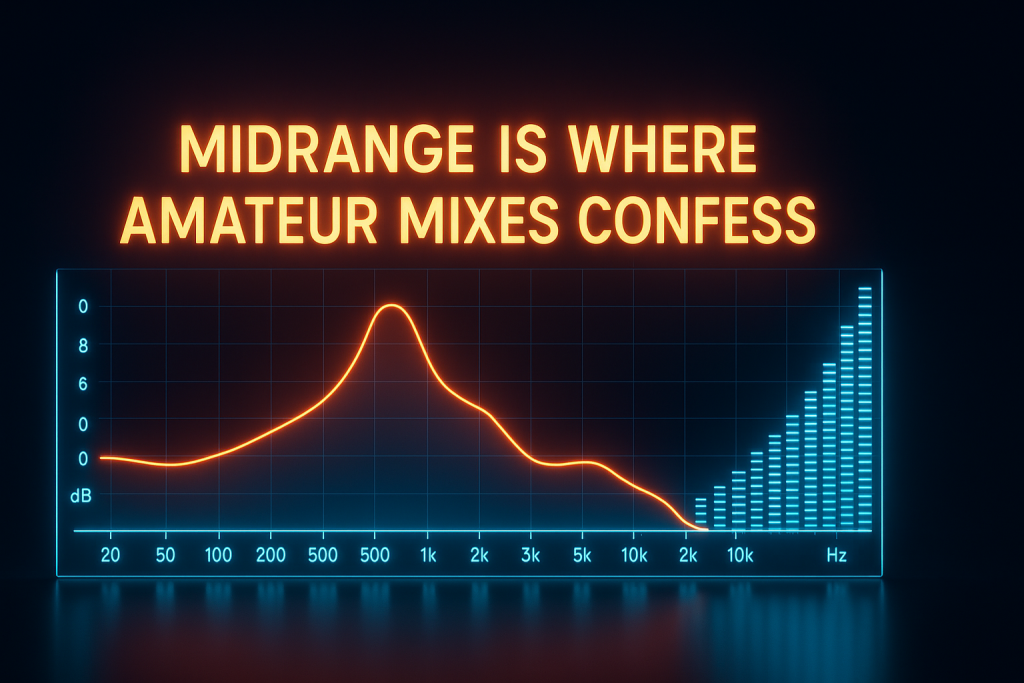
Midrange Is Where Amateur Mixes Confess
I can forgive a slightly soft top end. I can forgive a kick that needs half a dB more. I struggle with a crowded midrange because it makes every idea feel smaller.
Most broken bedroom mixes I hear are not broken at 12 kHz. They are fighting between 250 Hz and 2.5 kHz. That is where vocals, synth chords, snare body, bass harmonics, piano stabs, and crowd noise all try to rent the same flat.
The 300 Hz problem is usually arrangement wearing an EQ mask
There is a classic muddy patch around 250 to 400 Hz, but cutting every channel there is lazy. Sometimes the real issue is three sounds playing long notes in the same octave.
When I am fixing a custom production demo, I mute parts before I EQ them. If the mix clears up when a pad disappears, I know the pad needs a new voicing or a shorter release, not a heroic Pro-Q 4 curve.
Eq mixing techniques for vocals, stabs, and lead synths
For a vocal sitting over house drums, I often cut low rumble below 80 Hz, dip 250 Hz if the room tone feels cloudy, and add a small presence lift around 3 to 5 kHz only if the consonants are not already sharp.
Lead synths get different treatment. I would rather carve the backing chords at 1.5 kHz than hype the lead into harshness. If the hook needs size, I will widen a return or automate a filter before I boost 8 kHz blindly.
- Mute first, EQ second.
- Watch 250 to 400 Hz, but do not punish every channel.
- Carve backing parts before boosting the lead.
- Use narrow cuts for resonances and wider moves for tone.
- Check the vocal against the snare, not just against the instrumental.
Dynamic EQ Beats Static Cuts When the Groove Moves
Static EQ is still my first call. I do not reach for dynamic processing because it looks clever. I reach for it when a problem only happens on certain notes, words, or drum hits.
One singer I worked with had a gorgeous lower register, but every second line bloomed around 180 Hz. A static cut made the whole take skinny. A dynamic band in Soothe2 caught the bloom only when it jumped forward. That is the kind of restraint I trust.
Sidechain ducking is EQ when you use it like a surgeon
Sidechain ducking does not have to mean the whole bass pumping under the kick. A dynamic EQ sidechained from the kick can duck only 60 to 90 Hz on the bass for 80 milliseconds. The listener hears groove, not a compressor showing off.
This is one of the eq mixing techniques I use constantly on ghost production jobs because it fixes translation without changing the client’s musical idea.
When Soothe2 helps, and when it makes you lazy
Soothe2 is brilliant on harsh vocal stacks, brittle hi-hats, and resonant synth layers. It is also easy to overuse. If everything gets smoothed, the record loses teeth.
My rule is simple. If I can name the problem frequency, I use Pro-Q 4. If the resonance is moving too fast to chase, I try Soothe2 and keep the depth conservative. Good eq mixing techniques still need a reason.
- Use dynamic EQ for moving problems, not every problem.
- Sidechain only the frequency range that clashes.
- Keep attack and release musical, usually under a sixteenth-note feel.
- Bypass Soothe2 after five minutes to reset your ears.
- Print a rough bounce and test it away from the session.
Mid/Side EQ Is Powerful, but I Use It Late
Mid/side EQ can make a mix feel wider in ten seconds. It can also make the centre weak and the club mono check painful. I treat it like seasoning at the end, not a cooking method.
On a recent melodic techno master prep, the stereo synth wash sounded huge in the studio but swallowed the vocal once the chorus opened. The fix was not more width. I cut 350 Hz from the sides of the synth bus and left the centre alone.
Keep the centre boring and strong
Kick, bass, lead vocal, and main snare energy should normally feel solid in the middle. If the side channel has too much low end, the mix may sound impressive on headphones and vague on a club rig.
I usually mono-check everything below 120 Hz. Sometimes I go higher, around 150 Hz, on busy bass music. It is not fashionable. It works.
The side channel is for space, not rescue work
When the sides feel cloudy, I look around 250 to 600 Hz first. A small side-only cut can clear the vocal centre without making the whole synth bus thin.
These eq mixing techniques matter for artists ordering custom music too. A wide demo can sound expensive at first listen, but a stable centre is what keeps the record usable for DJs.
- Keep sub and kick energy centred.
- Cut side mud before boosting side air.
- Mono-check the drop, not only the intro.
- Avoid widening bass layers unless the low band is controlled.
- Use mid/side moves after the basic balance feels right.

The Final EQ Pass Before a Track Leaves My Room
The final pass is where I stop being creative and start being suspicious. I play the track quietly. I walk out of the sweet spot. I check the break, the first drop, the last 32 bars, and the DJ-friendly intro.
That is where eq mixing techniques become quality control. Not glamorous. Necessary.
Reference tracks keep my ego out of the room
I keep two or three references in the session, level-matched by ear and meter. For tech house, I might compare the kick length and bass density against a current club release. For melodic house, I listen more closely to vocal brightness and reverb size.
The point is not copying. It is calibration. If my mix has 4 dB more low-mid energy than every reference, I want to know before the master exaggerates it.
Print checks for DJs, artists, and ghost production clients
Before delivery, I bounce a full master, an instrumental if needed, and a short DJ test section. I check the intro and outro in 4-bar phrases because that is how DJs handle records under pressure.
I also leave practical headroom. If a mix is going to a mastering engineer, I avoid slamming the bus and keep peaks around -6 dB. If I am doing the final loud master, I still solve EQ before loudness. Loud bad EQ is just louder evidence.
- Level-match references before judging tone.
- Check the first drop and final drop separately.
- Test the intro in 4-bar phrases for DJ use.
- Leave -6 dB peak headroom for external mastering.
- Fix EQ before asking the limiter for volume.
| Approach | Best Use | Tool Example | Risk |
|---|---|---|---|
| Static EQ | Permanent tone shaping and cleanup | FabFilter Pro-Q 4 or Ableton EQ Eight | Over-cutting body from every channel |
| Dynamic EQ | Notes or words that jump out | Pro-Q 4 dynamic bands | Fixing arrangement problems with processing |
| Resonance suppression | Fast harshness on vocals, hats, synths | Soothe2 | Making the mix too smooth |
| Mid/side EQ | Clearing stereo mud or focusing the centre | Pro-Q 4 mid/side mode | Weak mono translation |
| Sidechain EQ | Kick and bass frequency conflicts | Trackspacer or dynamic EQ sidechain | Audible pumping if release is wrong |
Further reading
- Ableton Live manual — Ableton's official manual is a primary source for Live mixing tools and workflow.
- Sound On Sound EQ — Sound On Sound is a long-running engineering publication with respected practical mixing education.
Frequently asked questions
What are the best eq mixing techniques for beginners?
Start with balance, then use EQ in context. High-pass sounds that do not need low end, carve space between kick and bass, and avoid boosting top end before fixing cloudy mids. I would learn static EQ first, then dynamic EQ once you can hear what changes only on certain notes.
Should I EQ every track in my mix?
No. Some channels only need level, panning, or arrangement changes. EQ every track and the mix can become thin fast. I only add EQ when I can explain the job: remove rumble, reduce masking, shape tone, or make room for a more important part.
What frequency makes a mix sound muddy?
Mud often builds between 250 and 400 Hz, but the real cause is usually overlap. Pads, bass harmonics, vocal room tone, and snare body can all collect there. Cut carefully, and mute parts first so you do not solve an arrangement problem with twenty unnecessary EQ bands.
Is dynamic EQ better than compression?
Dynamic EQ is better when the problem lives in one frequency range. Compression is better when the whole signal needs level control or movement. For kick and bass clashes, I often prefer dynamic EQ because it ducks only the clashing band instead of pulling down the full bass sound.
How do I EQ kick and bass for club music?
Pick one sub owner. If the kick carries 60 Hz, cut a small pocket there in the bass and let the bass speak higher. Filter non-bass parts, check the groove in mono, and keep enough headroom so the limiter does not turn low-end conflict into pumping.
Can good EQ fix a bad arrangement?
Only to a point. EQ can reduce masking, but it cannot make five parts in the same octave feel spacious. If a mix clears up when one pad or synth is muted, rewrite the part, shorten the release, or change the voicing before reaching for more EQ.
Conclusion
The records that last rarely have the flashiest EQ curves. They have decisions. The kick knows its job. The bass has room. The vocal is not fighting a pad. The side channel feels wide without stealing the centre.
That is the real work behind eq mixing techniques in 2026. Use the newer tools, sure. Pro-Q 4, Soothe2, Ableton EQ Eight, Trackspacer, they all earn their place when the reason is clear. Just do not let the screen talk louder than the speakers.
Try this in your next session: loop the busiest 8 bars, turn the volume down, and fix only the clash you can actually name.
Eq mixing techniques — Quick Recap
The fastest way to lock in eq mixing techniques is to internalise the workflow above and repeat it on every project. Start small: pick one technique from this eq mixing techniques guide, apply it to your next session, and audit the result against a reference track.
- eq mixing techniques work best when used in context, not in solo.
- Low end needs one clear owner, usually kick or bass, not both.
- Most amateur mixes reveal problems between 250 Hz and 2.5 kHz.
- Dynamic EQ is ideal for moving clashes, especially kick and bass masking.
Treat eq mixing techniques as a habit, not a one-off — the producers who consistently nail eq mixing techniques are the ones who run the same checks on every track. That’s the difference between a clean, club-ready master and a track that sounds great at home but falls apart on a real system.
In a real studio session, eq mixing techniques comes down to the order in which you make decisions: reference first, gain stage second, then the creative work. Producers who treat eq mixing techniques as a checklist instead of a vibe end up shipping more tracks.
Most producers and DJs undervalue eq mixing techniques because the wins are invisible until the track plays back on a real system. Bake eq mixing techniques into your template and the next ten projects benefit automatically.
When you struggle with eq mixing techniques, the fix is rarely a new plugin. Loop a problem section, A/B against a reference, and isolate which element is breaking your eq mixing techniques.
Treat eq mixing techniques as a craft, not a chore. The producers releasing on the biggest labels lock eq mixing techniques in early so they can spend their energy on melody and arrangement instead of fighting the mix.
Document your eq mixing techniques process — even a short note in the project file. Future-you will rebuild the same eq mixing techniques win in half the time.
My Career makes videos from your own track and posts them for you, pitches your release to 34,000+ labels, playlists, radio stations, YouTube channels and blogs, puts it in every store and briefs you every morning. Free plan, no card, two minutes to set up.