
Key takeaways
- A signing is about reducing label risk, not only sending a strong WAV.
- Your EPK should be short, practical, and built for internal sharing.
- Club translation matters more than extreme streaming loudness.
- Pitch fewer labels and prove why each one fits your record.
- Ghost production works best when it supports an existing DJ identity.
- Clean rights, stems, and metadata make you easier to sign.
A dj record deal happens faster when your catalog, gigs, and data remove A&R guesswork. The uncomfortable part is that most DJs pitch like the record is the product, when the product is actually risk reduction: can this artist deliver a second release, play the music properly, pull people into a room, and avoid being a headache after signing? A dj record deal is rarely won by one heroic demo link.
Assume your production is already competent. The bar now is signal quality. Your best two records need to sit next to released tracks without collapsing on club systems, your EPK needs to show demand without pretending you are bigger than you are, and your outreach needs to land when a label can actually use you. This is the 90-day version: tighten the records, build the proof, pitch less, and give the label a clean reason to reply.
Build the Proof a Label Cannot Hear From Audio Alone
Labels do not sign audio in a vacuum. They sign a probability curve. A strong record starts the conversation, but proof decides whether anyone risks budget, calendar space, playlist relationships, artwork, press, radio plugging, and release management on you.
The mistake is sending a polished WAV and treating silence as a judgement on the music. Sometimes it is. Often, the label just cannot see what happens after release week. For a dj record deal, your proof needs to answer that before they ask.
Separate vanity numbers from buying signals
A 20,000-view Instagram Reel with casual scrollers is weaker than 180 people saving a private preview from your mailing list or Discord. A&R teams care about repeatable demand. Saves, set-list reactions, ticket movement, Shazam spikes, and direct fan replies beat passive reach.
Track the boring stuff. Export Rekordbox histories after shows. Keep screenshots of unreleased IDs getting crowd reactions. Use Chartmetric or Viberate if you have enough data, but a clean spreadsheet beats a messy analytics dashboard.
What most demo advice misses
The usual advice says to send your best track. Too thin. Send the track plus context: where you tested it, what part moved the room, which comparable releases it sits beside, and why your next record will not be a panic scramble.
A label wants to know whether your dj record deal would create momentum or maintenance work. Make that obvious in three sentences, not three paragraphs.
- Keep two unreleased masters ready, not one lonely demo.
- Document crowd tests with date, venue, slot time, and reaction.
- Save screenshots of DJ support, radio spins, and playlist traction.
- Show realistic growth over 90 days, not one suspicious spike.
- Know which three labels your sound genuinely fits.

Make the dj record deal Math Obvious
A label pitch gets stronger when the numbers map to a release plan. This is not about pretending you are already a touring headliner. It is about showing that a dj record deal has a route to attention, however narrow.
For electronic labels, the math is usually simple: does the record work in DJ sets, can the artist activate a small but real audience, and does the brand fit the label’s lane without copying its roster?
The dj record deal version of social proof
Do not bury the useful numbers under follower counts. A lean proof block should read like release ammunition: 34 percent email open rate, 600 monthly listeners from two self-releases, five club tests, support from two regional DJs, one editorial playlist near-miss, and a 45-second Reel that drove actual pre-saves.
Weak numbers can still work if they are honest and directional. Inflated numbers usually smell wrong by line two.
Use ratios, not raw flexing
Raw reach rewards people with older accounts and ad budgets. Ratios show commitment. A 3,000-follower profile with 150 real comments from local club people may beat a 40,000-follower page full of empty fire emojis.
When chasing a dj record deal, show conversion points: pre-save rate, link click rate, mailing list growth after a gig, or how many people asked for an ID after a set. That is label language.
- Followers matter less than saves, clicks, replies, and tickets.
- A private SoundCloud link should include release context in the description.
- Mention DJ support only when the supporter fits the label’s ecosystem.
- Use a one-page proof sheet, not a 14-slide pitch deck.
- Cut any number you cannot explain under pressure.

Your EPK Is a Risk Filter, Not a Biography
Your EPK should stop a busy label manager from hunting. If they need your best photos, short bio, private demos, social links, show history, and contact details, everything should be one click away. A dj record deal can die from friction before anyone critiques the second drop.
Skip the childhood origin story. Nobody needs to read that you fell in love with music at eight unless it proves a marketable angle. Keep the file useful.
Build the one-page version first
Use a clean Notion page, Google Drive folder, or lightweight website page. Name files properly: ArtistName_PressPhoto_3000px.jpg, ArtistName_Demo_Title_124BPM.wav, ArtistName_Bio_75words.txt. Labels pass assets internally. Bad naming makes you look amateur even when the record is strong.
Your hero photo should match the music. If the record is dark peak-time techno, do not lead with a beach lifestyle shot. If your set leans Afro house, do not dress the page like a hardstyle brand.
Keep the audio section brutally curated
Three links max: the lead demo, one supporting unreleased track, and one released reference from your catalog. If you cannot choose, the label will assume you do not know your own lane.
For a dj record deal, the EPK should make taste feel stable. Stable does not mean boring. It means the label can picture releases three and four without guessing whether you will suddenly pivot into pop-punk edits.
- 75-word bio for copy-paste use.
- Three press photos in portrait, landscape, and square crops.
- Private streaming links plus downloadable WAVs.
- Release history with real links, not screenshots only.
- Contact email for you or your manager, clearly visible.
- Short support list with dates and names.

Sign Music That Matches Your DJ Signal Chain
This is where bedroom producers often lose the room. The track sounds finished in headphones, then folds on CDJ-3000s through a club limiter. A&R people may hear the flaw before you do because they spend all week comparing demos against released masters.
A dj record deal does not require the loudest file in the inbox. It requires a record that behaves predictably when a DJ gains it, loops it, filters it, and blends it into a mastered catalog track.
Club translation beats streaming loudness
Keep your premaster around -6 dB peak headroom if the label asks for mastering later. If you send a mastered demo, do not smash it to -5 LUFS-I with a lookahead limiter gasping on every kick. LUFS-S during the drop tells you more about perceived aggression than LUFS-I across a long intro.
Use Metric AB or ADPTR Audio MetricAB against two label references. Watch low-end RMS, stereo correlation below 120 Hz, and transient shape on the kick. A clean -8 LUFS-I master often beats a broken -6.
The mix checks labels actually hear
Sidechain ducking should create groove, not a hole punched through the whole bus. If the bass vanishes 6 dB every kick, fix the envelope before you call it style. FabFilter Pro-C 2, Cableguys ShaperBox, or Ableton Compressor can all work if the release matches the bass pattern.
Use mid/side EQ carefully. Cutting 220 Hz in the side channel can clear synth width, but high-passing all sides at 180 Hz may make the drop feel detached on big systems. Soothe2 helps harsh vocal chops, yet overuse makes the top end feel laminated.
Arrangement is part of the signing signal
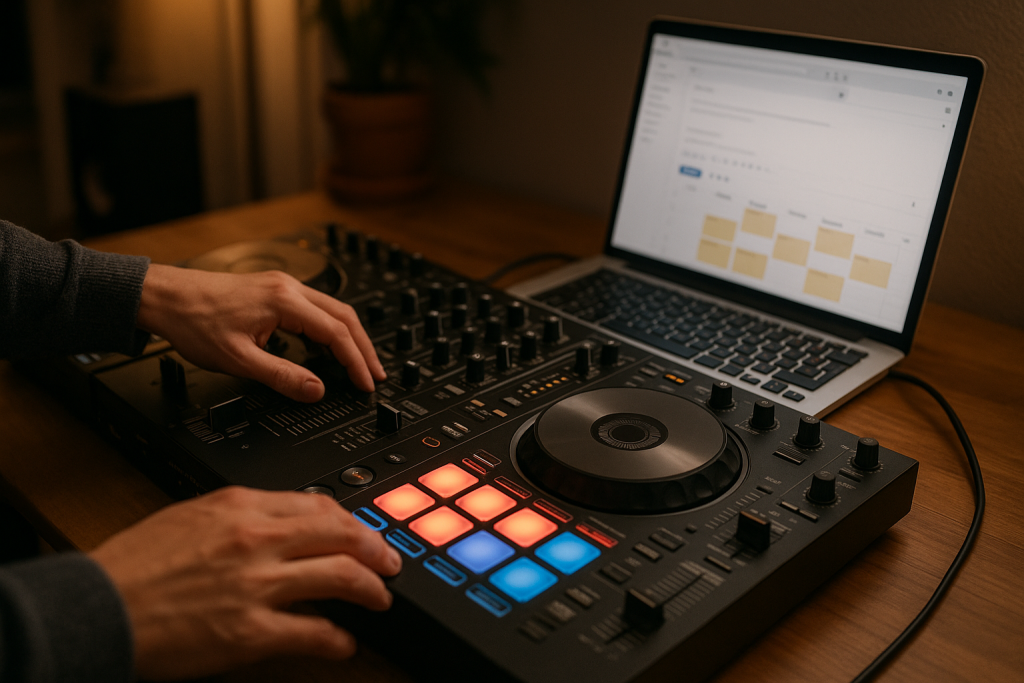
Labels listen for DJ utility. Give them clean 16-bar intros, obvious 4-bar phrase logic, and transitions that survive when someone mixes on a Pioneer DDJ-FLX10 at home or CDJ-3000s in a booth. Weird structure is fine only when the payoff justifies the extra risk.
If you want a dj record deal in a club lane, test the actual DJ use case. Load the file into Rekordbox, set hot cues, try a three-minute blend, and see where your own patience breaks.
- Check mono below 120 Hz before sending.
- Compare LUFS-I and LUFS-S, not just peak level.
- Leave clean cue points for club-friendly phrase mixing.
- Reference against the target label’s last five releases.
- Do one car check and one small Bluetooth check after the club check.
Send Fewer Demos, With Better Timing
Spray-and-pray emailing is not hustle. It is reputation damage at scale. The strongest pitch list for a dj record deal might be eight labels, not eighty, if each one has a recent release lane that your record can actually occupy.
Timing matters. Labels are often planning eight to sixteen weeks ahead, sometimes longer for vinyl, remix packages, or heavy PR campaigns. Sending a summer terrace record in late July is usually late unless the label moves fast digitally.
Read the label calendar like a DJ reads a room
Study the last six releases. Note BPM range, artwork language, featured vocal style, remix strategy, and whether the label pushes radio edits or extended mixes. If every recent release sits at 126 BPM with tight tech-house drums, your 112 BPM cinematic breakbeat track probably needs a different target.
For a dj record deal, fit is not surrender. It is positioning. You can be distinctive inside a lane. Randomness just makes the label do extra work.
Write pitches that respect A&R attention
Your email should be four blocks: one sentence on the record, one sentence on why that label, one proof sentence, and one private link. No attachments unless requested. No mass-email formatting. No fake urgency.
Use a private SoundCloud or Disco link with downloads enabled and metadata filled. If the file lands on a phone first, the label should still know artist, title, BPM, key, contact, and whether the track is unsigned.
- Pitch Tuesday to Thursday, not Friday night.
- Follow up once after 10 to 14 days.
- Stop pitching a track once serious talks start.
- Never send the same email to competing labels in visible batches.
- Track every submission in a simple CRM sheet.
Know When Ghost Production Helps and When It Hurts
Ghost production and custom music production can help if they sharpen an identity you already perform. They hurt when they create a fake artist the DJ cannot maintain. A dj record deal built on a sound you do not understand becomes fragile fast.
There is no moral drama here. Dance music has always had writers, engineers, mix specialists, topliners, and finishers. The serious question is whether the finished record matches your taste, your DJ sets, and your ability to brief the next one.
Use outside production to close specific gaps
If your drums slap but your low end never translates, hire help around sub design, kick-bass phase, and mix translation. If your toplines are weak, bring in a vocalist or writer. If arrangement is the problem, ask for club-structure revisions, not a complete identity transplant.
A custom record should still sound like something you would play at 1:30 a.m. without flinching. If it feels like cosplay, a label will feel that too.
The ownership conversation has to be clean
Before pitching a ghost-produced or co-produced record, know the rights position. Who owns the master? Are stems available? Can the label request alternate edits? Is the producer credited privately, publicly, or not at all? Can you approve remixes?
A dj record deal slows down fast when paperwork gets vague. Clean splits and clear delivery files make you easier to sign than the artist with a hotter demo and messy rights.
Keep your DJ identity in the loop
Use your sets as the filter. If the custom track does not fit between the records you already play, either the production brief is wrong or your artist direction is not honest yet. Load drafts into Rekordbox, test memory cues, loop the break, and try a real transition.
The goal is not to outsource taste. The goal is to get a release-ready track that amplifies taste you can defend.
- Ask for stems, instrumental, radio edit, and extended mix.
- Keep written confirmation of master ownership and usage rights.
- Brief with reference tracks from actual DJ sets.
- Reject tracks that impress online but fail in your set.
- Treat outside producers as specialists, not identity replacements.
| Route | Best use | Main risk | What to prepare |
|---|---|---|---|
| Direct label demo | When the record clearly fits one label’s current lane | Cold inbox silence if proof is thin | Private link, one-page EPK, clean proof block |
| Manager or trusted intro | When you have some traction but need access | Weak music can burn the relationship | Two finished records, show data, clear artist position |
| Self-release first | When you need market evidence before pitching | Momentum can fade if the campaign is underbuilt | Pre-save plan, content calendar, DJ support tracking |
| Custom or ghost-produced record | When the artist identity is strong but production quality lags | A track that does not match your sets | Rights clarity, stems, references, honest DJ testing |
Further reading
- Pioneer DJ CDJ-3000 — Official product source for the club-standard player referenced in DJ testing and release translation.
- Sound On Sound mastering — Respected engineering publication with practical mastering context relevant to demo loudness and translation.
Frequently asked questions
How do I get a dj record deal without a manager?
Build a narrow target list, send a strong private demo, and include proof the label can verify. You do not need a manager if the music fits, the rights are clean, and your EPK removes friction. A trusted intro helps, but a focused pitch still beats a weak introduction.
How many songs should I send to a label?
Send one lead track and one backup only if it supports the same artist direction. Three or more tracks usually creates indecision unless the label requested a batch. Your first link should be the record you would stake the campaign on.
Should I master a demo before sending it?
Send something loud enough to compare fairly, but avoid crushed masters. A clean reference master around -8 to -9 LUFS-I is often safer than a distorted file chasing loudness. Keep an unmastered premaster ready in case the label wants its own mastering chain.
Can a DJ get signed with ghost-produced music?
Yes, if the rights are clear and the music matches the DJ’s real identity. Problems start when the artist cannot explain, perform, or follow up the sound. Keep contracts clean, secure stems, and make sure the track belongs inside your actual sets.
What should be in a DJ EPK?
Use a short bio, press photos, private demos, release links, show history, social links, support notes, and direct contact details. Keep it one page or one tidy folder. The EPK should help a label make an internal decision quickly.
How long should I wait before following up on a demo?
Wait 10 to 14 days, then send one short follow-up with the original link. Do not guilt-trip, resend every week, or pitch a new track immediately. Silence usually means no, bad timing, or no clear fit for the release schedule.
Conclusion
A dj record deal is not a lottery ticket for whoever sends the most demos. It is a credibility stack: finished music, reliable club translation, a clear artist lane, proof of demand, clean rights, and a pitch that respects the label’s time. The record still has to hit. No spreadsheet fixes a weak drop or a vocal that feels rented.
For the next 90 days, work like the signing is already possible. Finish two records, test them in real DJ conditions, build the one-page EPK, and cut your label list until every target makes sense. Then send the pitch and watch what comes back. The replies, even the quiet ones, will tell you exactly where the next session should go.
Dj record deal — Quick Recap
The fastest way to lock in dj record deal is to internalise the workflow above and repeat it on every project. Start small: pick one technique from this dj record deal guide, apply it to your next session, and audit the result against a reference track.
- A signing is about reducing label risk, not only sending a strong WAV.
- Your EPK should be short, practical, and built for internal sharing.
- Club translation matters more than extreme streaming loudness.
- Pitch fewer labels and prove why each one fits your record.
Treat dj record deal as a habit, not a one-off — the producers who consistently nail dj record deal are the ones who run the same checks on every track. That’s the difference between a clean, club-ready master and a track that sounds great at home but falls apart on a real system.
In a real studio session, dj record deal comes down to the order in which you make decisions: reference first, gain stage second, then the creative work. Producers who treat dj record deal as a checklist instead of a vibe end up shipping more tracks.
Most producers and DJs undervalue dj record deal because the wins are invisible until the track plays back on a real system. Bake dj record deal into your template and the next ten projects benefit automatically.
When you struggle with dj record deal, the fix is rarely a new plugin. Loop a problem section, A/B against a reference, and isolate which element is breaking your dj record deal.
Treat dj record deal as a craft, not a chore. The producers releasing on the biggest labels lock dj record deal in early so they can spend their energy on melody and arrangement instead of fighting the mix.
Document your dj record deal process — even a short note in the project file. Future-you will rebuild the same dj record deal win in half the time.
My Career makes videos from your own track and posts them for you, pitches your release to 34,000+ labels, playlists, radio stations, YouTube channels and blogs, puts it in every store and briefs you every morning. Free plan, no card, two minutes to set up.