Key takeaways
- Send one clear demo, not a folder of maybes.
- Match the label’s recent releases, not its old reputation.
- Use a short email with a private link and one fit sentence.
- Keep masters clean, with a pre-master ready if the label replies.
- Clear ghost production, vocal, sample, and publishing rights before sending.
- Follow up once after fourteen days, then act on the signal.
To pitch tracks to labels and get a human reply, I stopped sending the track I loved and started sending the record a specific A&R could actually sign. That sounds colder than it felt. Last month I had six finished club records on the desk, two custom production briefs running, and a Friday warm-up set where one unreleased tech-house idea got a better reaction than the polished one. I wrote down what happened when I tried to pitch tracks to labels with less romance and more evidence.
The useful part was not a secret contact list. It was the boring chain: one clean bounce, three label matches, a short email, and a 14-day follow-up window. I still got ignored. Plenty. But the replies changed from silence to specific notes, and that is the bit worth stealing.
What changed when I started to pitch tracks to labels
I used to pitch tracks to labels like I was handing over a finished argument. Long note, private link, a few inflated words about support, then waiting around like the inbox owed me something. The better test was rougher. I made the pitch small enough for an A&R to judge before their coffee went cold.
The biggest change was sending one track, not a bundle. If the best record cannot hold attention alone, the other four will not rescue it. I learned that the hard way after sending a folder called demos_final_3, which is exactly the kind of filename that tells a label you are still arguing with yourself.
The small change when I pitch tracks to labels
When I pitch tracks to labels now, the first line names the track and the reason it fits that label. Not my life story. Not a paragraph about passion. One sentence, almost dry: I think this sits near your recent darker, rolling releases, especially the 128 BPM stuff with restrained vocals.
I kept the demo page plain too. Private SoundCloud link, downloads off unless requested, waveform visible, no mystery landing page. A&R people already have too many tabs open.
- One private streaming link, never an attachment.
- One sentence on fit, not a biography.
- One clear contact email in the track description.
- Send one record unless the label asks for an EP.
- Name the label fit before you mention yourself.
- Use a private link that plays on mobile without a login.
- Keep the file name clean, such as ARTIST_TRACK_DEMO_124BPM.wav.

The bounce mattered more than the backstory
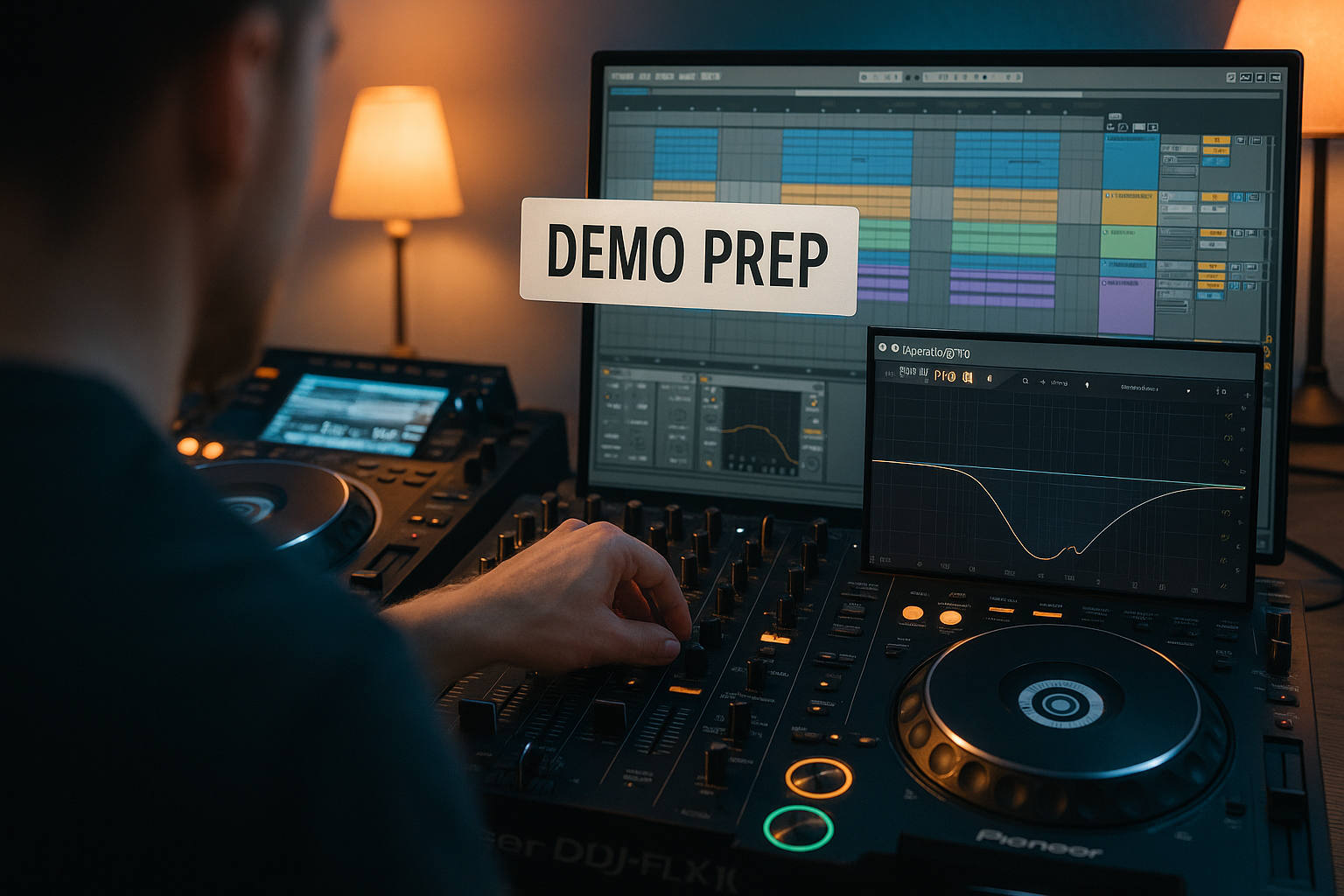
The night before sending, I checked each bounce on my Pioneer DDJ-FLX10, laptop speakers, AirPods, and a pair of Yamaha HS8s that are a little too honest around 180 Hz. The record that won was not the loudest. It had space. That mattered when I needed to pitch tracks to labels that release DJ tools, not headphone sculptures.
I printed two versions: a pre-master at -6 dB headroom and a louder reference around -8 LUFS integrated. I sent the louder streaming version, but I kept the pre-master ready. If a label replies, do not make them wait while you hunt through a messy exports folder.
The master I sent
The chain was simple: FabFilter Pro-Q 4 for a small cut at 220 Hz, Soothe2 taking maybe 2 dB off a harsh vocal chop, a touch of parallel compression on the drum bus, then a limiter catching peaks. I did not smash it. Labels can hear panic.
I also checked the first 32 bars on CDJ-3000s at the club. Not a full forensic test, just enough to know the intro gave a DJ clean 4-bar phrases and no weird low-end surprise. If you pitch tracks to labels in dance music, the intro is part of the pitch.
- Leave -6 dB headroom on the pre-master.
- Check the first 32 bars for DJ-friendly phrasing.
- Avoid clipping the demo just to sound louder in an inbox.
- Export WAV and MP3 versions before sending.

I treated the label like a DJ, not a database
I made a short sheet with twelve labels, then deleted seven. That felt too severe for about ten minutes. After listening properly, half of them were wrong for the record. The tempo lined up, but the label identity did not. To pitch tracks to labels well, I had to stop treating every tech-house imprint as interchangeable.
The test was practical: would a DJ play my track between two recent releases from that label without the room feeling a gear change? If not, I cut the label from the list. That single question saved me from sending polite spam.
The label notes I kept
My notes were messy but useful. I wrote down release tempo, vocal style, drum density, mix loudness, artwork tone, and whether the label seemed to break new artists or mostly sign friends of friends. That last one matters. Some labels are not hunting. They are documenting a scene they already know.
The labels that replied had one thing in common: I could name exactly why the track fit. Not vaguely. Specifically. One label had been releasing stripped percussion records around 126 BPM with dry bass stabs. Mine sat there. That was enough.
- Recent release tempo and groove, not five-year-old catalog habits.
- Whether the label signs unknown artists.
- DJ support patterns on SoundCloud, Beatport, and playlists.
- How much vocal content their records usually carry.
- Pick three serious label matches before expanding the list.
- Listen to the last ten releases, not the label’s biggest classic.
- Avoid labels that never sign outside their own circle.
- Write one fit sentence for each label before sending.

The email got shorter after the third rejection
The first rejection was a template. The second was silence. The third said the hook felt too familiar, which stung because it was true. After that, I rewrote the email. When I pitch tracks to labels now, the email looks almost underwritten. That is the point.
A&R people do not need to be warmed up with adjectives. They need artist name, track name, genre lane, link, one reason for fit, and what rights are clear. If you are using a vocalist, sample pack phrase, or ghost-produced instrumental, say what is cleared. Quietly. No drama.
The email I use to pitch tracks to labels
Subject line: Artist Name – Track Name – 126 BPM demo. The body is four lines. I used to think that looked lazy. It reads respectful.
Here is the shape I kept using when I needed to pitch tracks to labels without sounding like a press release: Hi Name, I am sending one unreleased 126 BPM club track that I think fits your recent darker releases. Private link here. All writing, production, and vocal rights are cleared. Thanks for listening, Name.
If I do not know the A&R name, I do not fake intimacy. A clean hello beats a creepy guess.
- Use a subject line with artist, title, BPM, and demo.
- Keep the email under 100 words.
- Mention rights only when it helps trust.
- Do not attach WAV files to the first message.
- Follow up once, then move on.

The ghost-produced record needed cleaner paperwork
One of the records came from a custom production session. The artist had the idea, I rebuilt the groove in Ableton Live 12, and we cut a new bass line after testing it on an Ableton Push 3. That track was strong. It also needed cleaner admin before anyone should pitch tracks to labels with it.
This is where bedroom producers get casual and then pay for it later. If a record is ghost-produced, co-produced, or built from custom music production, the label does not need your whole business arrangement. But you need it clear before the pitch leaves your outbox.
When not to pitch tracks to labels
Do not pitch tracks to labels while splits are still emotional. Do not send a demo with an uncleared Splice vocal that sounds like a lead artist. Do not promise exclusivity if the same track is already sitting in three inboxes with no deadline.
My rule was blunt: no pitch until the ownership note fit on one line. If I could not write that line, the track was not ready. I have not tested this paperwork flow on Logic 11 yet, but the DAW does not really matter here. The inbox does.
- Who owns the master?
- Who controls publishing?
- Are vocals, samples, and session players cleared?
- Can the artist sign a label agreement without chasing approvals?
- Clear producer and artist splits before pitching.
- Keep proof of sample and vocal licenses in one folder.
- Avoid sending the same track as exclusive to multiple labels.
- Write a plain rights summary before any A&R email.

Fourteen days was enough signal
I gave each label fourteen days. Not because fourteen is magic. It was just long enough for a real listen and short enough to stop the track dying in a private-link cemetery. If I pitch tracks to labels on Monday, I follow up the second Monday after. One sentence. Same link.
After that, I move the record. I might try a smaller imprint, test it in another DJ set, or edit the arrangement. Waiting six weeks for a label that has not opened the link is not patience. It is avoidance dressed up as strategy.
What I changed on day fifteen
On day fifteen, I checked the link stats and my notes. If nobody played past the drop, I questioned the intro or the first payoff. If the link had repeat plays but no reply, I sent one calm follow-up. If there were no plays, I assumed the pitch missed the person or the label was shut to demos.
The best reply came on day nine. Short message, no praise parade: strong groove, vocal too bright, send a dub. I cut 3 dB around 5.8 kHz with mid/side EQ, printed a dub, and sent it back the same afternoon. That reply mattered more than any public like.
- Follow up once after fourteen days.
- Track plays, repeat listens, and drop-off points.
- Make requested edits fast while the conversation is warm.
- Archive dead pitches instead of emotionally reopening them.
- Use rejection notes to improve the next send.
| Pitch route | Best for | My take | Main risk |
|---|---|---|---|
| Direct A&R email | A label you can clearly match | Best first move when the fit is obvious and the email is short. | Easy to ignore if your subject line is vague. |
| Official demo form | Larger labels with strict intake | Use it if they ask for it. Fighting the process rarely helps. | You may not know who heard it or when. |
| DJ support first | Club records needing proof | Strong if a known DJ plays it and the floor reacts. | The track can leak or feel old before signing. |
| Manager or trusted intro | Artists with existing network | Useful when the middle person actually has taste and trust. | A weak intro burns favors fast. |
Further reading
- Ableton export settings — Ableton's official Live 12 manual is authoritative for export and file handling details.
- Sound On Sound mixing — Sound On Sound is a long-running professional audio publication with detailed production and mixing education.
Frequently asked questions
How do I pitch tracks to labels without sounding desperate?
Keep the message short, specific, and calm. Name the track, give one reason it fits the label, include a private streaming link, and mention cleared rights if relevant. When you pitch tracks to labels, confidence usually sounds like restraint, not hype.
Should I send one demo or several tracks to a record label?
Send one track first unless the label asks for more. A focused single-demo email is easier to judge, easier to forward, and less likely to feel like homework. If they like it, they will ask what else you have.
How loud should my demo be before sending it to a label?
Send a clean streaming master that feels competitive but not crushed. I usually keep a pre-master around -6 dB headroom and a louder demo reference for listening. If the limiter is making the kick fold, back off.
Can I pitch a ghost-produced track to a label?
Yes, if the rights are clean and the artist has permission to release it under their name. Sort out master ownership, publishing splits, sample licenses, and any producer agreement before sending. Labels hate admin surprises after they say yes.
How long should I wait before following up with a label?
Fourteen days is a fair window for most dance labels. Send one polite follow-up with the same private link, then move on if there is no answer. Repeated nudges usually make the track feel less attractive, not more urgent.
Do labels care about social numbers before signing a demo?
Some do, but a strong fit still matters more for smaller and mid-sized dance labels. If your track solves a release-slot problem for them, modest numbers will not kill it. Fake-looking numbers, though, can make an A&R suspicious fast.
Conclusion
The cleanest way to pitch tracks to labels was less dramatic than I wanted it to be. I had to make the record easy to hear, easy to place, and easy to trust. The music still had to hit. No email fixes a weak drop, a crowded low end, or a hook that sounds borrowed. But once the track was ready, the pitch became a small piece of studio admin rather than a plea for validation.
Try this on your next finished record: pick three labels, write one fit sentence for each, export a clean demo and pre-master, send one short email, then follow up after fourteen days. Keep notes. The replies, and the silences, will tell you what to fix next.
Pitch tracks to labels — Quick Recap
The fastest way to lock in pitch tracks to labels is to internalise the workflow above and repeat it on every project. Start small: pick one technique from this pitch tracks to labels guide, apply it to your next session, and audit the result against a reference track.
- Send one clear demo, not a folder of maybes.
- Match the label’s recent releases, not its old reputation.
- Use a short email with a private link and one fit sentence.
- Keep masters clean, with a pre-master ready if the label replies.
Treat pitch tracks to labels as a habit, not a one-off — the producers who consistently nail pitch tracks to labels are the ones who run the same checks on every track. That’s the difference between a clean, club-ready master and a track that sounds great at home but falls apart on a real system.
In a real studio session, pitch tracks to labels comes down to the order in which you make decisions: reference first, gain stage second, then the creative work. Producers who treat pitch tracks to labels as a checklist instead of a vibe end up shipping more tracks.
Most producers and DJs undervalue pitch tracks to labels because the wins are invisible until the track plays back on a real system. Bake pitch tracks to labels into your template and the next ten projects benefit automatically.
My Career makes videos from your own track and posts them for you, pitches your release to 34,000+ labels, playlists, radio stations, YouTube channels and blogs, puts it in every store and briefs you every morning. Free plan, no card, two minutes to set up.