Key takeaways
- A clean 30-minute beginner set needs ten prepared tracks, not fifty random ones.
- Sync is useful when it frees your ears to judge phrasing, EQ, and level.
- Three cue points per track are usually enough: start, warning, and exit.
- Trim and gain staging fix more beginner mixes than dramatic EQ moves.
- Producers should DJ-test their own tracks before calling a club version finished.
- Recording practice sets makes timing, bass clashes, and level jumps impossible to ignore.
Djing for beginners got less scary for me the week I stopped treating it like a personality test and treated it like a 30-minute maintenance job.
I had two late sessions recently: one with a singer who wanted a custom club edit, one with a bedroom producer who had bought three finished tracks and wanted to understand how to actually play them. Same problem in both rooms. The tracks were fine. The hands were nervous. So I built a tiny notebook method for djing for beginners: ten tracks, clean cue points, strict levels, one recorded run, no heroic tricks. It is not flashy. It works. If you can count 4-bar phrases, keep the meters out of the red, and recover when the incoming kick feels late, you can play a clean 30-minute set tonight.
Djing for beginners starts with one boring loop
The first test I ran was almost stupid. I loaded two 124 BPM tech house tracks into Rekordbox, one on a Pioneer DDJ-FLX10 and one later on a CDJ-3000. I ignored effects. I ignored hot-cue fireworks. I looped 8 bars of drums and asked one question: can this person hold the groove for two minutes without touching everything?
That is where djing for beginners usually breaks. Not at the drop. Not at the big transition. It breaks because the left hand keeps reaching for the filter when the trim is still wrong.
A small djing for beginners drill
I used the same drill with three people last week. Pick Track A with a clean intro. Pick Track B with a clean intro. Set both to the same BPM, then beatmatch by ear for one minute before you look at the stacked waveforms. Yes, I allow sync after that. I am not religious about it. I care if the mix sounds locked.
The drill was simple: play 8 bars, bring in the second channel at -12 dB, raise it to -6 dB, then swap bass EQs at the start of the next 4-bar phrase. No echo. No spiral. No panic.
The gear did not matter as much as the clock
The DDJ-FLX10 felt easier because the pads and jogs sit where a nervous hand expects them. The CDJ-3000 felt cleaner, but less forgiving. For djing for beginners, I would rather see a controller at home for 30 honest minutes every day than a rented club booth once a month.
My notebook line from that night was blunt: if you cannot mix two drum intros for 64 beats, the RMX-1000 will not save you.
- Use two tracks within 2 BPM of each other for the first week
- Set a memory cue on the first downbeat, not on the vocal
- Practice one 8-bar loop until it feels boring
- Keep channel gains peaking around -6 dB before the mix starts
- Record the drill before adding effects
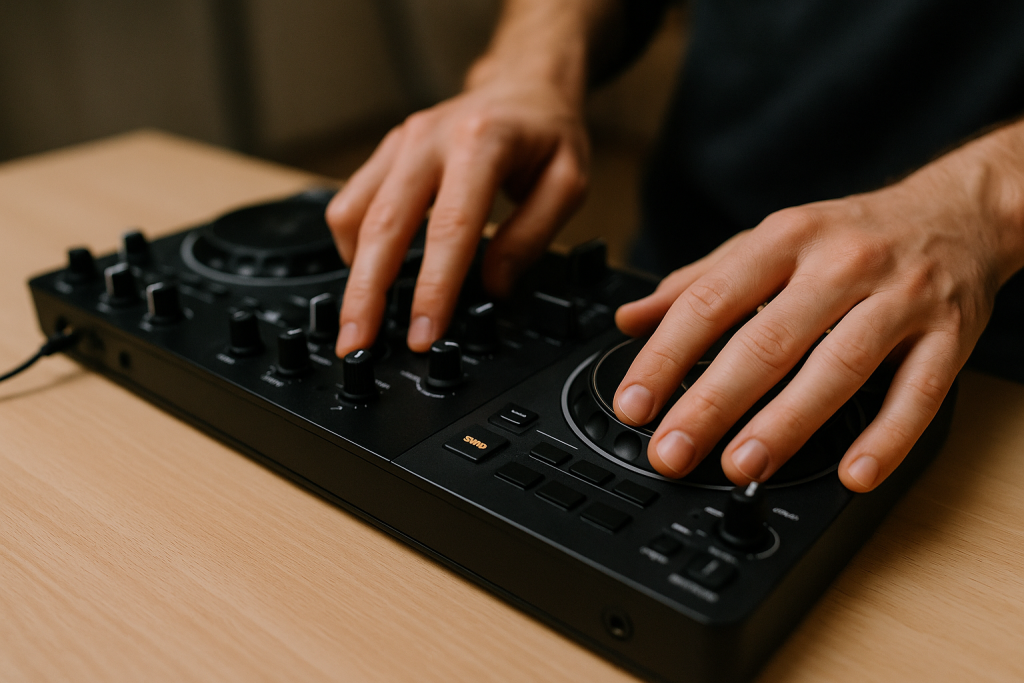
The sync button told me what the room heard
I used to be harder on sync. Age and too many soundchecks softened that opinion. During one session, the beginner turned sync off to prove something, then spent 20 seconds chasing a drifting hi-hat while the vocal hook walked into the wrong bar. The room did not hear integrity. The room heard a mess.
For djing for beginners, sync is a training wheel and a microscope. It lets you hear phrasing, EQ, and gain because pitch drift is not eating the whole brain.
Beatmatch by ear, then let sync confirm it
Here is the compromise I like: cover the BPM readout for the first 30 seconds, nudge the jog until the kicks feel glued, then uncover the screen and check. On the DDJ-FLX10, the tempo fader is long enough to make tiny moves without overcorrecting. On cheaper controllers, I set the tempo range to ±6% so every millimeter is not chaos.
djing for beginners becomes calmer when the goal is not moral purity. The goal is hearing when two grooves lean against each other properly.
Waveforms are useful, not magical
Stacked waveforms helped the producer see why a clap felt late, but they also created lazy eyes. I made him mix one pass with the laptop half-closed. Ugly for five minutes. Better after ten.
My rule now is this: watch the waveform when setting cues, listen when performing. If the sub in Track B is flamming against Track A, your ears will know before the screen admits it.
- Use sync after one honest attempt at matching by ear
- Keep tempo range narrow, especially on short faders
- Nudge with the jog wheel, do not ride the pitch fader every beat
- Check the kick and clap first, not the decorative percussion
- Practice one mix with the screen dimmed
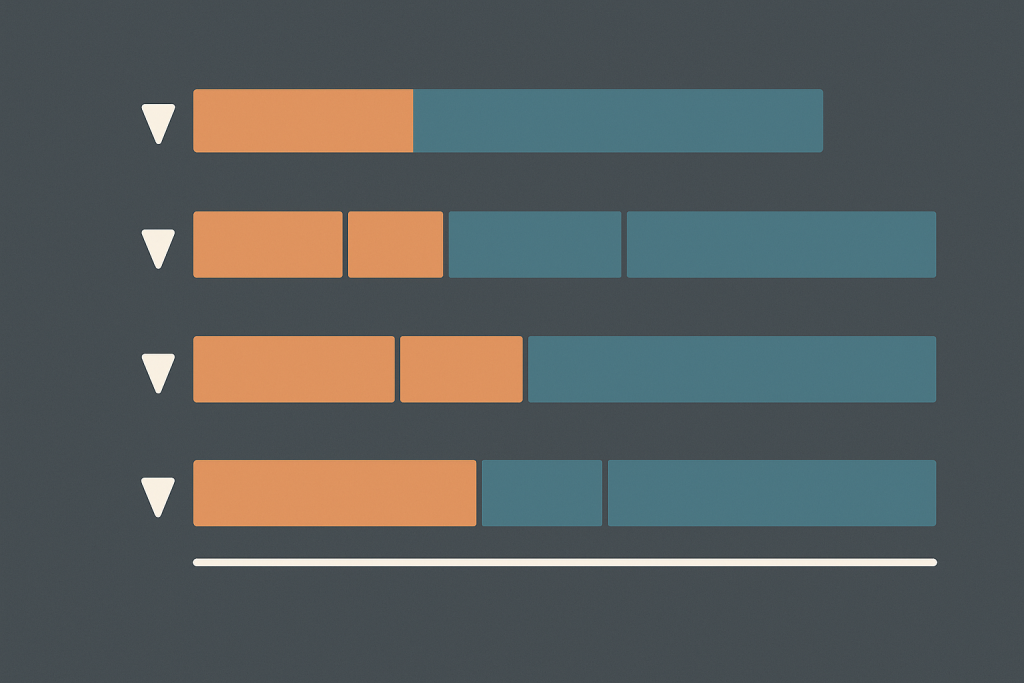
Four-bar phrases beat clever transitions
The best fix that week was not technical. It was counting out loud. One, two, three, four. Again. The beginner hated it for about three minutes, then the mixes stopped landing in weird places.
djing for beginners lives or dies on phrase awareness. Most dance music still speaks in 4, 8, 16, and 32-bar chunks. If you bring a new track in halfway through a vocal question, the crowd feels the grammar error even if they cannot name it.
Cue the sentence, not the sound
I set hot cue A on the first proper downbeat, hot cue B 16 bars before the drop, and hot cue C at the start of the outro drums. That was enough. More cue points made the session worse because every pad looked tempting.
For djing for beginners, three cues per track is a sweet spot: start, warning, exit. I would rather have three reliable marks than eight colorful guesses.
The 16-bar swap that worked
The cleanest transition we got was painfully plain. Track A played its chorus. Track B came in with low EQ cut at about 10 o’clock. At bar 9, we raised the mids a touch. At bar 13, we lowered Track A’s bass. At bar 17, Track B took the low end. No drama.
That move worked on house, melodic techno, and one Afro-house edit. I have not tested the same map on a busy drum and bass set, but at 174 BPM I would shorten the blend and watch the snares.
- Count 4-bar phrases until you stop feeling silly
- Place one cue 16 bars before a major change
- Avoid mixing across a lead vocal unless the key and rhythm really agree
- Swap bass on a downbeat, not because your hand got bored
- Use 32-bar blends for house and shorter blends for busier genres
Trim solved more problems than EQ
One bedroom producer brought in a folder of self-produced tracks, all mastered differently. One was hitting hard at -7 LUFS integrated, another sat closer to -10 LUFS, and the intros had completely different low-end weight. The first instinct was to EQ everything. Wrong move.
For djing for beginners, gain staging is the less glamorous skill that makes the set sound adult. If the incoming track is 4 dB louder, your transition will feel aggressive even when the EQ curve is sensible.
Set trim before the track enters
I cued each track in the headphones, watched the channel meter, and trimmed until the loud section peaked around -6 dB. Not the intro. Not the breakdown. The loud section. On a DJM-900NXS2 or DJM-A9, that leaves space before the master gets crunchy.
djing for beginners often turns into red-light tourism. People see LEDs and want more of them. I want steady green with occasional yellow. Red is not excitement. Red is evidence.
EQ is a switchboard, not a rescue team
The bass EQ did most of the work. I cut Track B’s low EQ before introducing it, then swapped lows on the phrase. The mids stayed near center unless a vocal was fighting. The highs got tiny moves, maybe 10 or 11 o’clock if hats were sandpaper.
If a custom production or ghost-produced track has too much 220 Hz mud, fix it in the mixdown with FabFilter Pro-Q 4 or a mid/side EQ pass. Do not expect the booth EQ to repair a crowded master while you are also trying to count bars.
- Cue the loudest section and set trim before mixing
- Keep the master out of red even if the room feels quiet
- Swap low EQs on phrase starts
- Use mids carefully when vocals overlap
- Fix mixdown mud before export, not during a live blend
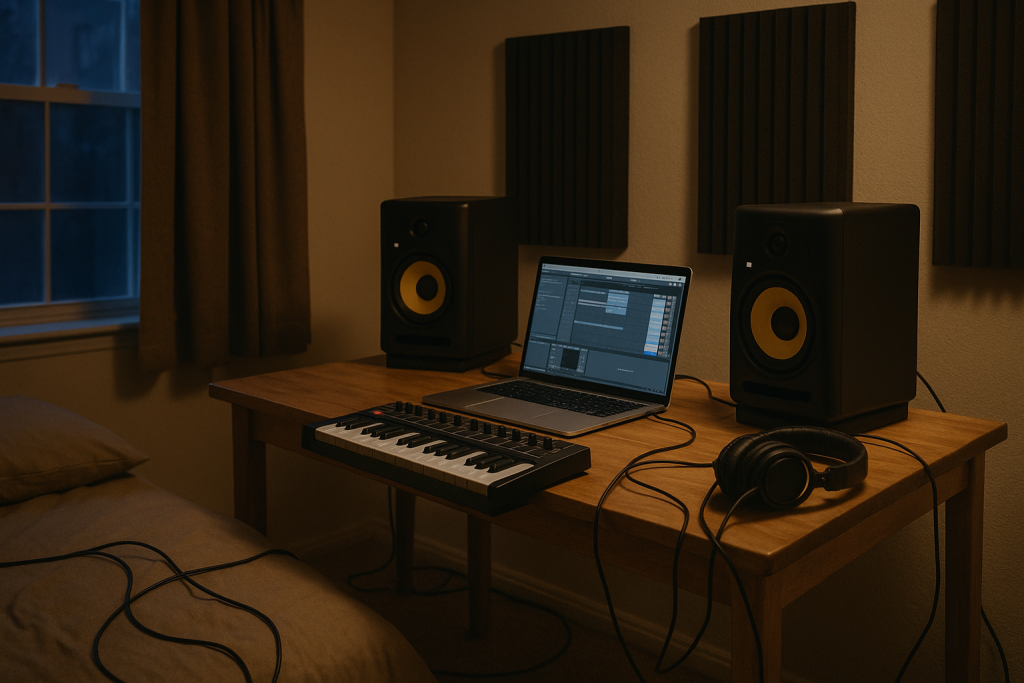
Bedroom tracks need a booth test
This note came from the custom music side. A producer had a melodic house track that sounded wide and expensive on headphones, then vanished when we placed it between two label records. The kick was polite. The bass was stereo. The breakdown was huge, but the drop folded.
djing for beginners is useful even if you mainly make tracks, because the decks expose arrangement problems fast. A song that cannot survive a basic blend may not be ready for a release, a pitch, or a paid exclusive license.
The Ableton check before Rekordbox
I pulled the track into Ableton Live 12 and checked three boring things: mono below 120 Hz, kick peak consistency, and whether the intro gave a DJ at least 16 bars to work with. On that file, the bass widened below 90 Hz, so the low end felt large in headphones and weak in the room.
For djing for beginners who also produce, this is gold. DJ practice tells you whether your arrangement helps another human mix the record.
Plugins that earned their keep
FabFilter Pro-Q 4 cleaned a low-mid pileup around 220 Hz. Soothe2 took a little bite out of a harsh vocal chop around 3.5 kHz. A sidechain ducking pass gave the kick 2 dB more room without making the bass pump like a bad demo.
I bounced a new version with -1 dB true peak, loaded it into Rekordbox, and it sat better immediately. Not perfect. Better enough to trust the test.
- Leave at least 16 bars of mixable intro or outro for club versions
- Keep sub bass mono below roughly 120 Hz
- Compare your track against two released records in the same key area
- Check loud sections, not only the prettiest breakdown
- Bounce a DJ test version before calling the master finished
Recording the set made the mistakes obvious
The final experiment was the least romantic: hit record, walk away from excuses. We recorded a 30-minute practice set into Rekordbox, then again into Ableton through a small interface so we could see the waveform and hear the gain jumps.
This is where djing for beginners becomes measurable. You hear the late blend. You hear the bass overlap. You hear the moment your hand grabbed the filter because you were nervous, not because the mix needed movement.
My 30-minute set map
I used ten tracks, roughly three minutes each, all within 122 to 126 BPM. The first two were tools with drum intros. Tracks three to six carried the hooks. Track seven reset the energy. Tracks eight to ten climbed without doubling every vocal.
For djing for beginners, that map is enough. Do not build a four-hour identity crisis. Build 30 minutes that you can play clean twice.
What I marked after playback
I dropped markers where the mix got louder by more than about 3 dB, where kicks drifted, and where two basslines fought. Then we fixed one category per pass. First levels. Then phrasing. Then EQ. Effects came last, and honestly, most stayed muted.
The second recording was not festival-grade, but it sounded intentional. That is the promise here: djing for beginners can move from panic to control in one focused half-hour if the task is narrow enough.
- Record one 30-minute pass without stopping
- Mark only three mistake types on playback
- Fix gain jumps before touching effects
- Repeat the same track order once more
- Save the recording date and notes in the playlist name
| Tool | Best use | My take |
|---|---|---|
| Pioneer DDJ-FLX10 | Home practice with Rekordbox or Serato | My first pick for serious beginners because the layout teaches club habits without renting a booth. |
| Pioneer XDJ-RX3 | Standalone practice without a laptop | Great if you want less screen glare, but I would still learn playlist prep properly. |
| CDJ-3000 with DJM-A9 | Club-standard booth training | Clean and honest, but expensive overkill before your phrasing and gain are steady. |
| Ableton Live 12 | Recording analysis and custom edits | Best for checking your own tracks, fixing intros, and spotting level jumps after a practice set. |
Further reading
- CDJ-3000 overview — Pioneer DJ's official product page is authoritative for club-standard player features and terminology.
- Ableton warping manual — Ableton's official manual is a primary source for tempo, warping, and audio clip preparation in Live 12.
Frequently asked questions
Is djing for beginners easier with a controller or CDJs?
A controller is the smarter first move for most people. A DDJ-FLX10 or similar unit gives you club-style controls at home, so you can practice daily. CDJs feel better and translate directly to booths, but they are too expensive to justify before your timing, cue points, and gain staging are reliable.
How long should a beginner DJ practice each day?
Thirty focused minutes beats three unfocused hours. I like one small target per session: beatmatch two tracks, clean up cue points, record a short mix, or fix gain jumps. djing for beginners improves fastest when the practice has a clear edge and a recording at the end.
Do beginner DJs need to learn beatmatching by ear?
Yes, but not as a purity contest. Spend a minute matching by ear, then use sync or the BPM display to check your work. Ear training helps when grids are wrong, drummers swing, or the booth monitor is rough. Sync is useful, but your ears still have to supervise it.
How many tracks do I need for a 30-minute DJ set?
Eight to twelve tracks is enough for a first 30-minute set, depending on genre and blend length. For house or melodic techno, ten tracks usually feels comfortable. Pick tracks within a narrow BPM range, prepare three cue points each, and avoid stacking too many big vocals back to back.
Should producers learn DJing before releasing club tracks?
They should at least learn the basics. DJing exposes weak intros, awkward drops, over-wide bass, and masters that do not sit beside released records. Even a rough controller session can tell you whether your arrangement gives DJs enough room to mix the track cleanly.
What is the biggest mistake new DJs make?
They touch too much. Filters, effects, hot cues, loops, and EQ all become distractions when the core blend is not stable. The biggest improvement usually comes from doing less: set trim correctly, count phrases, swap bass cleanly, and record the result before adding tricks.
Conclusion
The useful version of djing for beginners is small, repeatable, and slightly boring. That is good news. You do not need a club booth, a wall of effects, or a heroic 90-minute set to hear progress. You need ten tracks, three cue points per track, stable trim, basic phrase counting, and one recorded pass that tells the truth.
The sessions that pushed this notebook into shape were not perfect. One mix drifted. One custom track collapsed in mono. One filter sweep was pure nerves. Still, the second pass sounded like a DJ had entered the room. Try this in your next session: build the 30-minute crate, record it once, mark three mistakes, then play it again without changing the goal.
Djing for beginners — Quick Recap
The fastest way to lock in djing for beginners is to internalise the workflow above and repeat it on every project. Start small: pick one technique from this djing for beginners guide, apply it to your next session, and audit the result against a reference track.
- A clean 30-minute beginner set needs ten prepared tracks, not fifty random ones.
- Sync is useful when it frees your ears to judge phrasing, EQ, and level.
- Three cue points per track are usually enough: start, warning, and exit.
- Trim and gain staging fix more beginner mixes than dramatic EQ moves.
Treat djing for beginners as a habit, not a one-off — the producers who consistently nail djing for beginners are the ones who run the same checks on every track. That’s the difference between a clean, club-ready master and a track that sounds great at home but falls apart on a real system.
In a real studio session, djing for beginners comes down to the order in which you make decisions: reference first, gain stage second, then the creative work. Producers who treat djing for beginners as a checklist instead of a vibe end up shipping more tracks.
Most producers and DJs undervalue djing for beginners because the wins are invisible until the track plays back on a real system. Bake djing for beginners into your template and the next ten projects benefit automatically.
When you struggle with djing for beginners, the fix is rarely a new plugin. Loop a problem section, A/B against a reference, and isolate which element is breaking your djing for beginners.
My Career makes videos from your own track and posts them for you, pitches your release to 34,000+ labels, playlists, radio stations, YouTube channels and blogs, puts it in every store and briefs you every morning. Free plan, no card, two minutes to set up.