
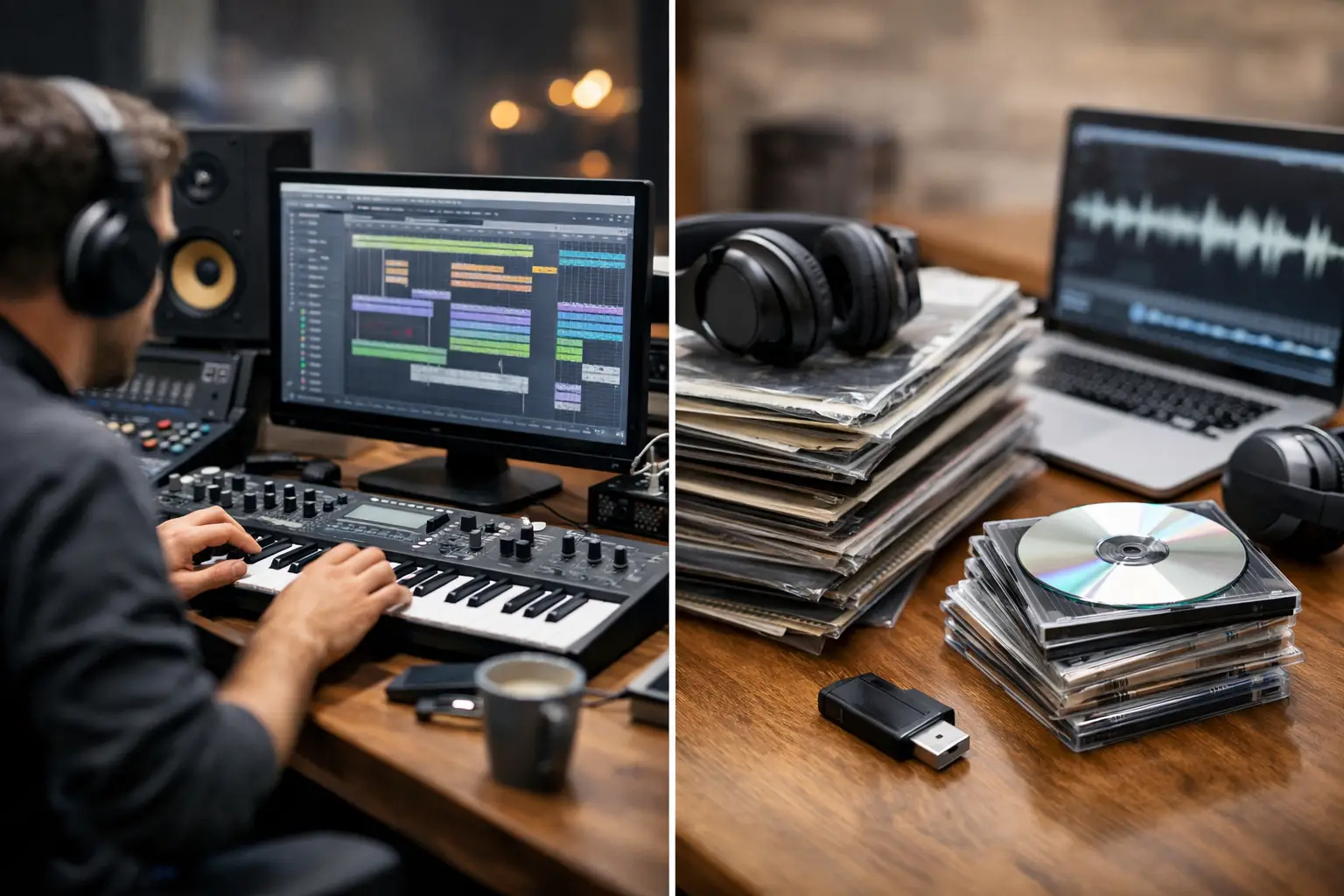
Custom Ghost Production vs Ready Tracks
A release deadline does not care that your last week disappeared into touring, client work, content, and half-finished ideas. What matters is getting a professional track delivered on time, with full ownership, clean files, and a result you can actually stand behind. That is where the decision between custom ghost production vs ready tracks becomes practical, not theoretical.
For EDM artists and labels, both models solve the same core problem: keeping release output consistent without handling every stage of production in-house. But they solve it differently. One prioritizes speed and immediate access. The other prioritizes precision and brand alignment. Choosing the right one depends on how specific your sound needs to be, how fast you need the record, and how much creative control you want before delivery.
What custom ghost production vs ready tracks really means
Ready tracks are pre-made, exclusive songs available for one buyer only. You review the catalog, filter by style, BPM, key, or mood, choose the track that fits your release plan, and purchase it with the production assets included. In a professional setup, that means stems, project files, a mixed and mastered final version, and full copyright transfer so the record can be released under your artist identity.
Custom ghost production starts earlier in the process. Instead of selecting a finished track, you commission a producer to build a record around your direction. That usually includes references, subgenre targets, arrangement notes, sound design preferences, vocal ideas, and feedback rounds. The result is not just exclusive. It is built to match your exact brief.
Both routes can be valid. The wrong choice is assuming one is always better.
When ready tracks make more sense
If speed is the priority, ready tracks usually win. The track already exists, which removes the production timeline, revision cycle, and uncertainty that come with creating from scratch. For artists who need to fill a release calendar quickly, that matters.
This model is especially effective for DJs and labels that already know what performs in their lane. If you can identify a track that fits your brand with minimal changes, a ready track can move from purchase to release far faster than a custom commission. You are not waiting on arrangement decisions, sound replacement, or multiple draft rounds. You are choosing, securing exclusive rights, and moving into branding, distribution, and promotion.
There is also a budget advantage in many cases. Because the core production work is complete, ready tracks are often a more efficient way to acquire release-ready music. That makes them attractive for emerging artists, growing labels, and anyone managing multiple releases at once.
The trade-off is obvious. You are selecting from what already exists. Even with strong filtering and high production standards, you are still matching your brand to a finished record rather than shaping the record around your brand from day one.
When custom ghost production is the better investment
Custom work becomes the stronger option when your sound is highly specific or your project has strategic importance. If you are building a recognizable artist identity, developing a label-focused sonic direction, or trying to land a record that sits exactly between your references, custom production gives you more control.
That control matters most in crowded EDM subgenres. In spaces like Tech House, Afro House, Techno, and Hardstyle, small production choices can define whether a track feels generic or clearly tied to your brand. Groove design, lead character, drop energy, drum weight, break structure, and mix balance all affect how recognizable the record feels.
Custom ghost production is also valuable when you need a track built around a vocal, a concept, or a specific club function. Maybe you want an intro designed for live mixing, a longer tension section for festival sets, or a lower-energy version for a label that favors deeper records. Those details are hard to retrofit into a finished track without losing quality or intent.
The trade-off is time. Custom projects require briefing, communication, feedback, and revision management. They also tend to cost more because you are paying for dedicated creative labor and a tailored result. If your references are unclear or your direction keeps changing, the process can slow down fast.
The biggest factors in the decision
The most useful way to compare custom ghost production vs ready tracks is through operational priorities, not emotion.
If your top priority is speed, ready tracks are usually the more efficient route. You can hear the product before you buy it, assess whether it fits your release plan, and move quickly once the purchase is complete.
If your top priority is sonic identity, custom production usually delivers more value. You are not hoping a finished track happens to fit your brand. You are commissioning a producer to build toward that target.
If your top priority is risk reduction, both can work well, but only if the provider is structured correctly. You need exclusivity, verified producers, full rights transfer, stems, project files, and a clear NDA framework. Without those basics, either model can create problems later.
If your top priority is volume, ready tracks often make scaling easier. If you need multiple releases across a quarter, pre-made exclusive tracks can help maintain consistency without stretching internal resources.
Ownership, confidentiality, and deliverables are not optional
This is where many buyers make a costly mistake. They compare creative format while ignoring the legal and operational side of the purchase.
Whether you buy a ready track or commission custom ghost production, the real standard should be complete transfer of rights, confidentiality, and professional deliverables. If you do not receive full copyright ownership, project files, stems, and a release-ready master, you are not buying a finished commercial asset. You are buying a partial solution.
For serious artists and label teams, that distinction matters. Full ownership protects your catalog. Stems and project files allow edits, radio cuts, extended versions, and future adjustments. NDA protection supports confidentiality. Proper mixing and mastering reduce the risk of delays at the distribution stage.
That is also why verified producer standards matter. A good process does not just give you music. It gives you confidence that the music was built by professionals who understand release expectations in your genre.
How different buyers should think about it
An emerging artist trying to release more consistently may get the strongest immediate return from ready tracks. The speed is higher, the path to release is shorter, and the cost is often easier to manage while building traction.
An established DJ with a defined brand may lean toward custom production for key records, especially when the goal is to sharpen identity rather than simply maintain output. In that case, custom work functions less like outsourcing and more like strategic production support.
A label team often benefits from using both. Ready tracks can support release volume and fast-moving schedule gaps. Custom projects can anchor priority campaigns, artist-defining singles, or records built for a specific label lane.
That hybrid approach is often the most practical. Not every release needs a fully custom process. Not every release should come from a catalog either. Strong catalog management means matching the production model to the business goal of the track.
A simple way to choose
If you can hear a finished track and say, “This fits my brand with minimal changes,” ready tracks are probably the smart move.
If you keep saying, “I need this groove, but with a different lead, stronger drums, a shorter break, and a drop closer to these references,” you are describing a custom project.
If your release date is close, default toward ready tracks. If your brand positioning is the priority, give more weight to custom work. If you need both consistency and flexibility, use both models intentionally.
At https://theghostproduction.com/, that distinction is built into the buying process. Artists and labels can either secure an exclusive, release-ready track from the catalog or commission custom ghost production around a defined brief, with verified producers, full rights transfer, stems, project files, and confidentiality built into the service.
The better option is not the one that sounds more premium. It is the one that gets you to a stronger release with less friction, lower risk, and no compromise on ownership. Choose the model that fits the role the track needs to play, and your release strategy gets a lot easier to manage.